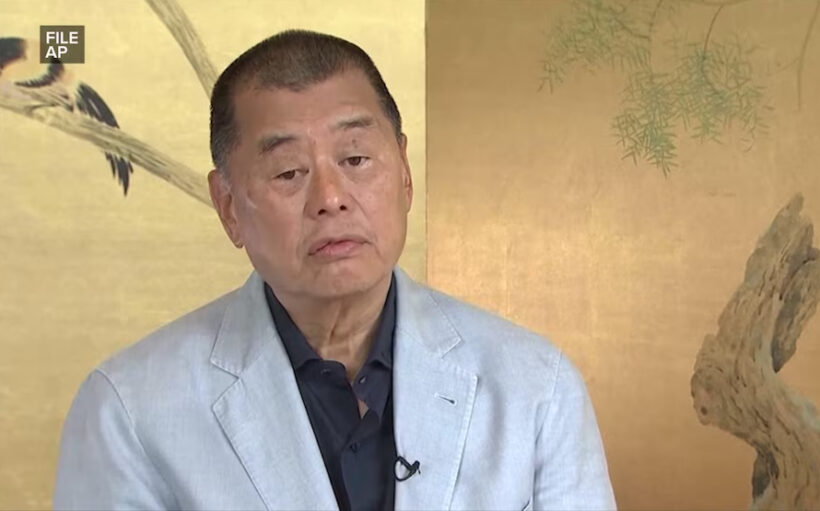
Media tycoon Jimmy Lai in 2020.
redo Jump to...
print Print...
Hong Kong’s National Security Law (NSL), imposed by Beijing in 2020 and supplemented by Article 23 legislation in 2024, criminalizes secession, subversion, terrorism, and collusion with foreign forces, granting authorities vast powers to suppress dissent and eroding the city’s autonomy under the “One Country, Two Systems” framework, leading to arrests, closure of media, and a climate of fear, while proponents argue it ensures stability.
The law applies extra-territorially, affecting anyone globally, and introduces penalties like life imprisonment, bans from public office, confiscation of assets, and restrictions on bail or legal access for national security offenses.
(CBS/AP) – Jimmy Lai, the pro-democracy former Hong Kong media tycoon and a fierce critic of Beijing, was sentenced on Monday to 20 years in prison in the longest punishment given so far under a China-imposed national security law that has virtually silenced the city’s dissent [against China’s communist regime].
Lai, 78, was convicted in December of conspiring with others to collude with foreign forces to endanger national security, and conspiracy to publish seditious articles. The maximum penalty for his conviction was life imprisonment.
His co-defendants, six former employees of his Apple Daily newspaper and two activists, received prison terms of between 6 years and 3 months, and 10 years on collusion-related charges. …
The democracy advocate’s arrest and trial have raised concerns about the decline of press freedom in what was once an Asian bastion of media independence [and free speech]. The [Chinese communist controlled] government [claims] the case has nothing to do with a free press, saying the defendants used news reporting as a pretext for years to commit acts that harmed China and Hong Kong.
Lai was one of the first prominent figures to be arrested under the security law in 2020. Within a year, some of Apple Daily’s senior journalists also were arrested and the newspaper shut down in June 2021.
In a statement, Lai’s son, Sebastien, said the “draconian” prison term was devastating for his family and life-threatening for his father. “It signifies the total destruction of the Hong Kong legal system and the end of justice,” he said. …
Lai has been in custody for more than five years already, [held in solitary confinement].
In January, his lawyer Pang said Lai suffered health issues including heart palpitations, high blood pressure and diabetes.
The prosecution said a medical report noted Lai’s general health condition remained stable. The government claimed Lai had requested to be held in solitary confinement.
Lai’s sentencing could heighten Beijing’s diplomatic tension with foreign governments, which have criticized Lai’s conviction and sentencing.
[The U.S., Britain, Australia, the European Union’s 27 member countries, Japan and Taiwan expressed concerns about the impact of the sentencing].…In a statement shared by the State Department on Monday, U.S. Secretary of State Marco Rubio called the sentence “an unjust and tragic conclusion to this case.”
“It shows the world that Beijing will go to extraordinary lengths to silence those who advocate fundamental freedoms in Hong Kong,” Rubio said, adding that “after enduring a trial lasting two years, and detention in prison for more than five, Mr. Lai and his family have suffered enough. The United States urges the authorities to grant Mr. Lai humanitarian parole.”
British Prime Minister Keir Starmer’s government also has called for the release of Lai, who is a British citizen. U.K. Foreign Secretary Yvette Cooper called the prosecution “politically motivated,” saying the prison term is tantamount to a life sentence.
[A spokesperson for the Chinese embassy in London urged Britain to “respect China’s judicial sovereignty and stop interfering in Hong Kong’s rule of law and China’s internal affairs” and also said Britain should “stop shielding criminals.”The Hong Kong and Macau Affairs Office, under China’s State Council, said the sentence was “a solemn and powerful declaration that whoever dares to challenge the law on safeguarding national security will be severely punished.”
Hong Kong’s leader John Lee [who is controlled by the communist regime in China] said: “(Jimmy Lai) has committed numerous heinous crimes, and his evil deeds were beyond measure.”
The newspaper mogul’s “heavy sentence of 20 years’ imprisonment demonstrates the rule of law, upholds justice and is deeply gratifying,” Lee said in a statement.
Lin Jian, a spokesperson for China’s foreign ministry in Beijing, said Lai was “a key planner and participant in a series of anti-China and disruptive activities in Hong Kong,” and lauded the sentencing as “reasonable, legitimate, and legal,” adding: “There is no room for argument.”
Lai founded Apple Daily in 1995, two years before the former British colony returned to Chinese rule. Its closure in 2021 shocked the local press scene. Hong Kong ranked 140th out of 180 territories in the press-freedom index compiled by media freedom organization Reporters Without Borders in 2025, far from its 18th place in 2002.
Published at CBS News from an AP report, with Reuters on Feb. 9, 2026. Reprinted here for educational purposes only. May not be reproduced on other websites without permission.
Questions
NOTE TO STUDENTS: Before answering the questions, read the “Background” and watch the videos under “Resources.”
1. Who is Jimmy Lai?
2. a) What charges was Mr. Lai convicted of in December?
b) Under what Hong Kong law was Mr. Lai convicted?
3. a) How much prison time did Mr. Lai receive compared to his (younger) co-defendants?
b) Why did he receive such a long prison sentence from the Chinese communist controlled Hong Kong judge?
4. Before China’s takeover, Hong Kong was considered a defender of media independence and free speech.
The Chinese communist controlled government claims the case has nothing to do with a free press, saying the defendants used news reporting as a pretext for years to commit acts that harmed China and Hong Kong.
How do democratic governments (and human rights groups including Amnesty International and Human Rights Watch) dispute China/Hong Kong’s claim?
5. How does the government defend holding Mr. Lai in solitary confinement since 2020?
6. a) What citizenship does Jimmy Lai hold?
b) Do you think that government should/could/is able to do more to secure his release? If so, what? Explain your answer.
7. What did Hong Kong’s leader John Lee say about Jimmy Lai and his sentence?
8. How did Hong Kong’s press freedom change as the Chinese government took more control over the region?
Background
Jimmy Lai became a billionaire through a classic rags-to-riches story:
- After fleeing Communist China as a child, Lai worked in garment factories in Hong Kong, quickly rising to manage a factory and eventually owning his own.
- He founded the popular Giordano fast-fashion retail chain in 1981, which expanded rapidly across Asia, becoming a massive commercial success.
- After selling his stake in Giordano in the mid-1990s, Lai channeled his fortune into media, launching Next Magazine (1990) and the influential Apple Daily (1995), [which he founded ahead of the 1997 handover of Hong Kong from the UK to China in an attempt to maintain freedom of speech].
- Lai used his media platforms and personal wealth to support Hong Kong’s pro-democracy movement, fearlessly criticizing the Chinese Communist Party.
- Apple Daily became a major voice for civil liberties, mobilizing massive protests, making Lai a symbol of resistance against Beijing’s increasing control.
- His activism led to his arrest under the (Chinese Communist government’s) National Security Law in 2020, resulting in imprisonment, even as his business empire was dismantled. (from Google AI, Dec. 17)
- Lai has been a British citizen since 1994. His sole passport is British.
How did China’s Communist government gain control of Hong Kong? —
Under the Sino-British Joint Declaration, which is an agreement signed by Britain and China in 1984 to settle the future of Hong Kong.
The two governments agreed China would reassume control of Hong Kong, (which had been occupied by Britain since the Opium War of 1840), starting on July 1, 1997 and the Chinese communists agreed Hong Kong would have autonomy* for 50 years. [*autonomy is the quality or state of being self-governing, especially: the right of self-government]
- In accordance with the “one country, two systems” principle agreed between the UK and the China, the communist system of China would not be practiced in the Hong Kong, and Hong Kong’s over 150 year capitalist system and its way of life would remain unchanged for a period of 50 years until 2047.
- During Hong Kong’s Umbrella Revolution in 2014, a campaign against the infringements on freedom in Hong Kong by mainland China, Chinese officials said for the first time, that China considered the Joint Declaration “void,” a position dismissed as “clearly wrong” by a senior Hong Kong legal scholar and rejected by the British foreign secretary, who noted that the document was a legally binding agreement that must be honored. (wikipedia, adapted)
What is Hong Kong’s “security law”?
In June 2020, the Communist Party of China passed a wide-ranging new security law for Hong Kong which makes it easier for the communists to punish protesters and reduces the city’s autonomy. Those who support democracy have called it “the end of Hong Kong.”
The details of the law’s 66 articles were kept secret until after it was passed. The law came into effect June 30, 2020, an hour before the 23rd anniversary of the city’s handover to China from British rule.
It gives Beijing powers to shape life in Hong Kong it has never had before. Critics say it effectively curtails protest and freedom of speech – China claims it will return stability.
The new law’s key provisions include that:
- Crimes of secession, subversion, terrorism and collusion with foreign forces are punishable by a maximum sentence of life in prison
- Those found guilty will not be allowed to stand for public office
- Companies can be fined if convicted under the law
- Beijing (China’s communist party) will establish a new security office in Hong Kong, with its own law enforcement personnel – neither of which would come under the local authority’s jurisdiction
- This office can send some cases to be tried in mainland China – but Beijing claims it will only have that power over a “tiny number” of cases
- In addition, Hong Kong will have to establish its own national security commission to enforce the laws, with a Beijing-appointed adviser
- Hong Kong’s chief executive (the Communist-supported Carrie Lam) will have the power to appoint judges to hear national security cases, raising fears about judicial autonomy
- Beijing will have power over how the law should be interpreted, not any Hong Kong judicial or policy body. If the law conflicts with any Hong Kong law, the Beijing law takes priority
- Some trials will be heard behind closed doors.
- People suspected of breaking the law can be wire-tapped and put under surveillance
- Management of foreign non-governmental organizations and news agencies will be strengthened
- The law will also apply to non-permanent residents and people “from outside [Hong Kong]… who are not permanent residents of Hong Kong”.
Hong Kong “National Security Law” of 2020:
On July 1, 2020, the day after China passed the “National Security” law for Hong Kong, pro-democracy protesters were out to voice their support for free speech. Vox reported on July 14:
When Britain handed Hong Kong over to China in 1997, it was with the promise that Beijing would honor Hong Kong’s quasi-independence until at least 2047, under the rule known as “one country, two systems.” The Chinese government has slowly eroded Hong Kong’s autonomy in the years since…
The imposition of the national security law…directly threatens Hong Kong’s civil society, independent press, and, most obviously, the territory’s sustained pro-democracy movement.
The law means the “complete and total control of Hong Kong and total destruction of Hong Kong’s system,” Victoria Tin-bor Hui, a political science professor at Notre Dame University, told me.
Pro-democracy protesters [agreed]:
Fung, a 27-year-old protester who asked to be identified by only her surname out of concern for her safety said that she and many of her friends awakened, bit by bit, to the totalitarianism of the Communist Party. Yet she held on to a little hope, a kind of dream, that the Chinese Communist Party could become more liberal, more free. Until now.
“Today, with this law passed, my friends [and I] think that we can never go back to what things were. Now we’re just another city, like China’s Guangzhou or Shanghai or Beijing, one of the cities under mainland China’s control,” Fung said.
Another protester, a 22-year-old who asked to remain anonymous for their safety, said via WhatsApp, “It’s really the first time that I had a genuine feeling that I would be arrested just because of speaking aloud a slogan or holding a poster on the street.”
Resources
- Thousands march in Hong Kong against extradition law (April 30, 2019)
- Hong Kong Protesters appeal to Trump for help (Sept. 10, 2019)
- In October 2019, the NBA’s Houston Rockets GM tweeted an image that said “Fight for Freedom. Stand for Hong Kong.” After that, “China bans Houston Rockets following GM tweet”
- CARTOON “LeBron” (Oct. 18, 2019)
- EDITORIAL: “How the NBA censored me on American soil” (Oct. 17, 2019)
- Hong Kong: China suspends U.S. military port calls over pro-Hong Kong (Dec. 3, 2019)
- China arrests Hong Kong pro-democracy activists (April 20, 2020)
- Hong Kong’s new hotline: inform on your neighbors (Nov. 10, 2020)
- Jailed pro-democracy advocate arrested again in Hong Kong (Jan. 12, 2021)
- China threatens family of Hong Kong pro-democracy teen (Jan. 26, 2021)
- Pro-democracy advocate Jimmy Lai convicted (Dec. 17, 2025)
Fox Business interview with Jimmy Lai’s son, February 9, 2026:
Daily “Answers” emails are provided for News Stories, Tuesday’s World Events and Friday’s News Quiz.