“The ignorance of one voter in a democracy impairs the security of all.”
~ President John F. Kennedy
TABLE OF CONTENTS
- General Election Overview
- Voting Issue #1: Voter ID Laws (question for debate; includes video)
- Voting Issue #2: Electronic Voting (question for debate)
- Voting Issue #3: Voter Apparel (question for debate; includes student worksheet)
- Voting Issue #4: Ballot Selfies (question for debate; includes student worksheet)
- Ballot Measures
- U.S. Senators and Representatives
- Governors
- State Elections (includes student worksheet)
- Conservative vs. Liberal Beliefs
- Capitalism vs. Socialism
- Editorials on voting
- Cartoons
2025 General Election Overview
The 2025 general election will be held on Tuesday, November 4. This is an off-year election –– a general election which is held when neither a presidential election nor a midterm election takes place.
The 2025 off-year election includes (see details at ballotpedia):
- the regular gubernatorial elections in New Jersey and Virginia
- four special elections in the U.S. House (and two special elections for the Senate in November 2026 to replace Florida Senator Marco Rubio who is now U.S. Secretary of State and Ohio Senator JD Vance, who was elected to the vice-presidency)
- two of the country’s 99 state legislative chambers (NJ and Virginia) are holding regularly-scheduled elections in 2025. Elections in those two chambers represent 180 of the country’s 7,386 state legislative seats (2.4%).
The vast majority of elections in an off-year are held at the county and municipal level. On the ballot are many mayors, a wide variety of citizen initiatives in various states, and many more local public offices. Special elections to fill vacancies in various federal, state and local offices are also held when required.
Off-year elections generate far lower voter turnout than even-numbered election years.
For links to all races by state (federal and local), go to Ballotpedia
QUESTIONS:
1. Name the other 3 states that hold gubernatorial elections in an off-year.
2. For what reasons do New Jersey and Virginia hold their gubernatorial elections in an off-year election?
VOTING ISSUE #1 — VOTER ID LAWS
→ Should voters be required to show photo ID to vote?
Two points of view:
- Voter ID laws are necessary to prevent voter fraud.
OR
- Voter ID laws are racist and cause voter disenfranchisement (voter suppression).
SUPPORT for Voter ID laws
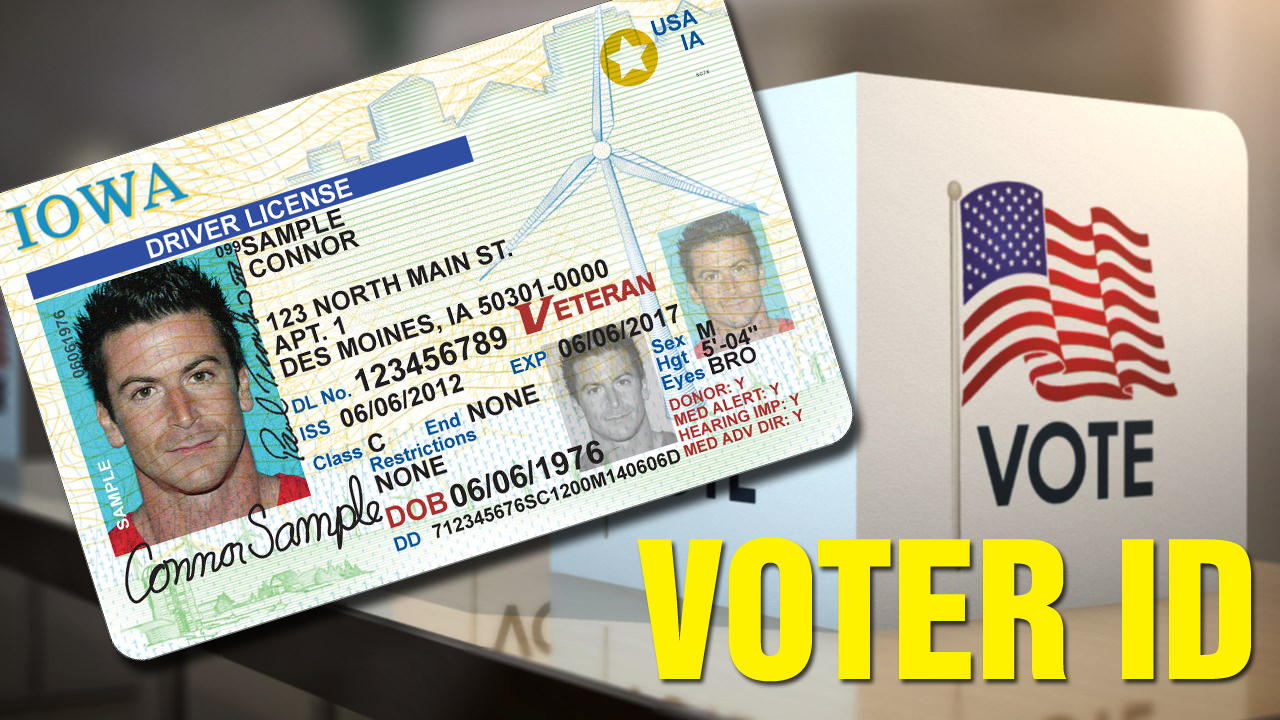 A March 2021 Rasmussen poll found that 75% of Likely U.S. voters think voters should be required to show photo identification such as a driver’s license before being allowed to vote. Only 21% are opposed to such a requirement. Gallup published a poll in October 2022 finding 79% of voters support voter ID laws. Support for voter ID requirements has mostly run in the mid-to-high 70s in surveys since 2006.
A total of 36 states have laws requesting or requiring voters to show some form of identification at the polls. (see map at ncsl.org)
The right to vote encompasses two critical considerations: (1) that voters have access to the ballot; and (2) that lawful votes are not diluted by those cast fraudulently. These are not competing considerations. By preventing or detecting fraud with a photo identification voting requirement, states are better able to ensure honest and fair elections. (from rpc.senate.gov)
States with voter ID laws provide free ID for those who cannot afford to pay and make further exceptions for those who say they cannot obtain an ID.
- Federal judge upholds voter ID law in North Carolina
- Appeals court rules Texas can use new voter ID law
- Kansas, Arizona win proof-of-citizenship requirement in voting suit
OPPOSITION to Voter ID laws
The ACLU opposes Voter ID laws. An ACLU fact sheet states: “Voter ID laws deprive many voters of their right to vote, reduce participation, and stand in direct opposition to our country’s trend of including more Americans in the democratic process. Many Americans do not have one of the forms of identification states acceptable for voting. These voters are disproportionately low-income, racial and ethnic minorities, the elderly, and people with disabilities. Such voters more frequently have difficulty obtaining ID, because they cannot afford or cannot obtain the underlying documents that are a prerequisite to obtaining government-issued photo ID card.”
Video – Photo ID and voting:
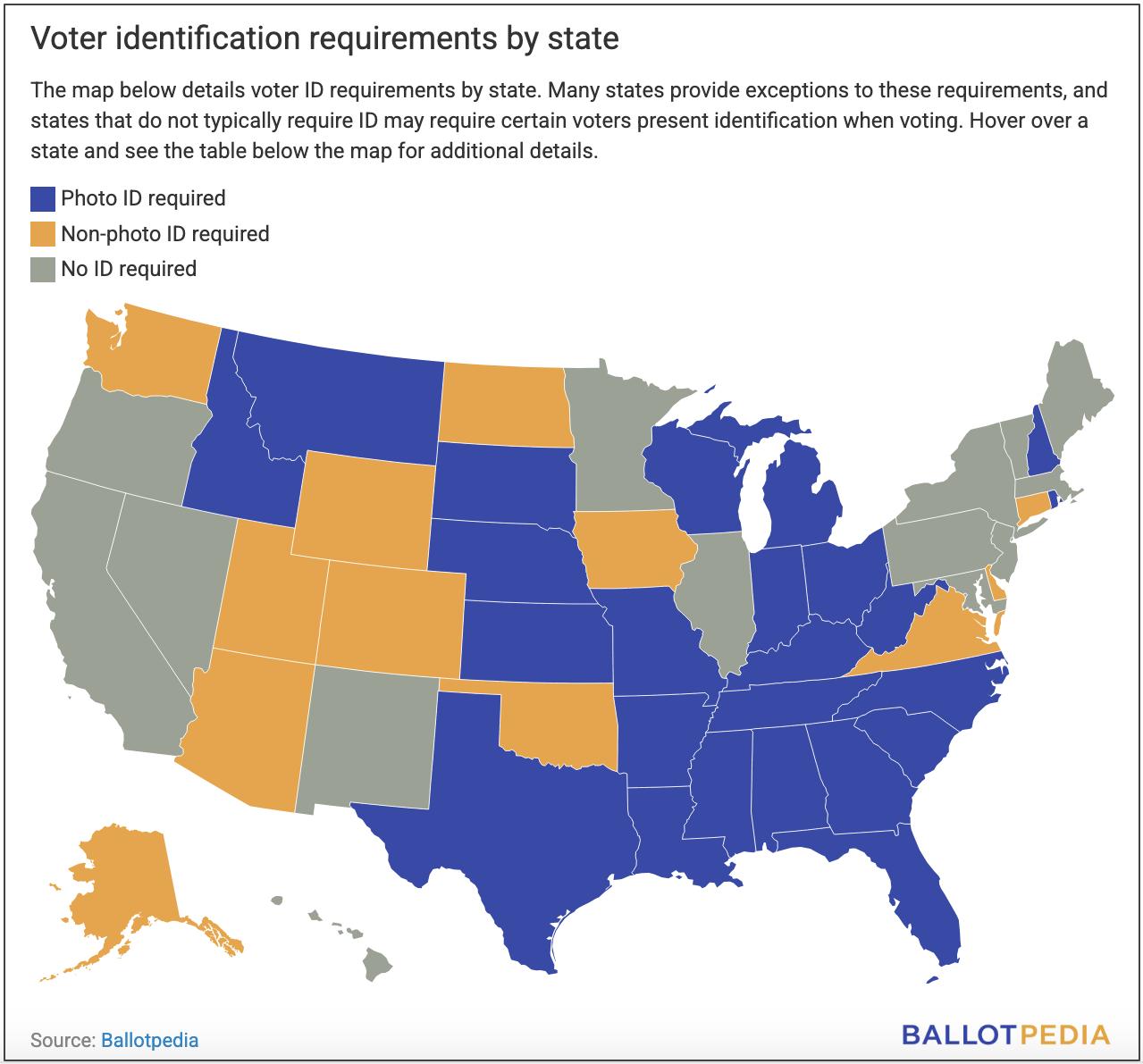
From Ballotpedia, August 29, 2025
Read about Voter ID laws by state at ncsl.org.
VOTING ISSUE #2 — ELECTRONIC VOTING MACHINES / PAPER BALLOTS

Should a paper ballot system replace touch-screen machines used in some states?
→ Should states use electronic voting machines or voting apps without paper ballot backups? OR should states use only paper ballots or paper ballots with machines (to prevent hacking/fraud)?
- Judge rules Georgia can still use electronic voting machines despite concerns over hacking
- Virginia Ends Use of Touch-Screen Voting Machines
- Using an app to vote? West Virginia 1st state to test the technology
- Georgia’s new paper ballot voting system
- See Ballotpedia’s “Voting Methods and Equipment by State“
Answer the following:
1. How to vote? — What method should states use: Paper ballot, electronic machine, voting app with or without paper backup, vote by mail, vote online. The types of voting equipment used in the United States vary from state to state. Visit the ballotpedia page for breakdown by state.
2. When to vote? — Election day only, unless absentee – OR, election day AND early voting (in person or mail in); if yes, how early?
3. Where to vote? — Online, through the mail (post office or mail box), drop off at polling station, deposit in a ballot drop box, or in person at polling station during early voting dates or on election day.
Go to the National Council of State Legislators website for explanation on the eight states that hold election by mail.
ASK A PARENT: Most Republicans support a return to same day in-person voting (and possibly one week of in-person early voting) using paper ballots (or electronic machines with a paper trail), where the voter must show ID to cast his/her ballot. Most Democrats support all the methods used today: mail in voting (for up to one or two months), early in-person voting, online voting – and oppose requiring voters to show ID to vote. With which methods do you agree? Ask a parent and a grandparent the same question. Discuss your answers.
VOTING ISSUE #3 — VOTER APPAREL
→ Do you support state laws restricting what voters can wear when they cast ballots?
(Laws which prohibit voters from wearing clothing with the name of a candidate or political party – or that references an issue on the ballot or promotes a group with recognizable political views)
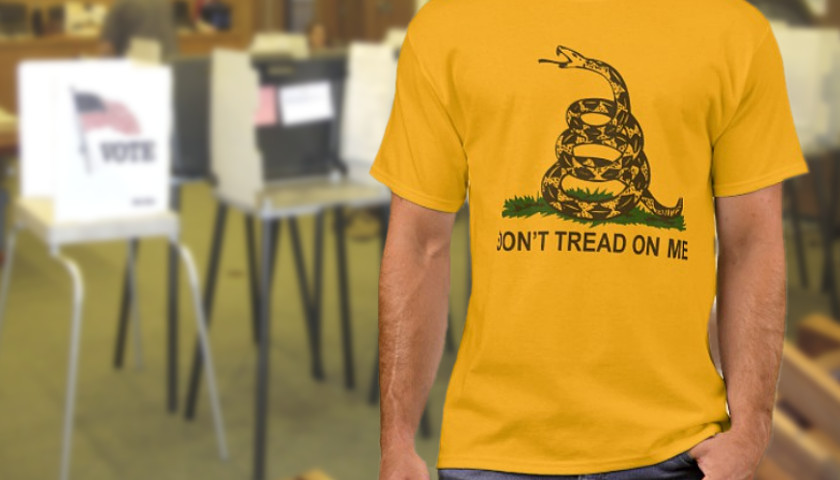 In 2010, when Minnesota voter Andrew Cilek showed up to vote wearing a “Don’t Tread on Me” t-shirt with a Tea Party logo – and a button that said “Please I.D. Me,” he was told by a poll worker to cover them up or take them off before he could cast a ballot. He changed his shirt a few times – to others deemed unacceptable by the poll workers.
A long-standing Minnesota law prohibited clothes or buttons that mention not only a candidate, a political party or a ballot issue, but also any group with recognizable political views, such as the Tea Party or MoveOn.
Mr. Cilek was finally allowed to vote after a poll worker took down his name and address for possible prosecution. When he and other Minnesotans sued, lower courts upheld the law as a reasonable way to preserve decorum at the polls. In 2018, the U.S. Supreme Court agreed to hear the case.
Read the article: Dress code to vote? Supreme Court hears case
In appealing to the Supreme Court, the challengers said the law went too far, restricting “The most peaceful method of political expression – the silent wearing of clothing,” including T-shirts that merely name a political group or ideology and make no attempt to persuade voters.
The ACLU agreed, arguing that the electorate “is surely hardy enough to vote their conscience,” even if they see a Black Lives Matter shirt or a Women’s March hat [or a “Don’t tread on me” t-shirt].
The state said its approach preserved order and decorum at polling places and helped prevent voter intimidation.
In June 2018, the U.S. Supreme Court agreed with Mr. Cilek and struck down the Minnesota law that prohibited voters from wearing political buttons and apparel when they cast ballots.
Read the article: U.S. Supreme Court strikes down Minnesota dress code for voters
Watch a March 2018 local news report (prior to the Supreme Court ruling):
.
Watch a June 2018 CBS News report (following the Supreme Court ruling):
Questions (Voter Apparel):
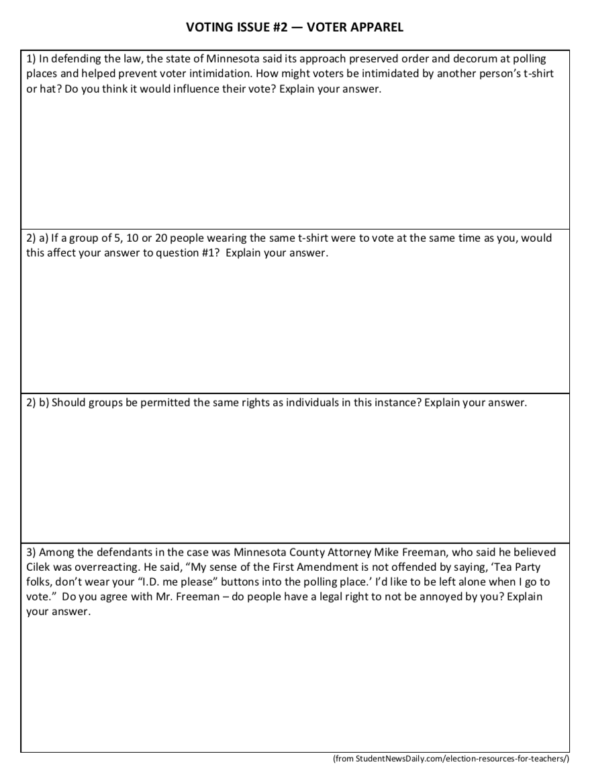
1) In defending the law, the state of Minnesota said its approach preserved order and decorum at polling places and helped prevent voter intimidation. How might voters be intimidated by another person’s t-shirt or hat? Do you think it would influence their vote? Explain your answer.
2) a) If a group of 5, 10 or 20 people wearing the same t-shirt were to vote at the same time as you, would this affect your answer to question #1? Explain your answer.
b) Should groups be permitted the same rights as individuals in this instance? Explain your answer.
3) Among the defendants in the case was Minnesota County Attorney Mike Freeman, who said he believed Cilek was overreacting. He said, “My sense of the First Amendment is not offended by saying, ‘Tea Party folks, don’t wear your “I.D. me please” buttons into the polling place.’ I’d like to be left alone when I go to vote.” Do you agree with Mr. Freeman – do people have a legal right to not be annoyed by you? Explain your answer.
You can also print the questions in this PDF worksheet about voter apparel:
VOTING ISSUE #4 — BALLOT SELFIES
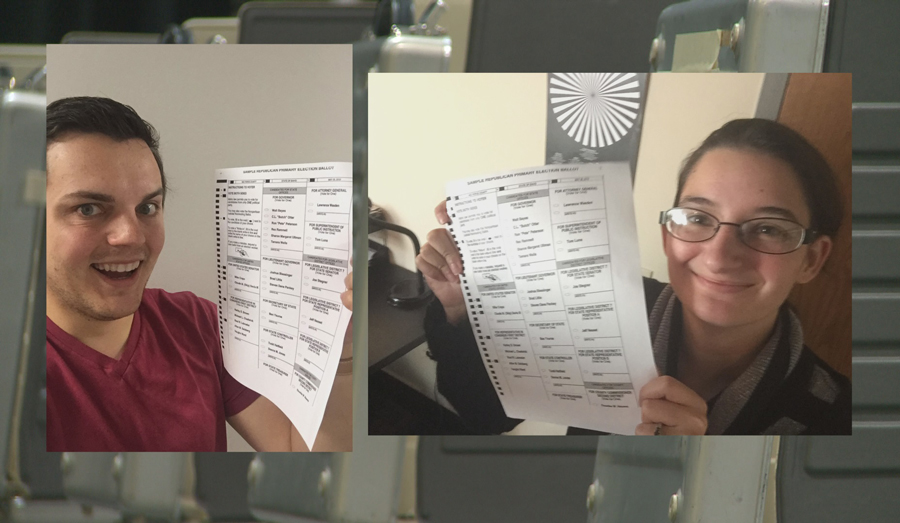 → Should voters be prohibited from posting a selfie with their completed ballots on social media? (Many states have such laws.)
The secret ballot is a voting method in which a voter’s choices are private, preventing attempts to influence the voter by intimidation and potential vote buying. It permits political privacy.
Articles on ballot selfies:
- Secrecy of the Ballot and Ballot Selfies
- Federal Judge in California denies request to allow ‘ballot selfies’
- New Hampshire to defend ban on ballot-box selfies in court
AGREE WITH THE BAN
Those who agree with bans on photos of completed ballots say this does not prevent voters from telling everyone HOW they voted, just prevents them from proving it by taking a picture of their ballot. The purpose of the current law is to prevent voter intimidation or vote buying (two types of voter fraud).
The NCSL suggests, “If one of the goals of posting ballot selfies is to foster vote engagement, there are other ways without eliminating the secret ballot. For example:
- Take a photo with an “I Voted” sticker.
- Take a selfie next to a “Vote Here” sign.
- Taking a photo of a ballot (or with your ballot) before it is filled-in.
DISAGREE WITH THE BAN
The ACLU disagrees, arguing a ban on ballot photos is outdated – that it prevents voters from exercising crucial political speech and discourages the use of technology in get-out-the-vote efforts: that it has a “chilling effect” on voters’ free speech.
Slate’s Mark Joseph Stern wrote in 2016 that courts have said free-speech considerations override vote-buying concerns. In a commentary, Stern wrote: “For millennials especially, ballot selfies have become perhaps the primary mode of political expression on Election Day. They amplify voter excitement and might even increase turnout. They are an exercise in two fundamental rights at once — free speech and voting — and help to promote democracy.”
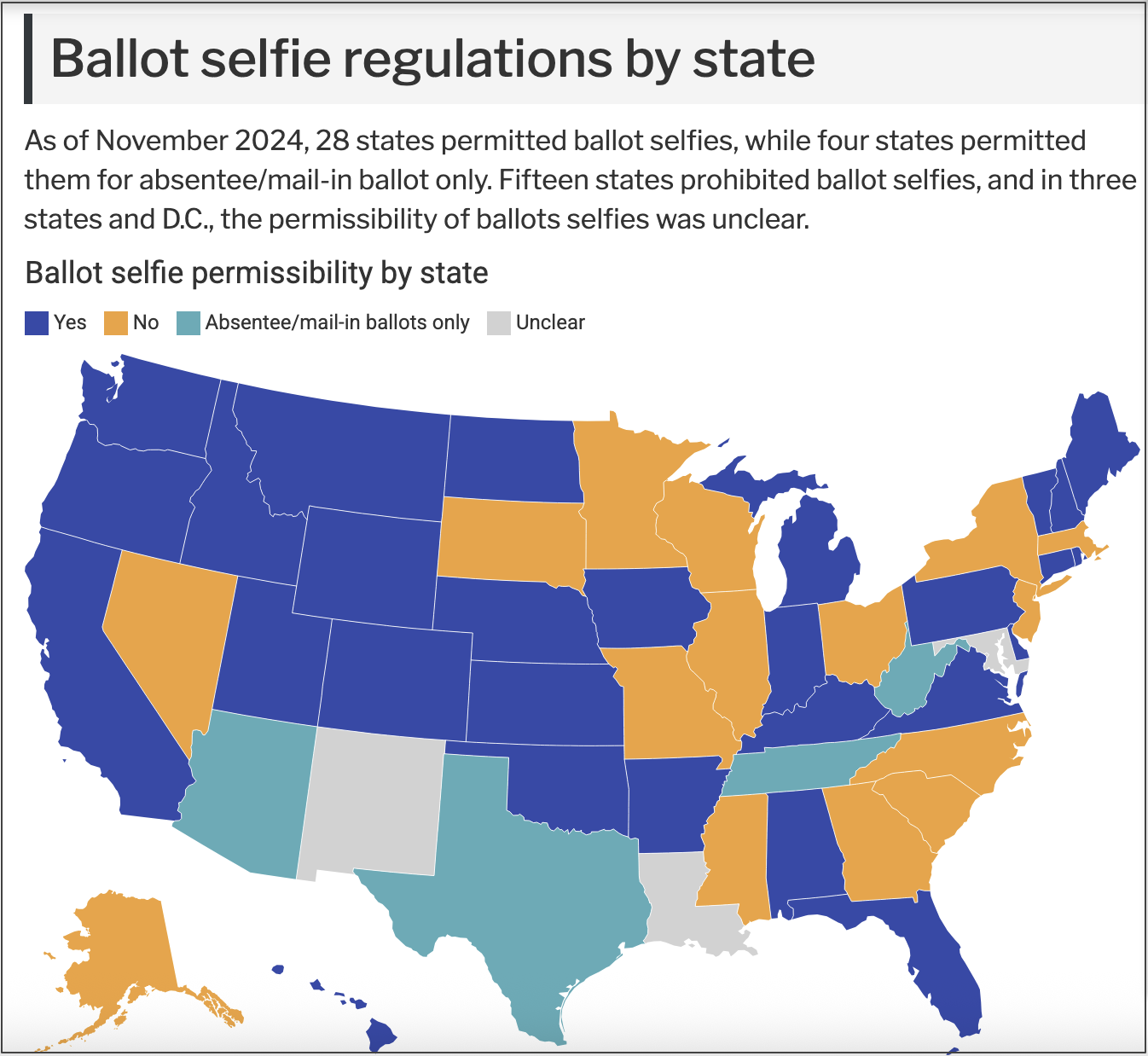
From Ballotpedia, August 29, 2025
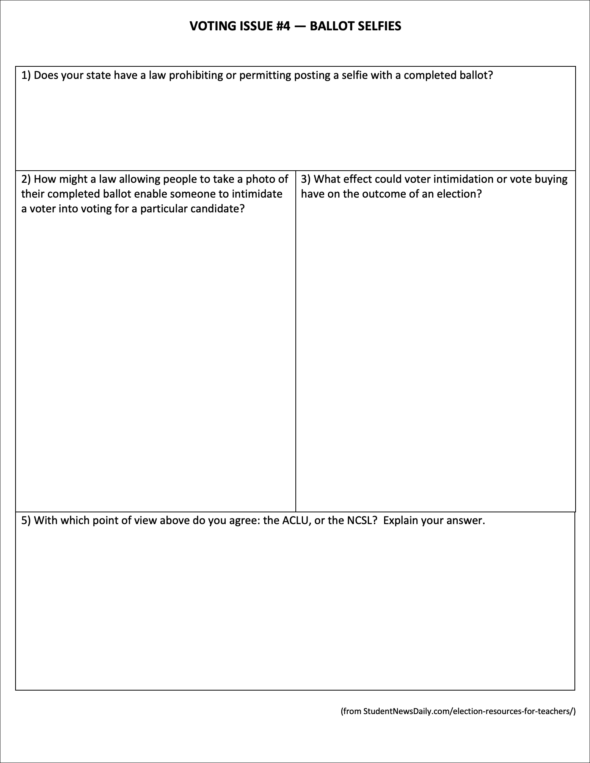
Questions (Ballot Selfies):
1) Does your state have a law prohibiting or permitting posting a selfie with a completed ballot?
2) How might a law allowing people to take a photo of their completed ballot enable someone to intimidate a voter into voting for a particular candidate?
3) How might a law allowing people to take a photo of their completed ballot enable a candidate to buy votes?
4) What effect could voter intimidation or vote buying have on the outcome of an election?
5) With which point of view above do you agree: the ACLU, or the NCSL? Explain your answer.
You can also print the questions in this PDF worksheet about ballot selfies:
BALLOT MEASURES
A ballot measure is a law, issue, or question that appears on a statewide or local ballot for voters of that jurisdiction to decide.
Anything that appears on a ballot other than a candidate running for office is called a ballot measure. Ballot measures are broken down into two distinct categories:
- Initiative (also called an initiated measure or proposition) – Citizens, collecting signatures on a petition, place advisory questions, memorials, statutes (laws) or constitutional amendments on the ballot for the citizens to adopt or reject. “Initiative” refers to newly drafted legislation submitted directly to a popular vote as an alternative to adoption by a state legislature.
- Referendum (also called a referred measure) – In many of the same states the citizens have the referendum process – the ability to reject laws or amendments proposed or already passed by the state legislature. A referred measure is a proposed law that a legislature or commission, or constitutional provision in the case of automatic referrals, puts on the ballot for voters to decide.
The terms above are both forms of “direct democracy” practiced by various states. 26 states allow for citizen-initiated ballot measures.
In a direct democracy, all citizens, without the intermediary of elected or appointed officials, can participate in making public decisions. Ballot measures are a form of direct democracy practiced by many states in the U.S.
Read more about ballot measures (initiatives and referendums) at ballotpedia.org.
For a list of types of ballot measures allowed by your state (if any), visit ballotpedia.org.
For a list of ballot measures on the 2025 ballot by date and by state, go to ballotpedia’s 2025 Ballot Measures.
See map below of the 26 states that allow for citizen-initiated ballot measures:
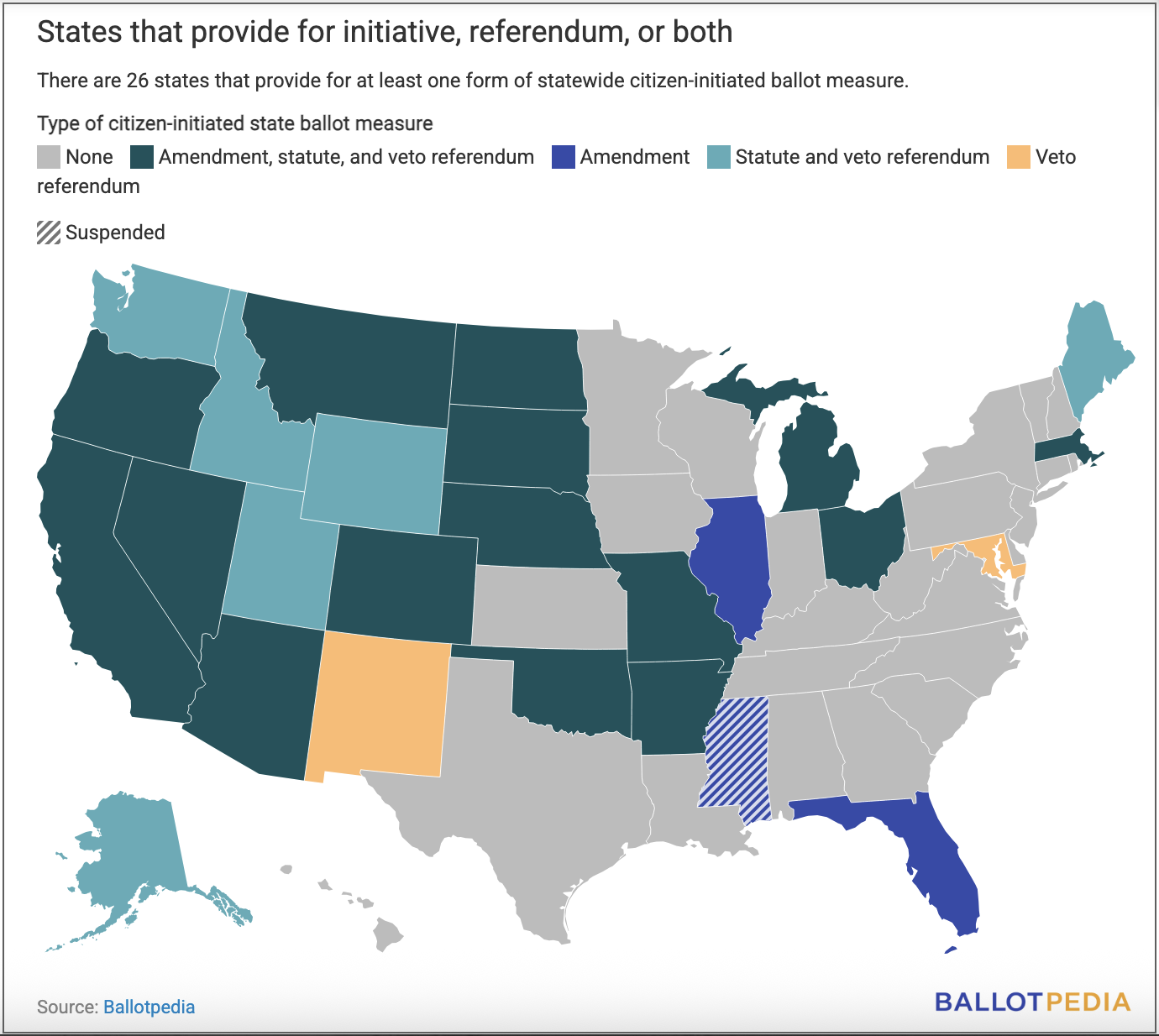
From Ballotpedia, August 29, 2025
As of August 28, 2025, 30 statewide ballot measures were certified for the ballot in nine states in 2025. (The average number of statewide ballot measures in an odd-numbered year recently has been between 33 and 34.)
Questions (Ballot Measures):
1) Does your state practice direct democracy through the ballot measure process?
2) If so, what initiatives or referendums are on your state’s ballot in the upcoming election?
3) If there are ballot measures in your state, how would you cast your vote on each question?
4) Read the proposed constitutional amendment to the Texas constitution that says “persons who are not citizens of the United States” cannot vote in Texas. Ask a parent: how would you vote on a similar amendment if one was proposed for your state? Please explain your answer.
5) On April 1, 2025 voters in Wisconsin approved a constitutional amendment, Question 1, to add a photo identification requirement to the state constitution. How would you vote on a similar amendment if one was proposed for your state? Please explain your answer.
U.S. SENATORS and REPRESENTATIVES
SENATORS – Republicans currently hold the majority in the Senate with 53 seats. There are 45 Democrats, and 2 independent senators (Independent Senator Angus King of Maine and Democratic Socialist Bernie Sanders of Vermont both caucus with the Democratic Party)
Did you know? A third of the Senate is up for election every two years. This year is not one of those years – it is an off-year.
Questions (Senators):
1. The 2014 elections marked 100 years of direct elections of U.S. Senators. Do you know which amendment established this policy? (see senate.gov for the answer)
2. Which article and section of the Constitution established three classes of U.S. Senators? What was the purpose for this division? (see ballotpedia.org)
REPRESENTATIVES – Republicans currently hold the majority in the House with 219 seats. There are 212 Democrats and 4 vacancies. There are 4 upcoming special elections in the House to fill those vacancies:
- Virginia’s 11th Congressional District on September 9, 2025
- Arizona’s 7th Congressional District on September 23, 2025
- Texas’ 18th Congressional District on November 4, 2025
- Tennessee’s 7th Congressional District on December 2, 2025
See Ballotpedia for information on the 2025 U.S. House of Representatives Elections information.
Questions (Representatives):
3. How does the majority party in both houses affect proposed legislation?
4. How does the House of Representatives control the federal government’s budget, spending and taxation?
See Wikipedia for a brief explanation.
GOVERNORS
Currently, 27 states have Republican governors and 23 states have Democratic governors.
There are 2 gubernatorial offices on the ballot in 2025. These elections are in New Jersey and Virginia. Read more at Ballotpedia’s 2025 Gubernatorial Elections page.
- For information on current governors, do an internet search for your governor’s official website and/or go to the National Governors Association website: nga.org
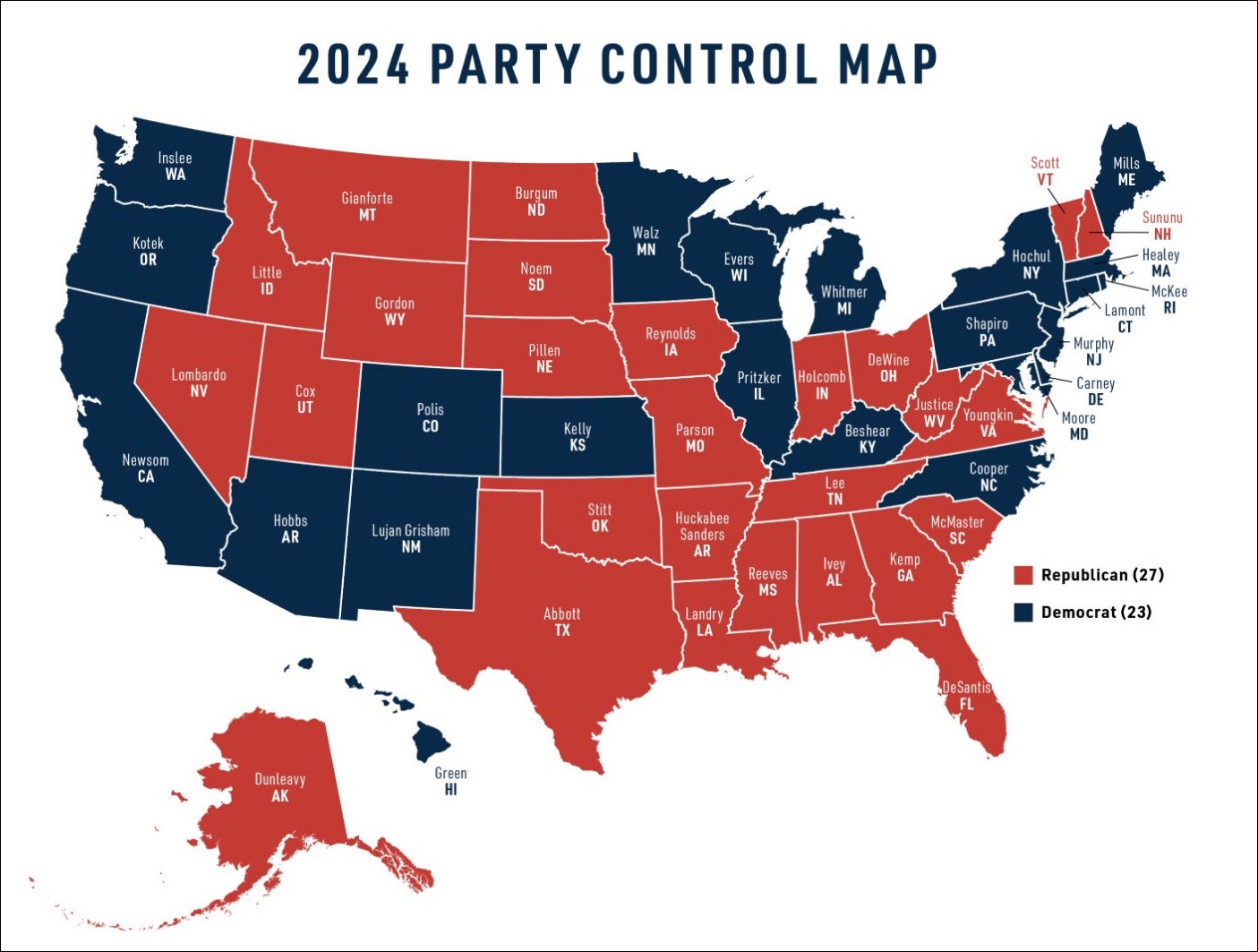
From RGA.org, July 2024.
STATE ELECTIONS
Links for all 50 states’ Election Board websites are provided here. Your state Election Board provides information mainly on voter registration and dates of primaries and general elections, as well as methods of voting. Closer to the election, the website should provide a sample ballot for voters.
See Ballotpedia for state legislative elections information.
Questions (State Elections):
Visit your state’s official election webpage.
1) How do you vote in your state? – What type of voting method does your state use: paper ballots, electronic voting machines (with or without paper ballots), online voting, mail in voting only (no in-person)?
2) Is there in-person early voting in your state? – and/or early mail in voting? Describe the ways/dates you can vote in your state.
3) What is the difference between mail in and absentee voting in your state?
4) Does your state require voters to show ID when voting in-person? If so, what type of identification is acceptable?
5) Republicans support a return to same day in-person voting (with at most one week of early in-person voting), using paper ballots, where the voter must show photo ID to cast his/her ballot. Democrats support all the methods used today: mail in voting, early in-person voting, online voting – and opposes requiring voters to show ID to vote. With which methods do you agree? Ask a parent and a grandparent the same question. Discuss your answers.
6) Look for the sample ballot provided on your state election website. Name the candidates running for federal, state and local office in your state/county/city. Include party affiliation and office for which each candidate is running.
OPTIONAL: In order to make an informed decision on which candidate you support, spend time researching each candidates’ positions on the issues. What issue(s) are important to voters in your state and/or local area in one of the upcoming elections you listed in question #6? How do the opposing candidates stand on the issue(s)?
Did you know? Currently, 38 states have trifectas.
Trifecta is a term used to describe when the state house, the state senate, and the office of the governor are each controlled by the same political party.
As of August 29, 2025, there are 23 Republican trifectas, 15 Democratic trifectas, and 12 divided governments where neither party holds trifecta control.
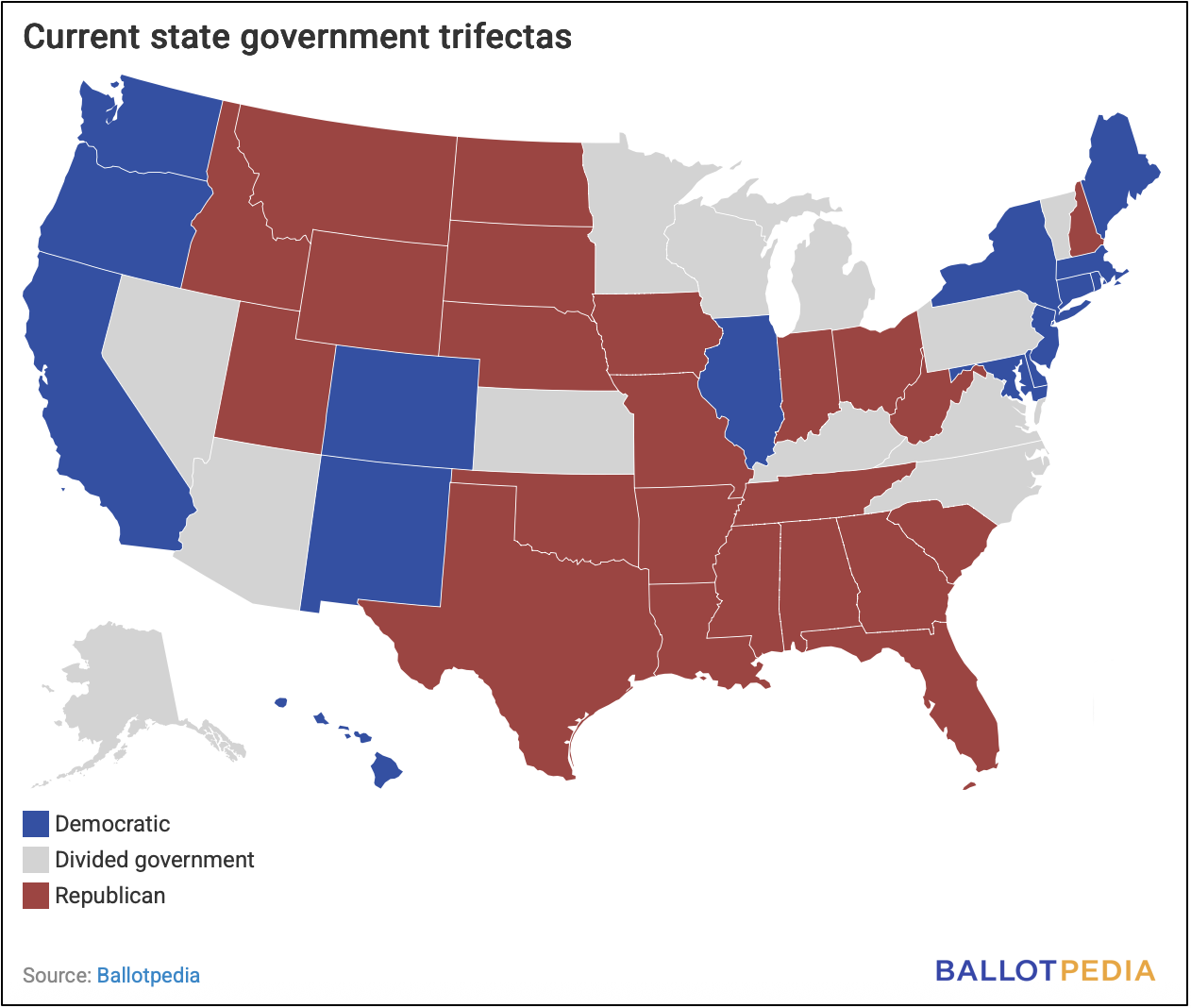
From Ballotpedia, August 29, 2025
Questions (Trifecta States):
Which party controls the state senate, legislature and the governorship in your state? (See a chart at Ballotpedia)
CHALLENGE: Follow the results of the November 2025 elections. Which party, if any, lost trifectas in any states? Name the states. Why do you think this is so?
CONSERVATIVE vs. LIBERAL BELIEFS
Check out StudentNewsDaily’s “Conservative vs. Liberal Beliefs” chart. (NOTE: This is a general overview of the conservative and liberal positions on the issues.)
Question (Conservative vs. Liberal Beliefs):
Read through the chart. For each issue, state which position best represents your beliefs and explain why.
SOCIALISM vs. CAPITALISM
What do you know about socialism and capitalism? A 2017 report on U.S. Attitudes Toward Socialism found that 44% of millennials would prefer to live in a socialist country. However, when asked to define the term, two out of three got it wrong. Visit our Socialism vs. Capitalism page for information.
EDITORIALS
Posted at StudentNewsDaily:
- Don’t Vote if You Didn’t Do Your Homework
- 5 Reasons Local Elections Are More Important Than You Think
- How Tampering with Search Engines Could Swing an Election
CARTOONS
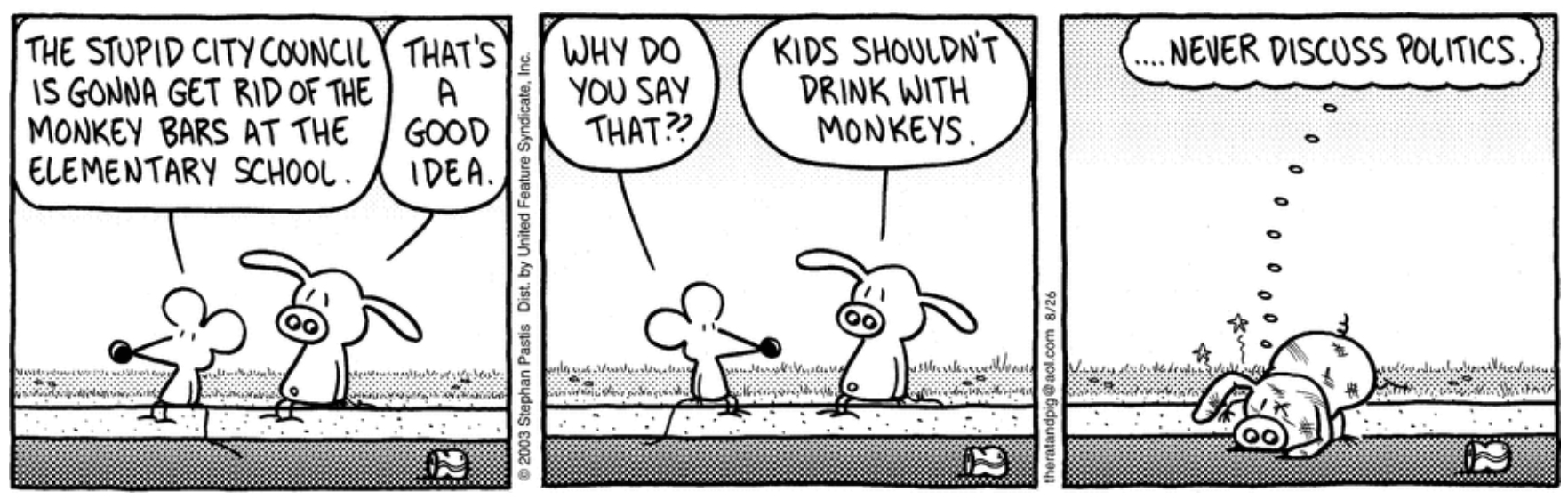
Cartoon by Stephan Pastis
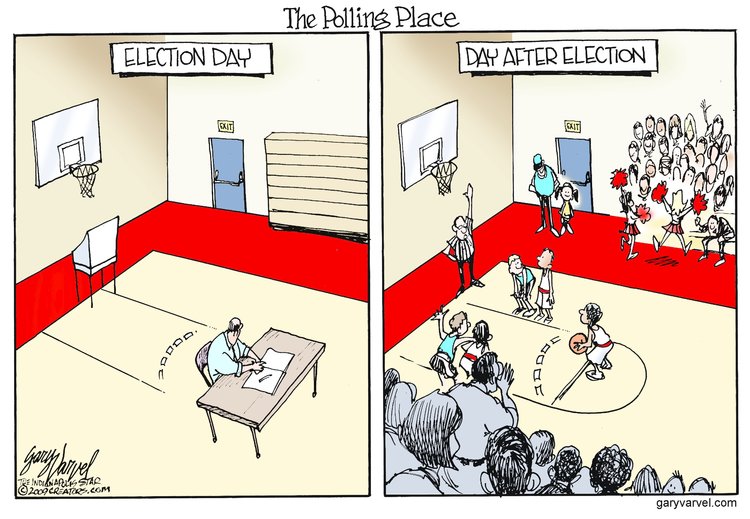
Cartoon by Gary Varvel
(This page last updated 8/29/25. Information compiled from various sources including Ballotpedia and Wikipedia.)