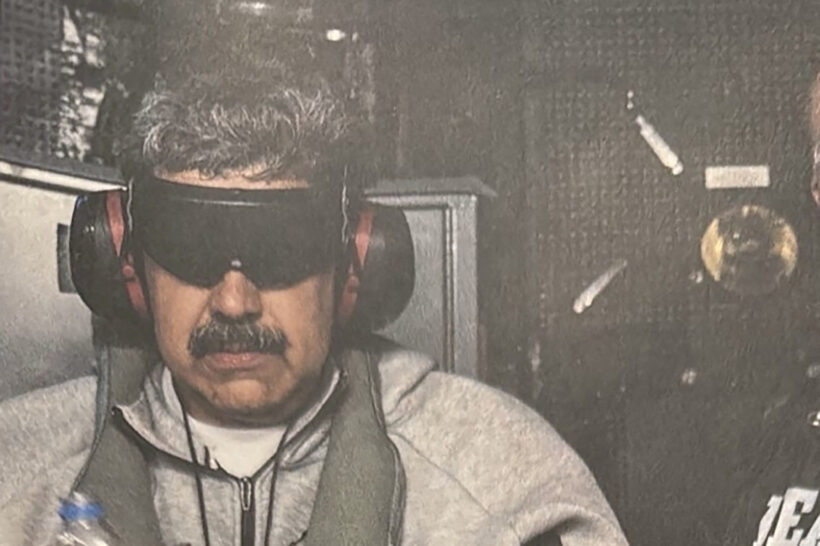
A photo released by President Trump shows Venezuelan President Nicolas Maduro on board a US ship after his capture from Caracas on January 3, 2026
redo Jump to...
print Print...
NOTES on Maduro:
- The U.S. indicted Nicolás Maduro in October 2020 on charges of narco-terrorism, conspiracy to import cocaine into the U.S., drug trafficking, and corruption, alleging he and his associates used Venezuelan military and intelligence resources to protect cocaine shipments and facilitate trafficking, including ties to the Marxist guerilla group FARC. The indictment accuses Maduro of leading a criminal enterprise that channeled drug proceeds to fund his government and enrich himself.
- Nicolás Maduro is widely considered an authoritarian dictator by numerous international bodies.
- Approximately 50 countries (including most in Latin America), and human rights organizations, all of which do not recognize him as the legitimate leader of Venezuela. In both the 2018 and 2024 presidential elections, Maduro declared himself the victor despite evidence to the contrary.
- In 2025, the U.S. declared Nicolás Maduro a “narcoterrorist.” Countries that have adopted this position or designated the “Cartel of the Suns” (widely believed to be headed by Maduro) as a terrorist organization include: Argentina, Dominican Republic, Ecuador, and Paraguay, Colombia, Peru. Most others in Latin America and Europe have criticized Maduro but have not officially labeled him a “narcoterrorist.”
- Narco-Terrorism: Directing Venezuelan state resources (military, intelligence) to protect cocaine shipments.
- Conspiracy: Plotting to import cocaine into the U.S..
- Drug Trafficking: Providing armed escorts and clandestine airstrips for drug flights.
- Corruption & Money Laundering: Using drug money for personal gain and to support his regime.
(Reuters with CNBC) — President Donald Trump said the U.S. is going to temporarily take over governing Venezuela after launching a large-scale surprise attack on the country overnight (that led to the capture of socialist dictator Nicholas Maduro, wanted in the U.S. for narco-trafficking).
“We are going to run the country until such time as we can do a safe, proper and judicious transition,” Trump said in a press conference Saturday morning from his Mar-a-Lago residence in Palm Beach, Florida.
The Venezuela operation “was one of the most stunning, effective and powerful displays of American military,” Trump said.
“Not a single American service member was killed, and not a single piece of American equipment was lost, many helicopters, many planes, many people involved in that fight,” Trump also said.
U.S. forces captured Venezuelan President Nicolas Maduro and his wife, Cilia Flores. The couple have been indicted in the Southern District of New York on drug-trafficking charges.
The Chairman of the Joint Chiefs of Staff, Gen. Dan Caine, said the mission involved “more than 150 aircraft launching across the western hemisphere in political coordination, all coming together in time and place to layer effects for a single purpose, to get an interdiction force into downtown Caracas, while maintaining the element of tactical surprise.”
According to sources familiar with the matter, planning for one of the most complex U.S. operations in recent memory had been in the works for months and included detailed rehearsals.
Elite U.S. troops, including the Army’s Delta Force, created an exact replica of Maduro’s safe house and practiced how they would enter the strongly fortified residence.
The CIA had a small team on the ground starting in August who were able to provide insight into Maduro’s pattern of life that made grabbing him seamless, according to one source familiar with the matter.
Two other sources told Reuters the intelligence agency also had an asset close to Maduro who would monitor his movements and was poised to pinpoint his exact location as the operation unfolded.
Prior to the operation, the Pentagon has overseen a massive military buildup of forces in the Caribbean, sending an aircraft carrier, 11 warships and more than a dozen F-35 aircraft. In total, more than 15,000 troops have been deployed into the region.
Sources have told Reuters the Pentagon had also quietly moved into the region refueling air tankers, drones and aircraft specializing in electronic jamming.
Late on Friday night and into early Saturday, Trump and his advisers met as a number of U.S. aircraft took off and carried out strikes against targets inside and close to Caracas, including air defense systems, according to a U.S. military official.
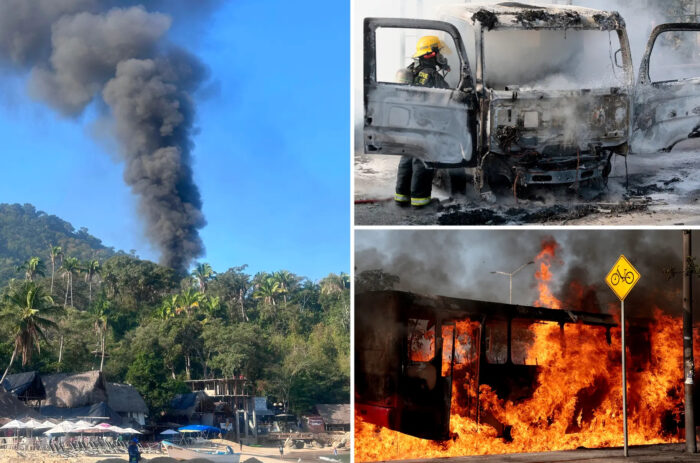
U.S. officials said the airstrikes hit military targets. Images taken by Reuters at the La Carlota air base in Caracas showed charred military vehicles from a Venezuelan anti-aircraft unit.
With the strikes taking place, U.S. Special Forces made their way into Caracas heavily armed, including with a blowtorch in case they had to cut through steel doors at Maduro’s location.
Around 1 a.m. EST Saturday, Caine said, the troops arrived at Maduro’s compound in downtown Caracas while being fired upon. One of the helicopters was hit, but still able to fly.
Social media videos posted by residents showed a convoy of helicopters flying over the city at low altitude.
Once they reached Maduro’s safe house the troops, along with FBI agents, made their way into the residence, which Trump described as a “very highly guarded … fortress.”
Once the troops were inside the safe house, Caine said, Maduro and his wife surrendered. Trump said the Venezuelan leader had tried to reach a safe room but was unable to close the door.
As the troops left Venezuelan territory, Caine said, they were involved in “multiple self defense engagements.” By 3:20 a.m. EST, the helicopters were over water, with Maduro and his wife on board.
Almost exactly seven hours after Trump announced the operation on Truth Social, he made another post.
This time it was a photograph of the captured Venezuelan leader blindfolded, handcuffed and wearing grey sweatpants.
Compiled from Jan. 3 articles at Reuters by Idrees Ali, Erin Banco, Steve Holland and Phil Stewart and CNBC by Jessica Dickler.
Questions
1. What charges did the U.S. bring against Venezuela’s leader Nicholas Maduro? Be specific.
2. How many countries officially do not recognize Maduro as the legitimate president of Venezuela?
3. What is the name of the drug cartel Maduro is alleged to be the head of?
4. What is notable about the state of the economy in Venezuela? (see “Background” below the questions)
5. How did U.S. troops prepare for the operation, which was one of the most complex in recent history?
6. What military equipment was deployed to the region prior to the operation?
7. How long did it take troops to capture Maduro?
8. Read the “Background” and watch the videos under “Resources” below.
No one can dispute Nicholas Maduro is a bad guy:
- Nicholas Maduro is alleged to have sent violent Venezuelan gang members from Tren de Aragua to the U.S. during President Biden’s term when he implemented an Open Border policy. TdA engaged in drug trafficking and human trafficking, among other crimes.
- In 2025, Maduro refused to accept back into the country Venezuelan criminals who the U.S. had apprehended and were deporting.
- He refused to end the massive drug trafficking operation sending illegal drugs to the U.S.
- Trump gave him numerous chances to end the narco-trafficking into the U.S.
- In November 2025, Trump demanded Maduro leave Venezuela within a week for anyplace he chose, along with his family members. He refused, and instead, among other things, demanded he retain control of the military in exchange for allowing free elections
- Maduro has been working with China, Iran, Cuba and Russia. This is a threat to U.S. security.
- Maduro was indicted by the US Justice Department in 2020 for crimes against the U.S. President Biden did not oppose that indictment.
- The vast majority of Venezuelans are very happy that he has been deposed
Watch news reports on this news story. Why do you think the media is spinning this with a negative point of view?
9. During Saturday’s press conference detailing the capture of Maduro, when asked, Trump said the U.S. would be in charge of Venezuela until there is a safe transition of leadership. He also said the U.S. would be running the country “with a group” and “designating various people.”
Later Saturday, Venezuela’s Supreme Court (whose justices were put in place by Maduro) ordered Vice President Delcy Rodríguez (who had been appointed to VP by Maduro) to assume the role of interim president. Elections must be held within 30 days if a president becomes “permanently unavailable,” but the Court then declared Maduro’s absence “temporary,” a scenario where there is no immediate election requirement.
On ABC on Sunday, when asked for details on how the U.S. plans to run Venezuela, Secretary Rubio said the U.S. would use leverage gained from its oil blockade on the country and regional military buildup to achieve its policy aims.
“What’s going to happen here is we have a quarantine on their oil, that means their economy will not be able to move forward until the conditions that are in the national interest of the United States and the interests of the Venezuelan people are met, and that’s what we intend to do,” Rubio said.
This is an ongoing story. Follow the news over the coming days/weeks for updates on the progress and how successful the Trump administration is.
10. Ask a parent: what do you think of the capture of Venezuela’s President Maduro?
Background

Why did the U.S. arrest Venezuelan leader Nicholas Maduro?
Drug Trafficking and Narco-Terrorism: Indicted by the U.S. Department of Justice (initially in 2020, with superseding indictments including his wife and son) for leading the drug “Cartel de los Soles,” conspiring to import tons of cocaine into the U.S., narco-terrorism, and related weapons charges, allegedly partnering with groups like the Colombia’s FARC (a Marxist guerrilla group that engaged in drug trafficking, kidnapping, and extortion), Mexico’s Sinaloa Cartel (one of the largest drug trafficking organizations in the world, designated a Foreign Terrorist Organization by the U.S.), and Tren de Aragua, the violent Venezuelan transnational criminal organization.
How the socialist policies of Nicholas Maduro destroyed Venezuela, once the wealthiest country in South America (and one of the richest in the world):
Corruption and Embezzlement: Accused of widespread corruption, including siphoning billions from state oil company PDVSA, money laundering, extortion, and personally enriching himself and his family through illegal activities, contributing to the collapse of public institutions.
Human Rights Abuses and Crimes Against Humanity: UN Fact-Finding Mission, Human Rights Watch, Amnesty International, and others report systematic repression since 2014, including arbitrary detentions, extrajudicial killings, torture, enforced disappearances, and persecution of political opponents by security forces like the Bolivarian National Guard.
Violent Crackdowns on Protests: Security forces under his command responsible for hundreds of deaths and thousands of injuries/arrests during protests in 2014, 2017, and post-2024 election, with reports of excessive force and extrajudicial executions.
Election Fraud: Widely condemned for rigging elections, including the 2018 and especially the 2024 presidential vote, where independent tallies showed opposition victory but official results declared Maduro winner without evidence; described as one of the largest electoral frauds in Latin American history.
Authoritarian Consolidation: Dismantled democratic institutions by controlling the judiciary, legislature, and electoral council; banned opposition candidates; censored media; and restricted freedoms of expression, assembly, and press.
Economic Mismanagement Leading to Humanitarian Crisis: Policies contributed to hyperinflation (peaking at millions of percent), GDP contraction of over 70%, widespread poverty, food/medicine shortages, and a collapse of health/infrastructure systems, forcing over 7-8 million Venezuelans to emigrate in one of the largest exoduses in modern history.
Restrictions on Humanitarian Aid: Initially denied the existence of a crisis and blocked international aid, exacerbating starvation, disease resurgence, and child malnutrition affecting millions.
Note: The above points are based on reports from international bodies (UN, HRW, Amnesty), U.S. indictments, and independent observers. (Grok, Jan. 3)
Resources
Press conference announcing the capture of Maduro, January 3, 2026:
Gen. Caine, chairman of the Joint Chiefs of Staff, details timeline of Venezuela operation culmination of months of planning and rehearsal
Secretary of State Marco Rubio:
President Trump takes questions:
Venezuelans celebrate Maduro’s ouster in Buenos Aires, January 3, 2026:
Secretary of State Marco Rubio on NBC News’ Meet the Press (Jan. 4, 2026):
Marco Rubio on NBC, Jan. 4, 2026 “…This is about the national interests of the United States…”
Secretary of State Marco Rubio on CBS News Face the Nation, Jan. 4, 2026, responds to the question why they didn’t arrest all of those indicted:
Read previous articles on the crisis in Venezuela brought on by the policies of Socialist dictator Maduro:
- Millions of Venezuelans flee dire conditions caused by Socialist government (Oct. 16, 2018)
- Maduro’s cash-strapped Socialist regime prohibits most international humanitarian donations (April 17, 2018)
- GM latest US company to have assets seized in Venezuela (April 20, 2017)
- Group of Lima nations to deny entry to Venezuelan officials (Jan. 15, 2019)
- US urges Venezuela army to accept ‘peaceful’ power transfer (Jan. 19, 2019)
- U.S. recognizes assembly leader as interim president of Venuzeula (Jan. 25, 2019)
- European nations recognize Guaido as interim president of Venezuela (Feb. 5, 2019)
- Venezuela protests turn violent as Guaido calls for end of Maduro regime (May 1, 2019) and scroll to bottom for videos and further links on Maduro’s authoritarian rule.
- US Strike Destroys Drug Boat, Kills 11 Tren de Aragua Members (Sept 4, 2025)
Daily “Answers” emails are provided for Daily News Articles, Tuesday’s World Events and Friday’s News Quiz.