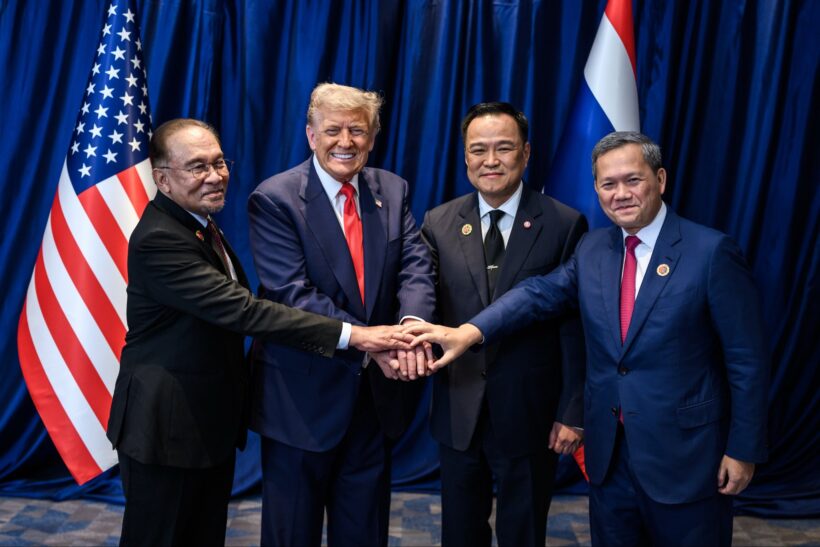
President Trump and the leaders of Malaysia, Thailand and Cambodia in Kuala Lumpur, Malaysia, on October 26, 2025. President Trump used threats of higher tariffs to broker a ceasefire between Cambodia and Thailand. The agreement, signed at the ASEAN summit. Trump also secured trade and critical minerals deals with the nations.
redo Jump to...
print Print...
Summary of Trump’s Asia trip:
- President Trump arrived in Malaysia this weekend for a three-nation Asia tour, signing peace and trade deals Sunday with the leaders of Cambodia, Thailand and Malaysia, and rare earths and critical minerals supply chain cooperation agreements with Malaysia and Thailand. The deals are aimed at strengthening Trump’s position before meeting Chinese President Xi Jinping in South Korea on Thursday.
- The president then traveled to Japan, where he paid a courtesy call on Emperor Naruhito before meeting with newly elected conservative Prime Minister Sanae Takaichi, who is the country’s first female PM. After holding a bilateral meeting with the prime minister on trade, security and rare earth minerals, Trump addressed thousands of sailors stationed in Japan aboard the aircraft carrier USS George Washington.
- The president’s final stop on his Asia tour is South Korea for the Asia-Pacific Economic Cooperation (APEC) Summit and a meeting with Chinese President Xi there on Thursday. The two leaders are set to sign a trade agreement to avert Trump’s threatened 100% additional tariff on Chinese goods. Officials from both countries, who have been working on the sidelines, have said that a trade deal between the U.S. and China is nearly complete. (CNBC with NY Post)
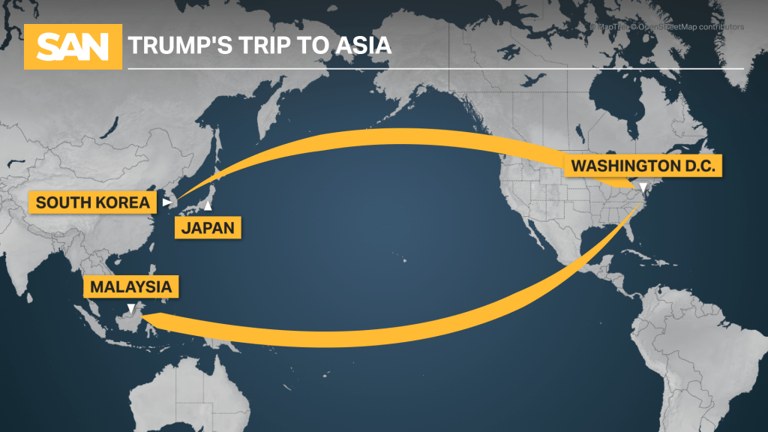
(by Anniek Bao, CNBC): During his first stop in Malaysia, Trump signed separate trade and mineral agreements with his Malaysian and Cambodian counterparts, as well as frameworks for trade pacts with Thailand and Vietnam.
The four countries, part of an 11-member regional bloc called the Association of Southeast Asian Nations (ASEAN), pledged to remove trade barriers, provide preferential market access to U.S. goods, and increase purchases of American agricultural, energy products, and aircraft.
They also agreed to cooperate with Washington on export controls, sanctions and access to critical rare earth minerals — commitments that appear to strengthen Trump’s standing in a region where Beijing has a growing clout.
In Japan, Trump met with Prime Minister Sanae Takaichi and the Emperor Naruhito before flying to South Korea, capping the trip with a meeting with the Asia-Pacific Economic Cooperation (APEC) Summit.
Under the agreements, Washington will keep a 19% tariff rate on most exports from Malaysia, Cambodia and Thailand, while some products will face no duties, according to joint statements from the White House.
Tariffs on Vietnam will remain at 20% with some goods eligible for duty-free access, according to the joint statement. Vietnam, which recorded a trade surplus of $123 billion with the U.S. last year, also pledged to step up purchases of American products to address the trade imbalance.
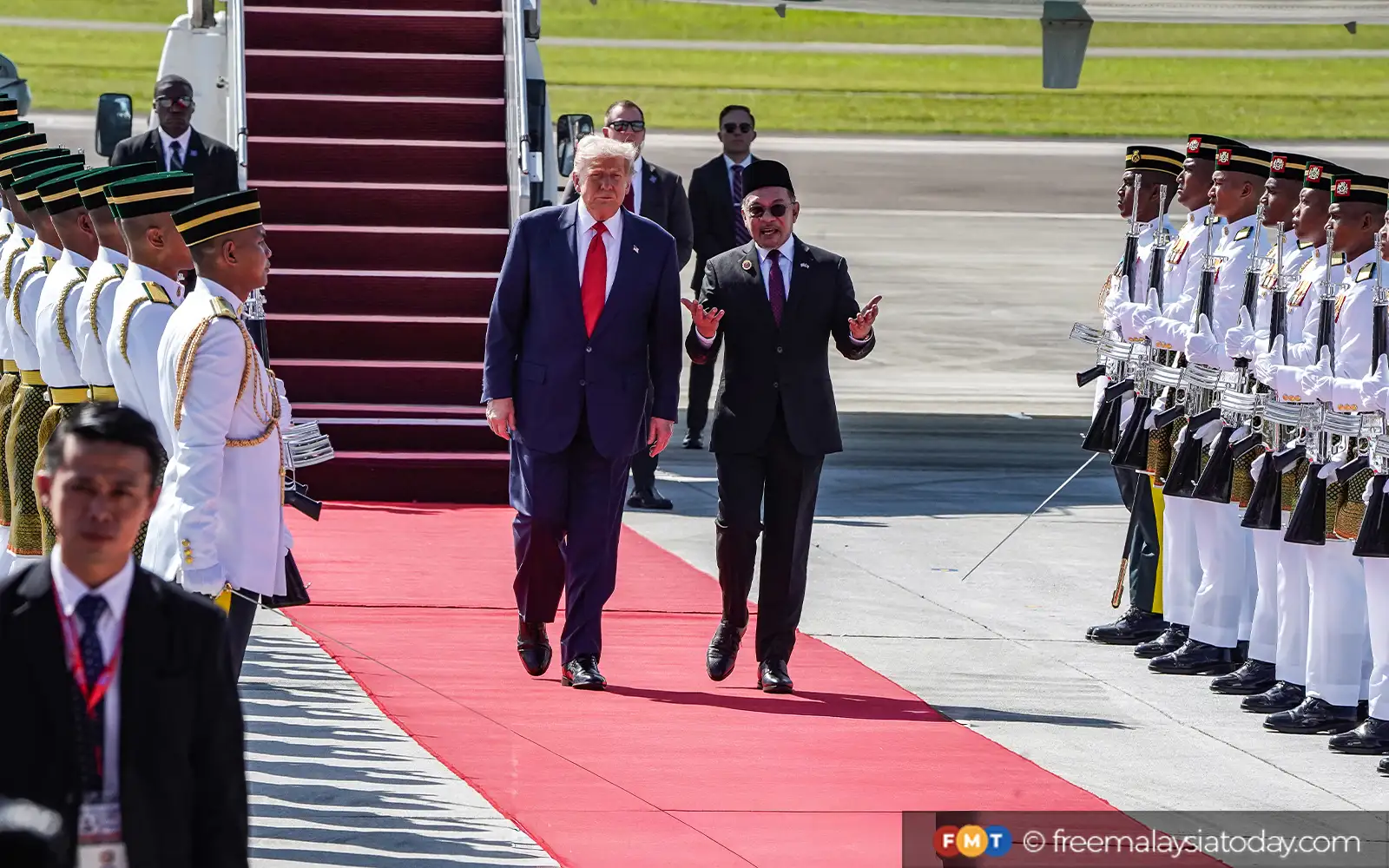
President Trump arrived on the morning of Sunday, Oct. 26, local time and was greeted by President Anwar bin Ibrahim and traditional dancers.
Malaysia agreed not to impose bans or quotas on U.S.-bound exports of critical rare earth minerals and to speed up development of its rare-earth projects needed by American companies.
The country, which sits on an estimated 16.1 million tons of rare earth deposits, has enforced a nationwide moratorium on the export of unprocessed rare earth materials since last year to develop its downstream industries and prevent resource exploitation.
Thailand will ease tariff barriers on U.S. goods by accepting some American-made vehicles, medical devices and pharmaceuticals, and by importing ethanol for fuel. It also pledged to relax foreign ownership restrictions for U.S. investors in the telecommunications sector.
Aside from trade agreements, Trump announced the formalization of an extended truce between Thailand and Cambodia, building on a ceasefire that he brokered in July following their violent border clashes this summer.
As Trump [met] with other leaders in Malaysia, U.S. and Chinese negotiators met on the sidelines of the ASEAN summit, where the bilateral talks yielded a framework ahead of an expected meeting between Trump and Xi in South Korea on Thursday.
In an interview with ABC News’ “This Week,” U.S. Treasury Secretary Scott Bessent said the negotiations produced a “substantial framework” that could ease concerns among American soybean farmers over China’s boycott.
China bought more than half of U.S. soybeans in 2023 and 2024, accounting for nearly $12.8 billion in 2024. But Beijing halted purchases earlier this year after Trump ignited a trade war.
Bessent also told ABC News that he expected China to delay its rare earth export controls, set to take effect in the coming weeks, by one year. Trump and Xi could also [finalize] a deal to allow TikTok to continue to operate in the U.S., Bessent added.
Excerpted from an article published at CNBC on Oct 27. Reprinted here for educational purposes only. May not be reproduced on other websites without permission.
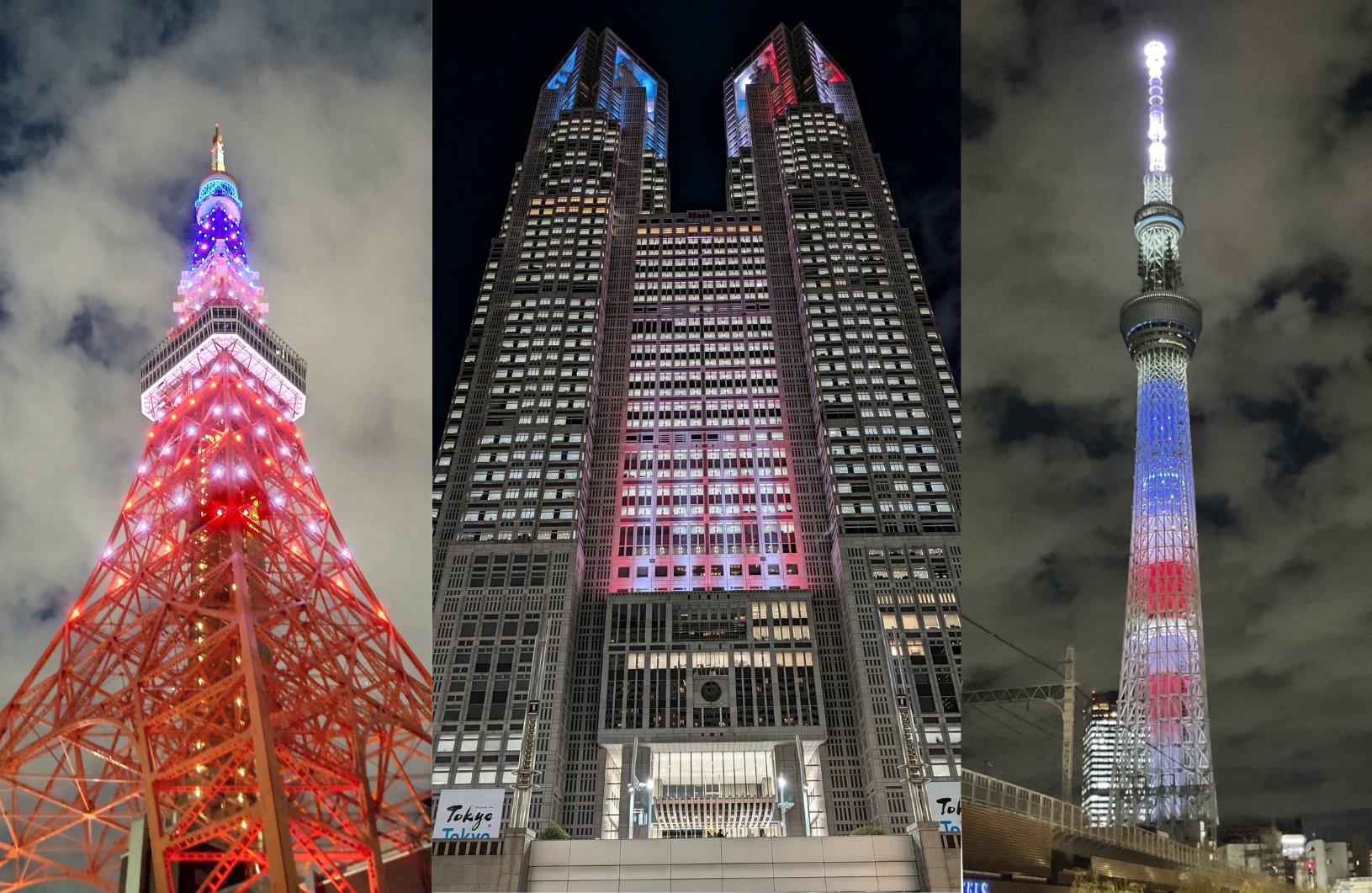
Prime Minister Takaichi Sanae posted on X “Welcome to Japan, Donald Trump! Looking forward to seeing you tomorrow and having a fruitful discussion on how we can further strengthen our great Alliance. Special lighting honoring President Trump’s visit is now illuminating landmarks across Tokyo!”
ON JAPAN: This week, Donald Trump signed multiple significant deals with Japan during his visit:
-
A landmark framework agreement on securing the supply of critical minerals and rare earth elements was signed with Japan’s Prime Minister Sanae Takaichi. This deal focuses on joint efforts to mine, process, recycle, and invest in rare earths and critical minerals essential for high-tech and defense industries. It aims to diversify supply chains and reduce reliance on China in these strategic materials.
-
Trump and Japan formalized a trade framework that includes a commitment of $550 billion in Japanese investments into U.S. industries, accompanied by a 15% baseline tariff on Japanese imports. This framework paves the way for expanded Japanese investments in energy, technology, semiconductors, manufacturing, shipbuilding, and agriculture.
-
Japanese firms announced about $490 billion in investments in the U.S., covering sectors such as development, construction, semiconductors, AI infrastructure, nuclear energy projects involving Westinghouse and GE Vernova, and other manufacturing industries. Companies involved include Toshiba, Hitachi, Mitsubishi, TDK, Fujikura, Murata Manufacturing, and more.
-
Trump also highlighted historic purchases Japan plans to make, including U.S. soybeans, natural gas, and Ford F-150 trucks, indicating expanded economic and military cooperation.
-
The leaders signed two broadly defined agreements—one declaring a “new golden age” for U.S.-Japan relations and another focusing on cooperating to strengthen rare earth supply chains.
Together, these deals mark a strategic deepening of economic, technological, and defense ties between the U.S. and Japan, aiming to enhance industrial competitiveness and secure critical mineral supplies amidst global geopolitical shifts. (from Perplexity “What deals did Trump sign with Japan this week,” Oct. 28)
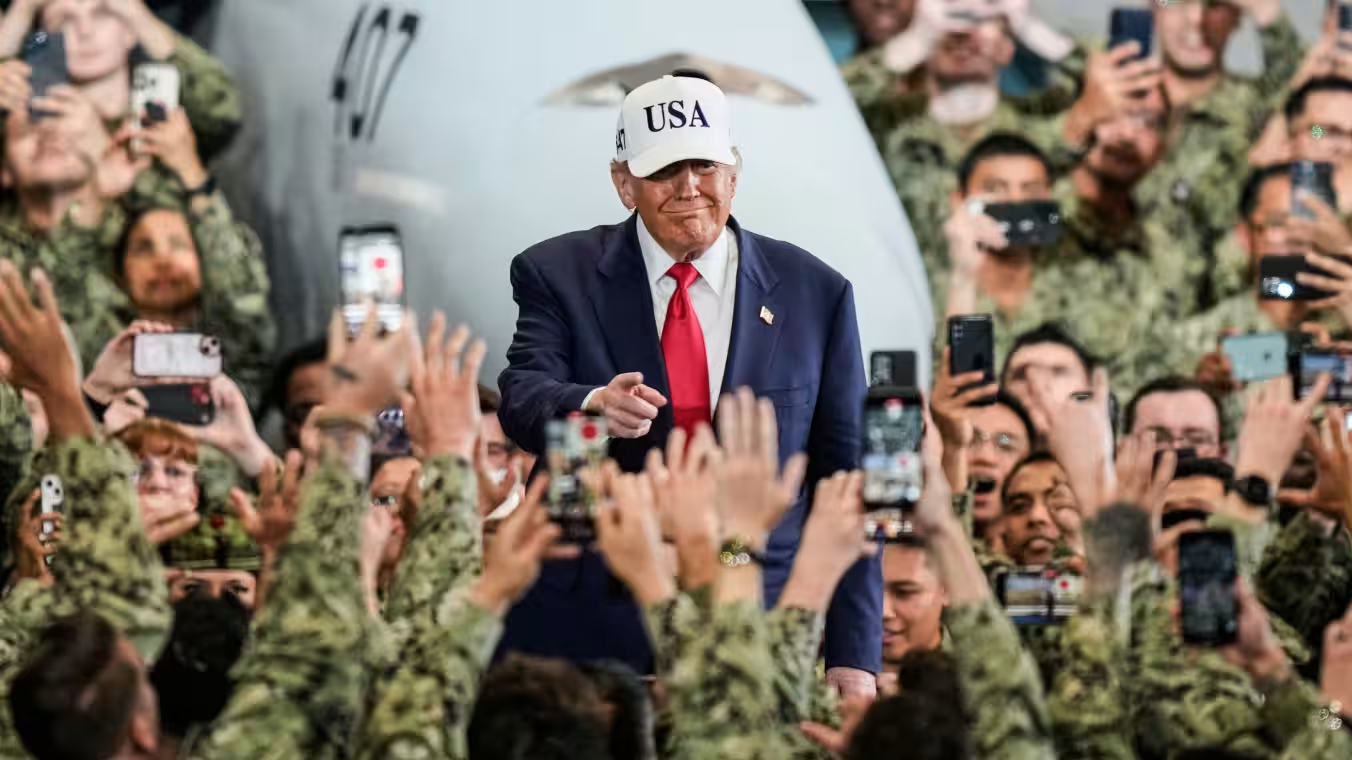
Trump speaks to troops aboard the USS George Washington in Japan on Oct. 28, 2025.
Questions
NOTE to Students: Before answering the questions, read the “Background” and watch the videos under “Resources” below.
1. What countries is President Trump visiting on his almost weeklong trip to Asia?
2. a) During the first stop, which two countries finalized a peace deal?
b) Who did they credit for establishing the truce between the two?
3. a) List the countries that signed rare earth and critical minerals agreements with the U.S.
b) What is the significance of these agreements?
4. What is the aim of the U.S./Japan agreement on rare earth elements and critical minerals?
5. Re-read the Background. Consider this information as well as the videos under “Resources.”
a) Before reading/viewing, what did you know about the president’s trip to Asia – or the purpose of his trip?
b) What did you learn that you think all Americans should know?
c) What is your reaction to the president’s trade deals, etc. on his trip? (encouraged, discouraged, etc….)?
6. There is a lot to cover from Trump’s trip. How thorough/concise/accurate do you think the media was in its coverage? Explain your answer. (If you didn’t know the president was on a weeklong trip to Asia, why do you think this is so?)
7. Whether Democrat or Republican, progressive, liberal, or conservative, how should Americans view the president’s trip to Asia? Explain your answer.
CHALLENGE: Follow the last two days of President Trump’s trip and his meetings in South Korea and with President Xi Jinping. What was the outcome? What stood out to you as being important/significant?
Background
Trump signed rare earths deals with Malaysia, Thailand and Japan:
President Trump signed rare earths and critical minerals supply chain cooperation agreements this week with Malaysia and Thailand, and also announced new trade frameworks with Cambodia and Vietnam during his Asia tour.
- The deals with Malaysia and Thailand specifically focus on diversifying critical mineral sources, securing U.S. access to rare earth elements, and supporting development of local mining and processing capabilities.
- Malaysia agreed not to ban or restrict exports of rare earths to the United States
- Thailand committed to joint ventures and expanded processing with American firms.
These moves are intended to reduce U.S. dependence on Chinese rare earth supply and mitigate the impact of China’s export controls. (Perplexity, Oct 27)
President Trump and Japan’s Prime Minister Sanae Takaichi signed a framework agreement to boost the supply and production of rare earth elements and critical minerals through coordinated mining, processing, recycling, and investment efforts:
- The agreement aims to reduce reliance on China’s dominant control over rare earths.
- The minerals involved broadly include those essential for electric vehicles, defense systems, electronics, batteries, catalysts, and permanent magnets.
- Japan has significant rare earth deposits mostly underwater, which makes mining challenging, but the agreement sets a path for investment and deregulation to accelerate production.
- The deal also includes plans for joint stockpiling, rapid response teams for supply disruptions, and economic policy alignment to create stable, equitable markets for these materials.
This partnership fits into a larger U.S. strategy to diversify rare earth sources, supporting sectors such as renewable energy, automotive, aerospace, and defense technology. (from Perplexity “what rare earths did trump agree to with japan” – Oct. 28)
Trump’s Asia trip:
—MALAYSIA: First stop in Asia was Kuala Lumpur, Malaysia. The president arrived on the morning of Sunday, Oct. 26, local time and was greeted by President Anwar bin Ibrahim and traditional dancers. Trump (and then Ibrahim) danced along with them momentarily.
- The president broke protocol with President Ibrahim and invited him to accompany him in “the Beast” presidential car to travel to the ASEAN Summit 2025, where Trump and other leaders including Cambodia’s Prime Minister Hun Manet, Thailand’s Prime Minister Anutin Charnvirakul, Vietnam’s Prime Minister Pham Minh Chinh
- Thailand and Cambodia signed a peace agreement.
- Trump made trade and rare earth minerals deals.
- He also met with Brazil’s leftist president Lula da Silva in a side meeting to discuss tariffs and a trade deal.
—JAPAN After spending Sunday in Malaysia, Trump flew to Tokyo, Japan, on Monday, Oct. 27, where he paid a courtesy call on Emperor Naruhito. When greeting Trump, the Emperor said “it’s very kind of you to come and see me.”
- The president held talks Tuesday morning, Oct. 28, with the new Prime Minister of Japan, Sanae Takaichi, who is the country’s first female PM. They signed trade deals and a rare earth and critical minerals deals.
- Trump also attended a dinner at the US Embassy, watched part of the World Series with Prime Minister Takaichi and others, and also traveled to the USS George Washington, where he spoke to the thousands of U.S. sailors stationed in Japan.
- In addition, the president met with families of Japanese people kidnapped decades ago by North Korea, who are asking him to help get their loved ones home.
–SOUTH KOREA: In the final leg of his trip, President Trump flies to Busan, South Korea to meet the country’s leader, President Lee Jae Myung on Wednesday, Oct. 29.
- The president will then meet leaders of the Asia-Pacific Economic Cooperation (APEC) and speak at a luncheon before meeting with Chinese President Xi Jinping on Thursday, Oct. 30.
AFP notes: “The eyes of the world will be on a meeting set for Thursday — the first time in six years Trump sits down with Xi.”
Trump said, “We’re going to be…meeting with President Xi…that’s a big meeting and I think it’s going to work out very well…”
Topics to be discussed by Trump and Xi include: China’s ban on its export of rare earths, tariffs imposed on China due to Beijing’s failure to curb the export of chemicals used in the production of fentanyl, which has caused nearly 450,000 U.S. overdose deaths, Chinese-built ships, agriculture (Beijing boycotted U.S. soybean imports this year due to the trade war – our farmers sell half their crops to China), sale of the CCP (Communist Party) controlled Tik Tok, and tariffs for semiconductors, pharmaceuticals and other key industries.
IN ADDITION: Hong Kong-based billionaire Jimmy Lai, 77, is a media tycoon and pro-democracy activist who is a vocal critic of the Chinese government. He has been imprisoned by the CCP since 2020 as a political prisoner and faces a potential life sentence. His family and supporters have asked President Trump to negotiate for Lai’s freedom. Trump has publicly acknowledged these appeals and stated his intention to raise the issue with Chinese President Xi Jinping.
Resources
Read “Trump Opens Asia Trip by Securing Landmark Wins for America” – Oct. 27, 2025
Watch Cambodia’s Prime Minister Hun Manet:
Watch a CNN report:
Watch a EuroNews report:
Watch a Jesse Watters synopsis:
Daily “Answers” emails are provided for News Stories, Tuesday’s World Events and Friday’s News Quiz.