print Print...
“In light of this evening’s events, I ask that all Americans recommit with their hearts in resolving our differences peacefully.” – President Donald J. Trump
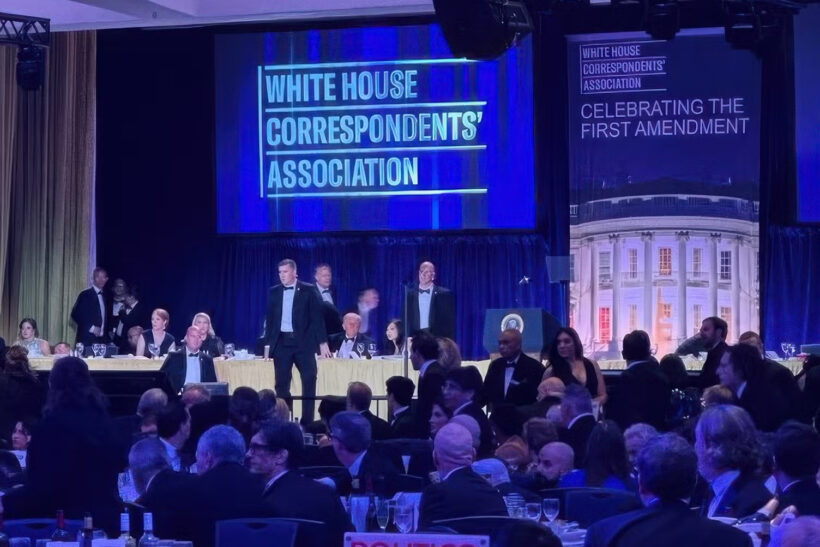
Cole Allen, a 31-year-old from Torrance, California, armed with a [multiple weapons], breached security and opened fire at the White House Correspondents’ Dinner held on April 25 at the Washington Hilton Hotel, targeting President Donald Trump and Trump administration officials. Secret Service agents intervened, evacuating Trump, First Lady Melania Trump, Vice President J.D. Vance, and others; one agent was shot but protected by a bullet-resistant vest and expected to recover, with no injuries to principal attendees. Allen, who authored an anti-Trump and anti-[Trump administration] manifesto…, was apprehended after exchanging gunfire with law enforcement.
“A man charged a security checkpoint armed with multiple weapons, and he was taken down by some very brave members of Secret Service,” Trump said.
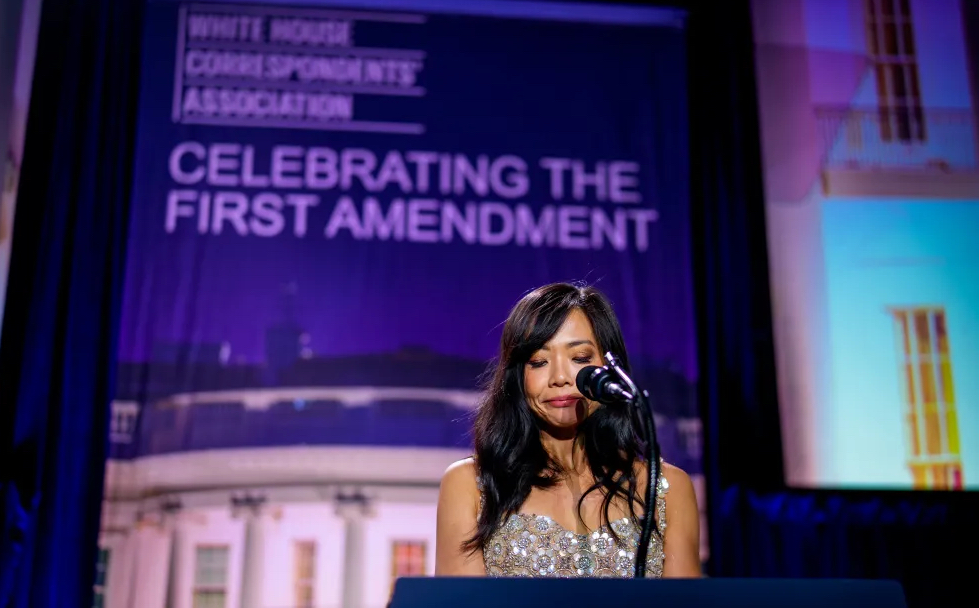
Weijia Jiang, WHCA president and CBS News’ Senior White House Correspondent
(by The night was going exactly as planned.
For eight months, as president of the White House Correspondents Association, I’d been working on this dinner party. Above all, I had hoped it would restore some normalcy between the Trump administration and the press. Maybe I was naïve, but I wanted it to be a room we don’t see enough of in Washington: a bipartisan one. And it was.
There were more than 2,500 journalists and guests dressed to the nines. CEOs, celebrities, ambassadors and members of the cabinet including Vice President JD Vance, Secretary of Defense Pete Hegseth, Robert F. Kennedy Jr., Todd Blanche, Secretary of State Marco Rubio, DHS Secretary Markwayne Mullin — many just feet from the president in the ballroom.
Most important was Donald Trump himself: after 15 years of boycotting the dinner [because the majority of the media does not report on him in an unbiased manner], he finally decided to come. It was the first time he had attended as president.
Trump was in a great mood. The Marine Corps Band had just played The Star-Spangled Banner, and the president was on the dais. We were chatting about the last time he attended, when Barack Obama was president.
“You know, everyone thinks I was upset by all those jokes Obama made. But I really wasn’t,” I remember him telling me as Oz Pearlman — the mentalist I had booked for the night — asked if he could interrupt. He was doing a trick on the press secretary, Karoline Leavitt, and he wanted the president and me to watch.
Leavitt is due to give birth in a matter of days, and she’d told me earlier that Pearlman claimed he’d figure out the name of her unborn baby. “There’s no way he would ever be able to do that,” she said. “Very few people know it. It’s impossible.”
We all watched. Melania Trump, seated to Leavitt’s left, was quite engaged. Oz prepared to turn over a piece of paper with a name scribbled on it with a Sharpie.
Oz revealed a name to the first lady and Leavitt, and I watched her reaction. The look on her face—shock and delight—is an image now frozen in my mind, because it’s the last thing I saw before chaos unfolded.
At that very moment, we heard commotion. I looked out in the audience and thought there might have been a heckler. But I didn’t see one.
Before I could make sense of what was unfolding, armed agents rushed toward the dais. They multiplied quickly, sprinting from the other side of the stage to surround us. I heard shouts of “down, down, down, get down.”
I got out of my chair and was following Trump when he hit the ground. I got on my hands and knees too. Only later did I see a big bruise on my left knee. I was crawling, and we were ushered behind the stage.
I crawled to the holding area, where the show producers were watching the video feeds of the live images from inside the ballroom.
Inside weren’t just my fellow journalists but also the most important people in my life. Moments before the chaos unfolded, I locked eyes with my 82-year-old father who waved to me. He looked happy. He and my mom both struggle with mobility. “Where are their wheelchairs?” I wanted to know. Who’s going to push them out of danger? My husband and my 7-year-old daughter were there too. Was she scared? Was she crying? I wanted to hold her.
I scanned the feeds looking for them, shaking. I asked anyone who could hear me: What happened? What’s wrong? Did anyone get hurt?
I have covered many shootings and murders in my career, including Sandy Hook in 2012. But this was the first time I found myself on the other side. No one can prepare you for it.
There was a rush of advance guys and Secret Service guys. “Blue, blue!” one said, rushing toward the room where Trump was being held.
There were several unverified news reports and tweets. Clearly, there was a situation with a shooter and a gun, but the information I had was just that the president wants the show to go on. He did not want to be deterred.
At some point, I went back on stage and assured everyone that the show would go on. People were glad to hear that. We waited and waited. Then one of the advance guys told me the president wanted to talk to me. I was led into a room by the president’s closest aides.
The first lady was standing and offered me a smile. “Are you OK?” she asked. Vice President Vance entered and asked the same.S ecretary Rubio was next to me. I just kept hearing, “We’re going to the White House. We’re going to the White House.”
But the president did not want to go. He told me that he wanted to get back on stage. But also that his speech — a “shtick,” he called it — would now be “totally inappropriate.”
They decided on a press conference at the White House in 30 minutes, which I announced to the ballroom. The room laughed. I assured them it wasn’t a joke.
Then, to the room of reporters, I added: “I said earlier tonight that journalism is a public service, because when there is an emergency, we run to the crisis, not away from it. And on a night when we are thinking about the freedoms in the First Amendment, we must also think about how fragile they are.”
I got a ride with the presidential motorcade, which had waited for me. Other reporters ran to the White House in their heels.
He looked solemn as he walked to the podium. After he gave an update about the suspect, he called on me to ask the first question. I wanted to know what he was thinking when he realized what was going on.
He said,
“It was always shocking when something like this happens, happened to me, a little bit, and that never changes the fact we’re sitting right next to each other, first lady on my right, and I heard a noise, and sort of thought it was a tray.”
I was struck when Trump acknowledged how the shooting shaped his view of his relationship with the press. He said,
“This was an event dedicated to freedom of speech that was supposed to bring together members of both parties with members of the press, and in a certain way, it did, because the fact that they just unified. I saw a room that was just totally unified.”
Unity isn’t a word we hear much these days. But that’s how I felt, too.
Questions
1. What is a firsthand account?
2. Who is Weijia Jiang?
3. Ms Jiang was sitting next to President Trump at the dinner when the would-be assassin fired one of his weapons outside the ballroom and Secret Service agents sprang into action. She said she has covered many violent crimes in her career. How was this different?
4. How did President Trump initially react once he knew everyone was ok?
5. What shocked Ms Jiang about the president’s statement about the entire group of journalists in attendance (many of whom were antagonistic toward him) at the press conference at the White House after the dinner was then cancelled?
6. Prior to the dinner, 250 former journalists and press associations signed a letter urging the White House Correspondents’ Association (WHCA) to “forcefully demonstrate opposition to [what they claimed is] President Donald Trump’s efforts to trample freedom of the press” during their annual dinner, citing his “systematic war” on the media.
Trump often calls out what at least half the country sees as biased reporting against anything he does. When he sees that reporting is not fair or accurate, he calls out the media and refers to some media outlets as “fake news.”
The WHCA, led by Weijia Jiang, did not adopt the requested confrontational tone, instead responding that the dinner’s purpose in gathering the president and journalists is to “remind us of what a free press means to this country.”
Conservatives (Trump supporters) say reporting on Trump and conservative beliefs is unfair and biased and believe this is an intentional strategy to undermine his presidency and influence public opinion.
a) What do you think? Should the Correspondents’ Association have taken the aggressive stance against the president requested by the 250 journalists? Do the journalists have a legitimate complaint against the president?
b) Does President Trump have a legitimate complaint against media bias? Do you think the media reports unfairly on President Trump? Do they report differently on Democratic presidents and politicians? Explain your answer.
c) Ask a parent the same questions.
7. Do you think in light of the attempted attack on the president and administration officials (and anyone who got in the attacker’s way) the media in general will report on President Trump in a fairer way going forward? Explain your answer.
Resources
Dan Bongino, April 26, 2026:
President Trump, Saturday, April 25, 2026:
President Trump, Sunday, April 26, 2026:
Daily “Answers” emails are provided for News Stories, Tuesday’s World Events and Friday’s News Quiz.