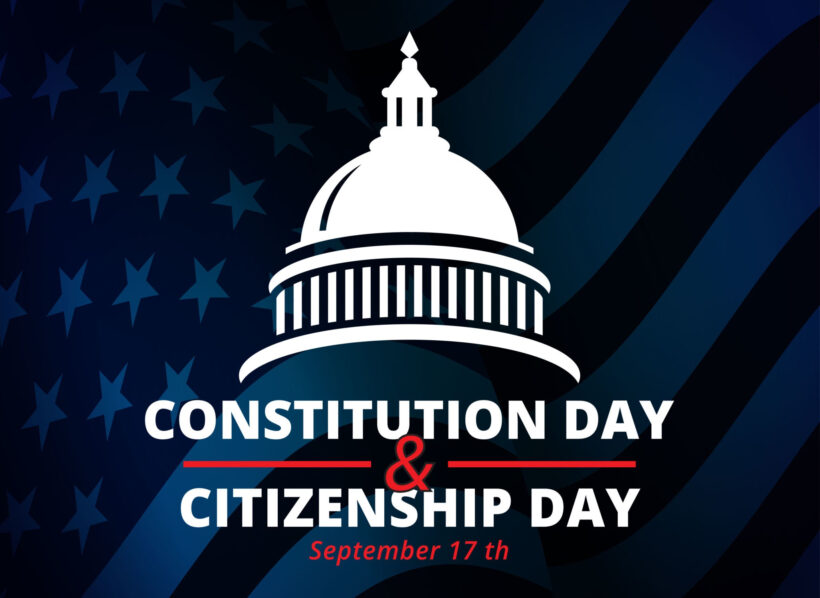
constitution day and citizenship day greeting design with american flag background vector illustration constitution day and citizenship day background design with capitol building and american flag
redo Jump to...
print Print...
For the first time in history, the entire US Constitution will go on display at the National Archives museum in Washington DC.
The public can view the special display in the National Archives Rotunda for the Charters of Freedom in the National Archives Building, from September 16 through October 1. The original Declaration of Independence, Constitution, and Bill of Rights are permanently displayed at the Archives’ Rotunda. (Note: The Capitol Rotunda is a separate space located inside the U.S. Capitol Building.)
The original four-page Constitution, along with the Bill of Rights are always available for public viewing at the National Archives.
However, this two-week display will also include all 27 Constitutional amendments and the rarely displayed “fifth page” of the Constitution signed by George Washington.
The display will mark Constitution Day on September 17, and join in the celebration of the United States 250th anniversary. Constitution Day commemorates the formation and signing of the U.S. Constitution by thirty-nine brave men on September 17, 1787.
For over 200 years, the Constitution has served as the supreme law of the land. The Constitution, along with the Bill of Rights and other amendments, define our government and guarantee our rights.
A federal law enacted in December 2004 designates September 17 as “Constitution and Citizenship Day,” to commemorate the signing of the U.S. Constitution on September 17, 1787. The law contains the following provision:
“Each educational institution that receives Federal funds in the fiscal year shall hold an educational program on the U.S. Constitution on September 17 of such year for the students served by the educational institution.”
In addition to Constitution Day, September 17-23 is also recognized as Constitution Week. A 1956 joint resolution of Congress requested the President to proclaim the week beginning September 17 and ending September 23 as “Constitution Week.” This week is dedicated to celebrating the U.S. Constitution and the rights of citizenship.
Mark Alexander writes in a commentary at PatriotPost:
“No matter what our calling, our occupation or our passion, we have a debt and duty as citizens to both learn about and support our Constitution, and we are obliged to do so above and before all other pursuits, for without constitutional Rule of Law, there are no other pursuits.”
GEORGE WASHINGTON AND THE CONSTITUTION:
- In 2012, George Washington’s personal copy of the Constitution, in which he had written notes, sold at auction for $9.8 million.
- The Mt. Vernon Ladies Association bought it.
- It allowed us to see, for the first time, how cautiously our first president assumed the office, his eyes not toward history but the future.
- Next to two passages explicating the signing of a bill into law, which he bracketed, Washington has written in cursive, “President.”
- He also inscribed “Presidential Powers” next to the paragraphs that lay out the president’s role as commander-in-chief, as well as his authority to grant pardons, make treaties and appoint Supreme Court justices.
- Beneath that, in the paragraph that reads, “He shall from time to time give Congress information of the state of the union,” Washington has added “required,” and it was he who established the address as an annual event.
Read brief biographies of the “Framers of the Constitution” (the Founding Fathers) at archives.gov.
Compiled from sources including National Archives, Mt. Vernon, Patriot Post ,etc.
Questions
1. On what date was the U.S. Constitution signed?
2. How many delegates signed the Constitution?
3. What does the 2004 federal law require every educational institution that receives Federal funds to do?
4. What does your school do on Constitution Day?
5. a) Write out the words to the Preamble to the Constitution.
b) Memorize the Preamble.
6. Read the Constitution in its entirety. (See Archives.gov)
a) How many articles are there in the Constitution?
b) Which Article lays out the powers of Congress? of the President? of the judiciary?
7. Take one (or all:) of the quizzes below. How many answers did you know?
Quizzes on the U.S. Constitution:
- A short answer quiz from Wallbuilders: How much do you know about the Constitution?
- 10 question multiple choice questions on the U.S. Constitution. from ConstitutionFacts .com.
- An advanced quiz (50 questions, multiple choice) from ConstitutionFacts .com.
- Special Constitution quiz from StudentNewsDaily. (10 multiple choice)
- Special quiz for Constitution Day from StudentNewsDaily. (20 multiple choice)
- A quiz on the Amendments from the 2019 Constitution Day post at StudentNewsDaily. (20 multiple choice)
OPTIONAL: Under “Resources” below, watch the “Preamble” video, which first aired in 1975. Do you think this tune helped kids to remember the Preamble? Ask a grandparent if they remember this or any Schoolhouse Rock cartoons.
Background
The Preamble to the U.S. Constitution:
“We the People of the United States, in Order to form a more perfect Union, establish Justice, insure domestic Tranquility, provide for the common defence, promote the general Welfare, and secure the Blessings of Liberty to ourselves and our Posterity, do ordain and establish this Constitution for the United States of America.”
Resources
Read “How a college term paper led to a constitutional amendment” at studentnewsdaily.com.
Wallbuilders’ Celebrating the Constitution.
Wallbuilders’ Constitution Hub.
Free 10 part video course “Constitution 101: The Meaning and History of the Constitution”
The National Constitution Center’s “Constitution 101 Course”
Regarding the Constitution, there are two types of judges: activist and constitutionalist:
- Judicial activism (activist judge) is “the act of replacing an impartial interpretation of existing law with the judge’s personal feelings about what the law should be” (wikipedia)
- A constitutionalist “refers to those who advocate strict adherence to the intentions of the framers of the U.S. Constitution” (wikipedia)
Liberals generally support the nomination of activist judges and conservatives generally support the nomination of constitutionalist judges. Read the text of a speech given by the late Supreme Court Justice Antonin Scalia, a constitutionalist:
Constitutional Interpretation the Old Fashioned Way.
Schoolhouse Rock! was created to teach children about the U.S. government and its founding documents, as well as concepts in mathematics, grammar, science, history, civics, and economics. The show ran from 1973 to 1985. The cartoon below is titled “The Preamble”
Daily “Answers” emails are provided for News Stories, Tuesday’s World Events and Friday’s News Quiz.