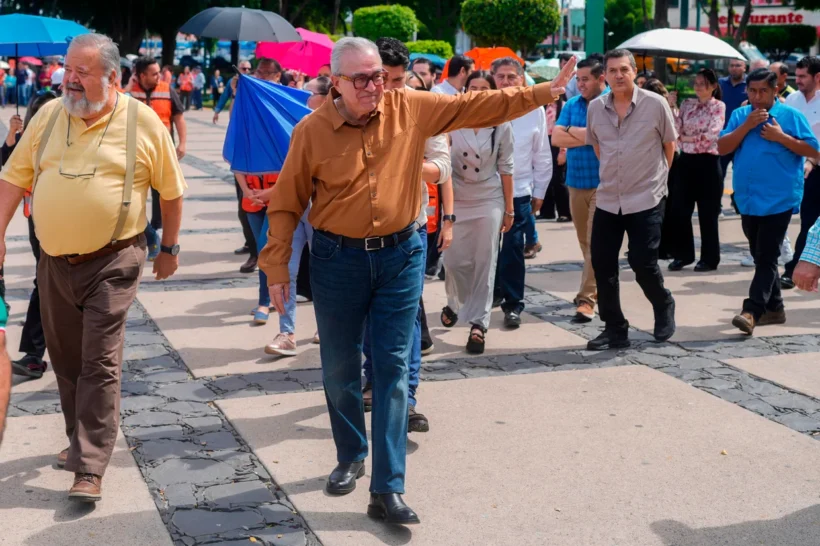
Sinaloa state Gov. Ruben Rocha waves as he takes part in an annual earthquake drill in Culiacan, Mexico, Sept. 19, 2024. Eduardo Verdugo / AP
redo Jump to...
print Print...
NOTE: The Sinaloa Cartel is known for being one of the largest and most powerful drug trafficking organizations in the world, primarily smuggling fentanyl, cocaine, and other drugs into the U.S. To protect its criminal empire and control territory, the Sinaloa Cartel uses extreme violence against rivals, law enforcement, and civilians.
During the 2024 campaign, President Trump promised to formally label major drug cartels as Foreign Terrorist Organizations (FTOs) and Specially Designated Global Terrorists (SDGTs). This was aimed at cutting off their access to the global financial system and allowing for harsher prosecution.
(by Danielle Haynes & Darryl Coote, UPI) – The Justice Department announced an indictment Wednesday charging 10 current and former Mexican officials, including Sinaloa Gov. Ruben Rocha Moya, with drug-trafficking offenses.
A release from the federal prosecutors said all 10 suspects had “partnered with the Sinaloa Cartel to distribute massive quantities of narcotics to the United States.”
The Justice Department accused the current and former officials of corruption and bribery, allowing members of the drug cartel to operate with impunity.
“The Sinaloa Cartel is a ruthless criminal organization that has flooded this community with dangerous drugs for decades,” U.S. Attorney Jay Clayton for the Southern District of New York said.
“As the indictment lays bare, the Sinaloa Cartel, and other drug-trafficking organizations like it, would not operate as freely or successfully without corrupt politicians and law enforcement officials on their payroll.”
Rocha, 76, denied the allegations in a statement, saying they “lack any truth or foundation whatsoever. He accused the U.S. government of violating Mexico’s sovereignty.
“To the people of Sinaloa, I say that, with the courage and dignity that characterize us, we will demonstrate the lack of foundation for this slander,” he said in a social media statement.
Mexico’s Secretariat of Foreign Affairs confirmed in a statement on Wednesday evening that it had received extradition requests for “various individuals” from the U.S. Embassy and that they had been transferred to the Attorney General’s Office for evaluation in accordance with the International Extradition Law.
According to the statement, the documents received by the Mexican government “do not contain evidence sufficient to determine the responsibility of the people for whom provisional detention for extradition purposes is being requested.” The Attorney General’s Office will decide whether the extradition requests are legally viable under Mexican law, it said.
The Trump administration has led a hardline policy on drug trafficking, designating 10 gangs and cartels, including the Sinaloa Cartel, as terrorist organizations that President Donald Trump has said the United States is in “armed conflict” with.
Along with the designations, the Trump administration has warned financial institutions about potential sanctions exposure for working with the cartel, sanctioned various Sinaloa entities and individuals, brought cases against alleged members and blacklisted organizations linked to the Sinaloa Cartel.
Each of the suspects indicted Wednesday faces the same three charges: narcotics importation conspiracy; possession of machine guns and destructive devices; and conspiracy to possess machine guns and destructive devices. If convicted, they each face up to life in prison with a mandatory minimum of 40 years in prison.
One of the suspects, Juan Valenzuela Millan, aka Juanito, faces additional charges of kidnapping resulting in death and conspiracy to commit kidnapping resulting in death. If convicted, the former high-level commander in the Culiacan Municipal Police faces a mandatory sentence of life in prison.
The other defendants include:
- Enrique Inzunza Cazarez, a Mexican senator and former secretary-general for Sinaloa
- Enrique Diaz Vega, the former secretary of administration and finance for Sinaloa
- Damaso Castro Zaavedra, deputy attorney general for the Sinaloa state attorney general’s office
- Marco Antonio Almanza Aviles, former head of the investigative police for the Sinaloa state attorney general’s office
- Alberto Jorge Contreras Nunez, aka “Cholo,” former head of the investigative police for the Sinaloa state attorney general’s office
- Gerardo Merida Sanchez, former secretary of public security for Sinaloa
- Jose Antonio Dionisio Hipolito, aka “Tornado,” former deputy director of the Sinaloa state police
- Juan de Dios Gamez Mendivil, the mayor of Culiacan
Questions
1. The first paragraph of a news article should answer the questions who, what, where and when. List the who, what, where and when of this news story. (NOTE: The remainder of a news article provides details on the why and/or how.)
2. a) What did the U.S. Justice Department accuse the indicted Mexican officials of doing? Be specific.
b) List the specific charges brought against the men.
c) What penalty does each face if convicted?
3. How did U.S. Attorney Jay Clayton describe the Sinaloa Cartel?
4. How did Sinaloa Gov. Ruben Rocha respond to the allegations?
5. a) What is extradition?
b) How has the Mexican government responded the the U.S. request for extraditions?
6. What other steps has the Trump administration taken in addition to designating the cartels as foreign terrorist organizations?
7. From paragraph 10: The Trump administration has led a hardline policy on drug trafficking, designating 10 gangs and cartels, including the Sinaloa Cartel, as foreign terrorist organizations that President Donald Trump has said the United States is in “armed conflict” with.
Consider the info under “Background” and the links under “Resources” – including:
- Designating a drug cartel as a Foreign Terrorist Organization (FTO) by the United States government means officially labeling the organization not just as a criminal enterprise, but as a group whose violent activities threaten U.S. national security, citizens, or foreign policy.
- The Sinaloa Cartel is known for being one of the largest and most powerful drug trafficking organizations in the world, primarily smuggling fentanyl, cocaine, and other drugs into the U.S. To protect its criminal empire and control territory, the Sinaloa Cartel uses extreme violence against rivals, law enforcement, and civilians.
Do you agree? Should the cartels be designated as terrorist organizations? Explain your answer.
Background
Designating a drug cartel as a Foreign Terrorist Organization (FTO) by the United States government means officially labeling the organization not just as a criminal enterprise, but as a group whose violent activities threaten U.S. national security, citizens, or foreign policy.
This legal designation, authorized under Section 219 of the Immigration and Nationality Act, shifts the focus from simply prosecuting drug trafficking to applying national security and counterterrorism measures.
Once designated as an FTO, specific actions are taken by the U.S. government:
- U.S. financial institutions are required to freeze all assets and block financial transactions linked to the cartel.
- It becomes a federal crime to knowingly provide material support or resources (money, weapons, training, services) to the cartel. This applies to U.S. citizens and residents, with punishments including life in prison.
- Members and representatives of the designated cartel are barred from entering the United States, and those already in the country can be deported.
- Foreign financial institutions that knowingly facilitate significant transactions for the cartel can face penalties.
Proponents of the designation argue that modern cartels (such as those in Mexico) have evolved beyond traditional, profit-driven crime into entities that, in 2026, resemble terrorists due to their:
- Use of terror tactics (assassinations, public violence) to intimidate civilians, politicians, and police.
- Operating as “quasi-governmental” entities in some regions, controlling local infrastructure and traffic.
- Directly impacting the U.S. with illegal drugs and violence, as outlined in recent executive actions.
(from Google AI Overview, prompt “what does it mean to designate a cartel as a terrorist organization” May 3, 2026)
Resources
Watch an NBC report, April 29, 2026:
Read the U.S. Attorney’s Office for the Southern District of NY’s press release detailing the accused Sinaloa state government and law enforcement officials’ partnership with the Sinaloa Cartel.
See previous articles on the Sinaloa cartel:
- US seizes 134 acres in Texas used by Sinaloa cartel (Feb. 2026)
- Sinaloa cartel boss likely gave US info on Venezuela drug boats: source (Sept 2025)
- Sinaloa Drug Smuggling Super Tunnel from Mexico to California Found (Nov. 2013)
On Inauguration Day (January 20, 2025) President Trump signed an executive order “Designating Cartels And Others As Foreign Terrorist Organizations…”
Daily “Answers” emails are provided for News Stories, Tuesday’s World Events and Friday’s News Quiz.