print Print Cartoon
Questions
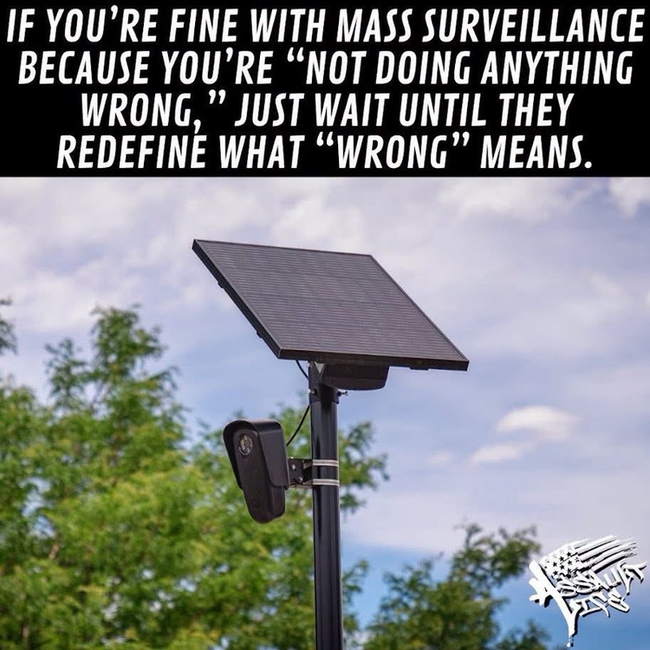
1. What point is the meme creator making about people who don’t care about mass surveillance because they don’t break the law?
2. What worldwide phenomenon in recent history supports the meme creators’ opinion? Explain your answer.
3. Consider the answers to questions #1 and #2. Do they change your answer to the question:
What would be your reaction to the government’s widespread use of surveillance cameras in your community? Explain your answer.
a) I don’t care because I don’t do anything wrong…I have nothing to hide
b) Surveillance cameras violate my right to privacy. Law enforcement will have to use old-fashioned detective work to solve crimes – not monitor citizens’ every move in public places.
4. List practical democratic actions citizens can take to oppose (or support) local mass surveillance infrastructure.
Scroll down to the bottom of the page for the answers.
Answers
1. What point is the meme creator making about people who don’t care about mass surveillance because they don’t break the law?
The point is that once widespread surveillance systems are in place and accepted, those in power can later change the rules — redefining what counts as “wrong,” illegal, or unacceptable.
The meme creator challenges the idea that privacy only matters if you have something to hide, and instead stresses the risk of giving governments (or other authorities) permanent tools of control that can be turned against anyone if the definition of acceptable (or legal) behavior shifts.
2. What worldwide phenomenon in recent history supports the meme creators’ opinion? Explain your answer.
The COVID pandemic: The government enforcement of lockdowns, mask mandates, and vaccine passports in Western democracies like the U.S., Canada, Europe, and Australia.
During the pandemic, governments rapidly introduced new rules that turned ordinary, everyday choices into punishable offenses.
What was “legal” changed overnight: Activities that were completely normal one day — like opening a business, walking in a park without a mask, not requiring customers wear masks in your private business, gathering with family, kids playing sports — became illegal the next.
Good citizens became lawbreakers: People who had never broken a law in their lives suddenly faced heavy fines, job loss, or even arrest because the definition of “acceptable behavior” completely shifted.
3. Consider the answers to questions #1 and #2. Do they change your answer to the question:
What would be your reaction to the government’s widespread use of surveillance cameras in your community? Explain your answer.
a) I don’t care because I don’t do anything wrong…I have nothing to hide
b) Surveillance cameras violate my right to privacy. Law enforcement will have to use old-fashioned detective work to solve crimes – not monitor citizens’ every move in public places.
4. List practical democratic actions citizens can take to oppose (or support) local mass surveillance infrastructure.
-Attend City Council Meetings and speak during the public comment section to voice your concerns directly to decision-makers.
-Gather signatures from residents who oppose (or support) the surveillance. Present the final petition at the next council meeting to demonstrate widespread community opinion.