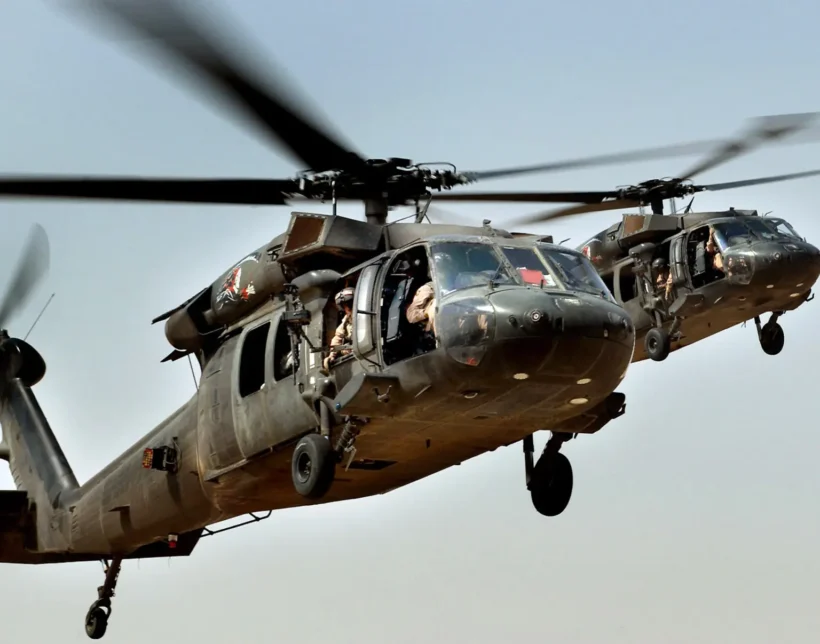
US Army UH-60 Black Hawk helicopters. UPI
redo Jump to...
print Print...
(by Geoff Earle, NY Post) – An elite Army unit capable of inserting some of the American military’s most deadly special operations forces into a fight has been deployed to the Caribbean as President Trump exerts an increasing show of force in Venezuela.
The 160th Special Operations Aviation Regiment, known as the vaunted “Night Stalkers,” operates attack helicopters like the Army’s MH-60 Black Hawks and small transport helicopters into the most perilous situations.
Video surfaced earlier this month showing Army Black Hawks and smaller ‘Little Birds” undergoing training in Trinidad, located about 500 miles east of the capital city of Caracas, giving the first hint of the rotary-wing power being readied.
The “Night Stalkers” are able to deposit highly trained fighters, including Navy SEALs, Army Green Berets, or Delta Force personnel, into battle zones.
Training with such aircraft indicated practice for potential missions battling drug cartels — or even the regime itself — said defense expert Mark Cancian, a retired Marine Colonel now with the Center for Strategic International Studies in DC.
No other element of the armed forces uses the “little bird” helicopters that have been spotted off the Venezuelan coast.
“They have excellent surveillance equipment to watch for potential drug smugglers coming out of Venezuela and the attack capabilities to destroy those vessels. They could also seize vessels, although they have not done that yet as far as is known,” Cancian told the Post.
Then there are the most extreme measures the Night Stalkers have trained for.
“The 160th could take special operations forces into Venezuela to strike cartel or regime targets. I don’t expect that because of the risk of casualties or capture but it’s possible,” he noted.
The special operations aviation force had flown within 90 miles of the Venezuelan coast, a Washington Post analysis found.
The move appears designed to get the regime’s attention.
In yet another potent show of force, the US military flew powerful B-52 bombers off the coast of Venezuela on Thursday.
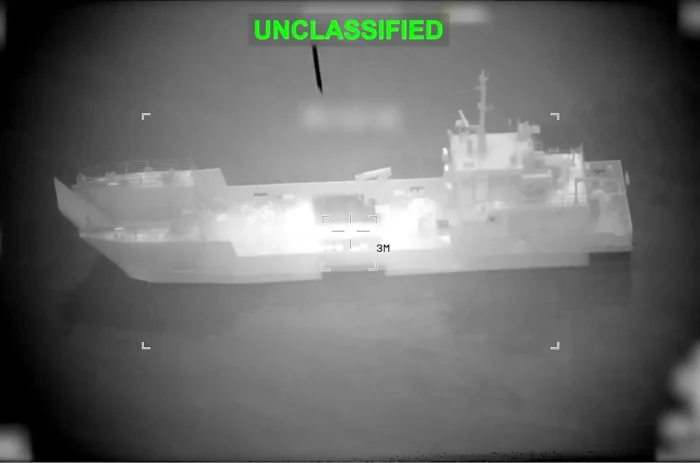
Trump posted dramatic video of one of the American strikes to Truth Social Saturday and wrote about the destruction of an alleged submarine drug vessel that the military struck off the coast of Venezuela.
The boat was “loaded up” with “mostly fentanyl” and other illegal drugs, said the president.
“It was my great honor to destroy a very large DRUG-CARRYING SUBMARINE that was navigating towards the United States on a well-known narcotrafficking transit route,” Trump posted.
The military says it has destroyed six alleged drug vessels off the coast of Venezuela.
Asked Friday about left-wing dictator Nicolás Maduro offering “everything” to avoid a confrontation, Trump contended the Venezuelan leader “doesn’t want to f– around with the United States.”
The White House calls the Maduro regime “illegitimate.” [Editor’s note: Since 2019, more than 50 countries, including the U.S., do not recognize socialist leader Nicolás Maduro as the legitimate president of Venezuela, particularly since his contested re-election in 2024 and his previous disputed election in 2018].
Trump has also confirmed that he authorized covert CIA action inside Venezuela.
“I authorized for two reasons, really. Number 1, they have emptied their prisons into the United States of America … And the other thing are drugs. We have a lot of drugs coming in from Venezuela.”
Venezuela has been mobilizing its own show of much more limited force. Its army is said to number 125,000, although Maduro claims he can mobilize a militia of millions to defend his homeland.
The government has been airing propaganda videos, including some of “slightly plump” Venezuelans running obstacle courses, according to the Wall Street Journal.
“The people are ready for combat, ready for battle,” Maduro told a crowd this week.
Published at NY Post on Oct. 18, 2025. Reprinted here for educational purposes only. May not be reproduced on other websites without permission.
Questions
NOTE to Students: Before answering the questions, read the “Background” and watch the video under “Resources” below.
1. a) What do the 160th Special Operations Aviation Regiment “Night Stalkers” do?
b) Where were they seen training earlier this month?
2. a) What were the Night Stalkers most likely doing, according to defense expert Mark Cancian?
b) How did he know the aircraft training were the Night Stalkers?
3. What are the Night Stalkers able to do?
4. Why doesn’t Mr. Cancian expect the 160th to go into Venezuela?
5. What is most likely the purpose of the Night Stalkers’ training missions within 90 miles of the Venezuelan coast?
6. What other maneuvers did the U.S. military engage in on Thursday near Venezuela?
7. Scare quotes are quotation marks that writers place around a word or phrase to express skepticism (doubt as to the truth of something).
Scare quotes signal the writer’s disapproval or skepticism towards the enclosed term, which is an opinion not appropriate for a news report aiming to inform objectively.
a) Why do you think the reporter uses scare quotes around the term “illegitimate” in paragraph 18?
b) How do you know he should not have used scare quotes around the word illegitimate?
8. a) What action has President Trump authorized in Venezuela?
b) Why has he done so?
9. Consider what we know about President Maduro’s involvement in narcoterrorism. Watch the BBC News video with President Trump under “Resources” below. He says the way we have done it for 30 years has not stopped the drug trade. And the president has said multiple times that he wants to save American lives. Do you support the actions the Trump is overseeing to destroy the drug trade/cartels bringing illegal drugs into the U.S.? Explain your answer.
Background
The 160th SOAR (Special Operations Aviation Regiment) “Night Stalkers”:
- Headquartered at Fort Campbell, Kentucky, is the U.S. Army’s premier special operations aviation unit, tasked exclusively with supporting Tier 1 and Tier 2 special operations forces in complex, denied, and high-threat environments.
- Its core mission is to provide dedicated rotary-wing support to U.S. Army Special Forces, particularly elements of U.S. Army Special Operations Command (USASOC), including the 1st Special Forces Command, the 75th Ranger Regiment, and most notably, the Army’s elite Delta Force (1st SFOD-D).
- In addition, it regularly supports joint operations alongside Navy SEALs, Marine Raiders, and the CIA’s Special Activities Center. (read more here)
Venezuela is a dictatorship, not a democracy: While it was once a stable democracy in Latin America, the country has transitioned into an authoritarian regime under the leadership of Hugo Chávez and his successor, Nicolás Maduro. This shift is characterized by electoral fraud, suppression of human rights, and a lack of free press, leading to its poor ranking on international measures of freedom and civil liberties. (from Google AI Overview)
From Perplexity AI’s answer to question: “How did the socialist policies of Chavez and Maduro destroy Venezuela’s economy?”:
- The socialist policies of Hugo Chávez (president of Venezuela from 1999 until his death in 2013) and his successor Nicholas Maduro severely damaged Venezuela’s economy through aggressive nationalization, rigid price and currency controls, and unsustainable social spending that created market distortions, shortages, and hyperinflation.
- Chávez’s government seized over a thousand companies across key sectors—agriculture, oil, utilities, banking, manufacturing, and food distribution — replacing experienced management with political appointees.
- State control led to inefficient operations, collapsing production, and frequent blackouts and water shortages as government-run enterprises could not deliver basic services or maintain infrastructure.
- Food production dropped 75% in two decades while the population rose by 33%, creating a recipe for chronic shortages and hunger.
- …The socialist policies of Chávez and Maduro destroyed Venezuela’s economy by undermining private enterprise, causing market failures, diminishing production, fueling corruption, and creating a dependence on spending that collapsed when oil revenues fell.
Nicholas Maduro:
- Since 2019, more than 50 countries, including the United States, do not recognize socialist leader Nicolás Maduro as the legitimate president of Venezuela, particularly since his contested re-election in 2024 and his previous disputed election in 2018.
- In March 2020, Maduro was charged in the Southern District of New York for narco-terrorism, conspiracy to import cocaine, possession of machine guns and destructive devices, and conspiracy to possess machine guns and destructive devices.
- After initially offering a reward offer of up to $15 million for information leading to the arrest and/or conviction of Maduro in 2020, the Department of State on January 10, 2025, increased the reward offer to up to $25 million.
- On August 7, 2025, the Department announced the further increase in the reward offer to up to $50 million after the Department of Treasury sanctioned Cartel of the Suns* as a Specially Designated Global Terrorist on July 25, 2025. As leader of Cartel of the Suns, Maduro is the first target in the history of the U.S. State Department’s Narcotics Rewards Program with a reward offer exceeding $25 million. (state.gov)
On July 25, 2025, the U.S. Treasury sanctioned the Venezuelan cartel headed by illegitimate president Nicholas Maduro:
- Based in Venezuela, the *Cartel de los Soles (Cartel of the Suns) is headed by Nicolas Maduro Moros and other Venezuelan high-ranking individuals in the Maduro regime who corrupted the institutions of government in Venezuela, including parts of the military, intelligence apparatus, legislature, and the judiciary, to assist the cartel’s endeavors of trafficking narcotics into the United States.
- The cartel’s name is derived from the sun insignias often portrayed on the uniforms of Venezuelan military officials.
- The Cartel de los Soles supports Tren de Aragua in carrying out its objective of using the flood of illegal narcotics as a weapon against the United States. Additionally, the Cartel de los Soles has provided support to the Sinaloa Cartel of Mexico. (treasury.gov)
Read a 2019 article on Venezuela – and scroll to bottom for videos and further links on Maduro’s authoritarian rule.
Resources
President Trump takes questions from the press on Venezuela, October 16, 2025:
For video, visit the Night Stalkers’ website at: go160thsoar.com.
Since early September 2025, the U.S. has destroyed at least six boats from Venezuela [that] were carrying narcotics and operated by the Venezuelan criminal gang Tren de Aragua.
- These strikes have resulted in at least 27 deaths, with two survivors captured during the most recent strike.
- The U.S. conducted the operations mainly in international waters of the Caribbean, and President Trump [emphasized that the purpose of these] actions is to disrupt drug trafficking and save American lives.
- He noted that each boat destroyed prevented thousands of drug-related deaths in the United States.
- The administration also characterized these strikes as part of a broader “armed conflict” against drug cartels, specifically naming the Tren de Aragua gang based in Venezuela, and described this as an escalation in America’s fight against narcoterrorists. (Perplexity)
Read a Sept. 4 article “US Strike Destroys Drug Boat, Kills 11 Tren de Aragua Members“
Daily “Answers” emails are provided for Daily News Articles, Tuesday’s World Events and Friday’s News Quiz.