print Print...
NOTE: Mainly Democrats and a few Republicans oppose Trump’s authorization of the military mission to capture and extradite Venezuela’s Nicholas Maduro, who has been wanted by the U.S. since 2020 – without prior approval from Congress. They say he violated the War Powers Act of 1973.
Greta Van Susteren gives a brief background on the War Powers Act and the Monroe Doctrine that the president uses to defend his actions.
Watch the January 9, 2026 video below and then answer the questions.
Questions
The answers to the first 10 questions can be found in the first 3 minutes of the video.
1. The U.S. Senate voted on Thursday to advance a War Powers Resolution, which would restrict the president’s use of military force in Venezuela unless Congress gives prior approval.
All Democrats and five Republicans voted to advance it for a full vote. Name the 5 Republicans who voted with the Democrats against the president.
2. Greta Van Susteren asks the question: “Does [the president] need prior approval?” She reads Trump’s response to the vote, in which he wrote
“…the War Powers Act is unconstitutional, totally violating Article II of the Constitution, as all Presidents, and their Departments of Justice, have determined before me.”
How does Van Susteren explain what needs to happen for the War Powers Act to pass?
3. The Trump administration didn’t notify Congress before Venezuelan leader Nicholas Maduro’s capture. Why didn’t the Trump administration notify Congress?
4. What does the Constitution say about war?
5. When is the last time Congress declared war?
6. Van Susteren notes “We have had many military actions since 1942.” List the countries Van Susteren names in which presidents took action without a Congressional declaration of war. (Challenge: List the presidents)
7. When/during what conflict was the War Powers Resolution passed by Congress and made law? (Challenge: When were U.S. troops first deployed into that country? By which president?)
8. The War Powers Act requires that a president consult with Congress before committing forces into armed conflict abroad. What is the exception (which is what Trump used)?
9. What does Greta point out about Trump’s action in Venezuela?
10. Van Susteren notes, many presidents since the War Powers Act was enacted have committed troops without congressional approval – and many of those presidents were criticized by members of Congress for not getting prior approval. What examples does she give?
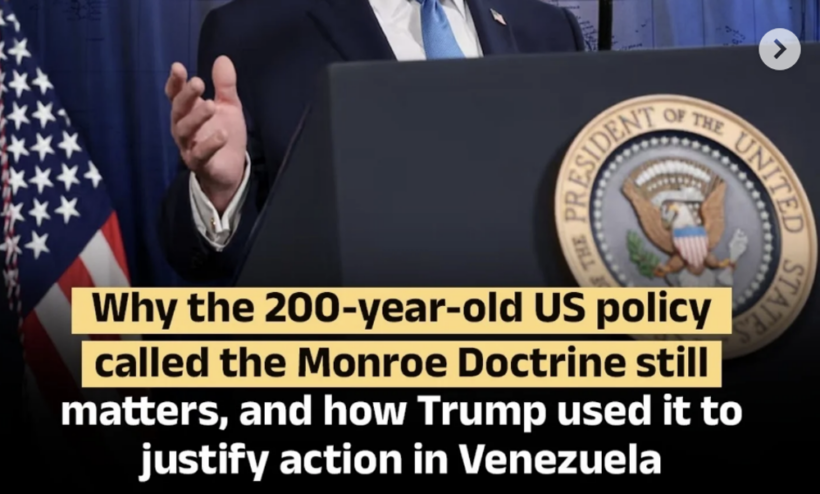
11. President Trump said his actions in Venezuela are justified under the Monroe Doctrine.
a) What did President Monroe in 1823 warn European powers (in what became known as the Monroe Doctrine) not to do?
b) Name the 2 continents and 2 oceans that are in the Western Hemisphere.
c) Which Democratic president in 1962 cited the Monroe Doctrine over the Cuban Crisis? What menace was his administration attempting to isolate?
12. Starting at approximately 4:00 into the video, Van Susteren talks with liberal law professor emeritus of Harvard University Alan Dershowitz. He explains why what Trump did was not against the law and discuss presidents taking action without getting Congress to declare war.
a) Did you find Dershowitz’s answer helpful in understanding the issue? Explain your answer.
b) Did you find this overall news segment helpful in understanding the issue? Explain your answer.
13. Do you think Greta Van Susteren was unbiased/even-handed in her report? Explain your answer.
Resources
Read a Jan. 5 article: “Maduro captured in surprise military strike“
Daily “Answers” emails are provided for Daily News Articles, Tuesday’s World Events and Friday’s News Quiz.