redo Jump to...
print Print...
(UPI and CBS News) — President Donald Trump announced plans Monday to launch a $12 billion stockpile of critical minerals to curb U.S. dependence on China.
“Today we’re announcing the creation of the U.S. strategic critical minerals reserve, the first-ever stockpile of the critical minerals that you’ve been hearing so much about,” Mr. Trump said in the Oval Office, alongside business executives. Mr. Trump said the reserve will be “for civilian use in times of emergency.”
“Just as we have long had a strategic petroleum reserve and a stockpile of critical minerals for national defense, we’re now creating this reserve for American industry so we don’t have any problems,” he said.
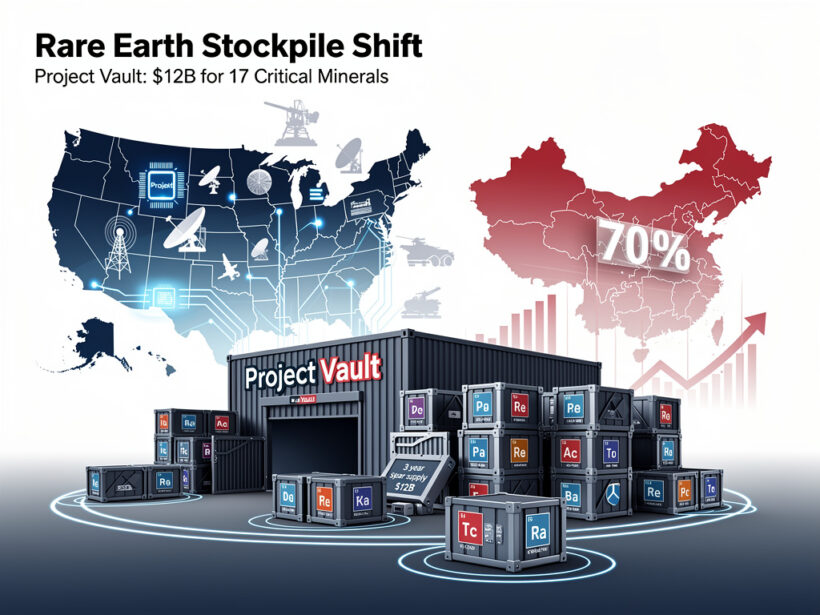
The project, announced during a press conference from the White House on Monday, is called Project Vault and it will be funded by a $10 billion loan from the U.S. Export-Import Bank and about $1.67 billion in private capital.
Trump’s plan seeks to procure and store rare-earth minerals that are critical to the automotive, defense, and tech industries. Minerals would be stored for use by U.S. manufacturers.
Some critical minerals that are of interest to tech companies and electric vehicle manufacturers include cobalt, lithium, titanium, silicon, nickel and graphite.
Rare earth minerals have been a focus of Trump’s during his second term. The White House said the United States was reliant on imports of minerals in 2024.
The president has made critical minerals a negotiation point with countries including Ukraine and Australia, and has expressed a desire to secure Greenland’s critical minerals. The U.S. is continuing to navigate trade waters with China.
Some companies that are expected to be involved in the Project Vault stockpile include General Motors, Stellantis, Boeing and Google.
Critical minerals are critical to supply chains for many modern products like electric vehicle batteries, semiconductors and smartphones.
Compiled from articles at UPI and CBS News on Feb. 2. Reprinted here for educational purposes only. May not be reproduced on other websites without permission.
Questions
NOTE TO STUDENTS: Before answering the questions, read the “Background” and watch the videos under “Resources.”
1. What is significant about President Trump’s announcement about the creation of the strategic critical minerals reserve?
2. Who is the strategic petroleum reserve – and the existing stockpile of critical minerals – to be used by?
3. What industries need rare earth minerals to make their products?
4. List some of the critical minerals used by tech companies and electric vehicle manufacturers.
5. Which companies are expected to be involved in the Project Vault stockpile?
6. Watch the videos under “Resources” below. What does John Jovanovic, president of Export-Import Bank, say about financing for the strategic critical minerals reserve and taxpayers?
7. The Strategic Petroleum Reserve is an emergency stockpile of petroleum maintained by the US Department of Energy. It is the largest publicly known emergency supply in the world; its underground tanks in Louisiana and Texas have capacity for 714 million barrels. The U.S. started the petroleum reserve in 1975 to protect against supply disruptions, like the 1973-74 oil embargo or natural disasters, by providing a backup supply to stabilize markets and meet national obligations.
What is your reaction to President Trump’s work to establish a critical minerals strategic reserve to counter China and ensure American businesses are never harmed by any market disruptions or shortage?
NOTE: On February 4, 2026, Secretary of State Marco Rubio will host the inaugural Critical Minerals Ministerial at the Department of State in Washington, D.C. The United States will welcome delegations from over 50 nations to advance collective efforts to strengthen and diversify critical minerals supply chains.
Background
Project Vault is a $12 billion initiative announced in February 2026 by the Trump administration designed to stockpile both rare earth elements and a broader range of critical minerals (such as gallium and cobalt).
- The project aims to reduce U.S. dependence on China for materials used in electronics, automobiles, and defense.
- Purpose: To create a strategic reserve for civilian and industrial use, ensuring a 60-day supply of minerals in case of emergency or supply chain disruptions.
- Scope: While focusing heavily on rare earth elements to counter Chinese dominance, the stockpile will include various critical minerals essential for manufacturing semiconductors, batteries, and other technologies.
- The initiative is designed to assist U.S. manufacturers by providing a buffer against price volatility.
- The project serves as a counterpart to the existing national defense stockpile, targeting the commercial sector to ensure supply chain security. (from Google AI Overview, Feb. 2)
FROM OCT. 2025: What is preventing us from mining and refining the plentiful rare earth deposits that have been discovered?
- Lengthy and complicated permitting processes for rare earth mining and refining in the U.S. are imposed at both the federal and state levels, with the federal process being particularly time-consuming and complex.
- Federal permits can take 7 to 10 years on average to obtain, with some projects facing timelines beyond a decade.
- While strict federal and state government regulations aimed to protect the environment and public health, they also made domestic extraction and processing prohibitively expensive compared to China, where Chinese Communist state-sponsored and lax [little to no] environmental enforcement allowed rapid scaling up of production.
Overall, the U.S. permitting system is widely regarded as one of the longest and most cumbersome globally, particularly at the federal level, significantly hindering rare earth mining and refining development in the country.
The combined federal-state regulatory regime, along with high litigation risk, creates an environment where projects are delayed extensively compared to other mining nations like Australia or Canada. [Recognizing the essential need for the U.S. and our allies not to be reliant on China for rare earths, the Trump administration is working] to reform and accelerate permitting.
Currently, during President Trump’s second term, he has focused heavily on expediting the permitting process for miners, etc. with Interior Secretary Doug Bergam and others, as well as establishing partnerships with countries including Australia and Greenland.
Read “Background” explanations from previous articles on Trump’s efforts to secure the U.S. supply of rare earth minerals:
- Rare earth processing plant in TX aimed at reducing reliance on China (April 2021)
- Trump orders increased production of critical minerals (March 2025)
- China suspends rare earth exports, kneecapping US (April 2025)
- US and Australia sign rare earths deal: why it matters (Oct 2025)
Read from March 2025
- Executive Order “Immediate Measures to Increase American Mineral Production” and
- Fact Sheet summarizing President Trump’s executive order on American mineral production
Resources
President Trump announces Project Vault to stockpile critical minerals for American businesses to break China’s grip:
John Jovanovic, president of Export-Import Bank of the United States: “What we have with Project Vault is marrying the capital solution with what we need, when we need it most…most crucially that it not be subsidized by American taxpayers.”
February 2, 2026 – Maria Bartiromo interviews Barbara Humpton, CEO of USA Rare Earth:
Daily “Answers” emails are provided for Daily News Articles, Tuesday’s World Events and Friday’s News Quiz.