redo Jump to...
print Print...
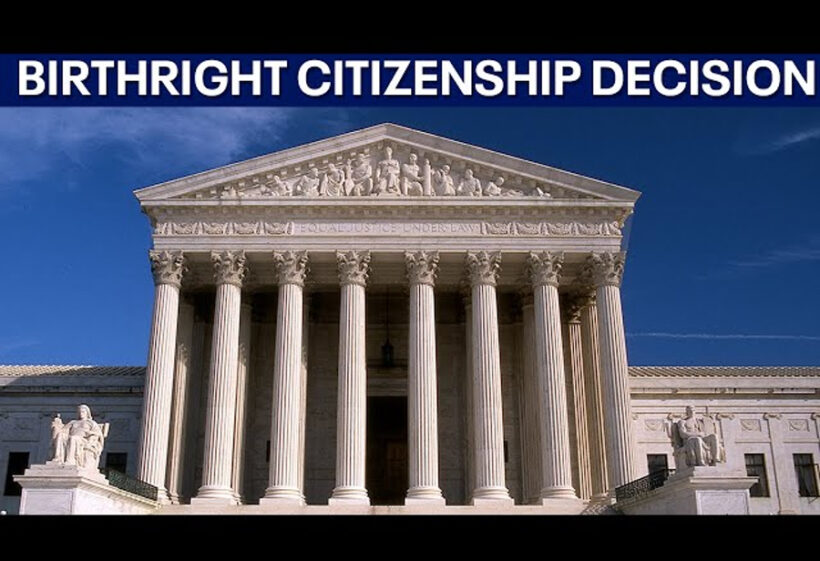
(by Katelynn Richardson, Daily Caller ) — The Supreme Court agreed on Friday to [hear a challenge to] President Donald Trump’s executive order [on] birthright citizenship.
Trump issued the executive order ending guaranteed citizenship for children of illegal aliens or [non-citizens] on temporary visas in January on his first day in office.
The Trump administration urged the justices to take up the case in September after lower courts held his order unconstitutional, [which blocked it from being implemented].
“The Clause [in the 14th Amendment] was adopted to confer citizenship on the newly freed slaves and their children, not on the children of aliens temporarily visiting the United States or of illegal aliens,” the administration’s petition states.
Trump’s birthright citizenship order came before the justices last term, though they were not asked to decide its constitutionality. Instead, the administration asked the justices to consider whether lower courts can issue injunctions that block orders like it nationwide.
The Supreme Court held in June that “universal (nationwide) injunctions” likely exceed the authority granted to federal courts.
Trump’s order restores the original meaning of the 14th Amendment’s Citizenship Clause, the administration argues, which only “extends to children who are ‘completely subject’ to the ‘political jurisdiction’ of the United States.”
“This Court’s earliest cases interpreting the Fourteenth Amendment explicitly rejected the notion that anyone born in United States territory, no matter the circumstances, is automatically a citizen so long as he is subject to U.S. law,” Solicitor General D. John Sauer wrote in the petition.
Opponents argue that the Supreme Court already answered this question in its 1898 Wong Kim Ark ruling, where it held that “the Fourteenth Amendment affirms the ancient and fundamental rule of citizenship by birth within the territory, in the allegiance and under the protection of the country, including all children here born of resident aliens.”
Sauer argued that the Wong Kim Ark ruling did not “decide the citizenship rights of children of illegal aliens and temporary visitors.”
The Supreme Court has not yet scheduled oral arguments but they will likely take place early next year [and be decided by the end of the 2025-26 term in June, 2026].
Published at Daily Caller on Dec. 5. Reprinted here for educational purposes only. May not be reproduced on other websites without permission.
Questions
NOTE TO STUDENTS: Before answering the questions, read the “Background” below and watch the videos under “Resources.”
1. What is the text of the “birthright citizenship” clause of the 14th Amendment?
2. What did President Trump’s Jan. 20 executive order on birthright citizenship do?
3. a) Instead of addressing birthright citizenship specifically, what issue did the Trump administration ask the justices to consider last term (which they heard in the Spring)?
b) How did the court rule on that in June?
4. In September, after Trump’s executive order on birthright citizenship was blocked by several lower courts across the country, the administration asked the Supreme Court to take up the case. What arguments did Solicitor General John Sauer make in the petition to the Supreme Court?
5. a) What argument do opponents use in the case?
b) How did Solicitor General Sauer refute this argument?
6. Each year, approximately 250,000 to 290,000 babies are born in the U.S. to undocumented immigrant parents – representing about 7-8% of all U.S. births – and automatically become U.S. citizens under the 14th Amendment’s principle of birthright citizenship, according to data from Pew Research Center and university studies.
Read President Trump’s Executive Order on Birthright Citizenship “Protecting The Meaning And Value Of American Citizenship” – Jan. 20, 2025
Do you think he makes a reasonable argument in “Protecting The Meaning And Value Of American Citizenship” for the intention of the birthright citizenship clause of the 14th Amendment? Explain your answer.
Background
Read President Trump’s Executive Order on Birthright Citizenship “Protecting The Meaning And Value Of American Citizenship” – Jan. 20, 2025
The executive order notes: “Nothing in this order shall be construed to affect the entitlement of other individuals, including children of lawful permanent residents, to obtain documentation of their United States citizenship.”
- The executive order states that it is to take effect after February 19, 2025. However, Democratic attorneys general from 22 states filed lawsuits on Jan 21, 2025 to the president’s Executive Order arguing the order violated the 14th Amendment and precedent.
- These states, plus D.C. and San Francisco, include California, New York, New Jersey, Massachusetts, Washington, Oregon, Colorado, Illinois, Minnesota, Maryland, Connecticut, Delaware, Hawaii, Maine, Michigan, Nevada, New Mexico, North Carolina, Rhode Island, Vermont, and Wisconsin,
- On March 28, the Iowa Attorney General filed an amicus brief and was joined by 23 Republican Attorneys general in defending Trump’s Executive Order
- The states that support the executive order (by joining the amicus brief led by Iowa’s Attorney General) are: Alabama, Arkansas, Florida, Idaho, Indiana, Iowa (led the brief), Kansas, Louisiana, Mississippi, Missouri, Montana, Nebraska, North Dakota, Ohio, Oklahoma, South Carolina, South Dakota, Texas, Utah, Wyoming.
- The order, signed January 20, 2025, is currently blocked from taking effect by lower court injunctions while awaiting a Supreme Court hearing.
PBS notes” “Birthright citizenship means anyone born in the U.S. is a citizen, regardless of their parents’ immigration status. People, for instance, in the United States on a tourist or other visa or in the country illegally can become the parents of a citizen if their child is born here.”
How many countries permit Birthright Citizenship?
- Most countries in the world do not offer birthright citizenship — only 30 out of the world’s 194 nations automatically grant citizenship to children born to illegal immigrant parents, according to the Center for Immigration Studies (CIS).
- No European country has birthright citizenship.
- Of the 30 countries that offer birthright citizenship, 29 are in North or South America.
- The U.S. and Canada are alone among developed nations worldwide that automatically grant citizenship to people born within their territorial jurisdiction.
(from “Where does the concept of birthright citizenship come from?“)
Resources
Read “Birthright Citizenship: An Overview” (pdf version)
What is Birthright Citizenship And Why Is President Trump Trying To End It?
Watch Attorney Stephen Miller’s explanation of birthright citizenship. Miller is White House Deputy Chief of Staff for Policy and U.S. Homeland Security Advisor:
Read a previous article from April “Supreme Court keeps hold on birthright citizenship – will hear arguments in May”
Read about birth tourism “Chinese flock to USA to give birth to U.S. citizens“
Daily “Answers” emails are provided for Daily News Articles, Tuesday’s World Events and Friday’s News Quiz.