redo Jump to...
print Print...
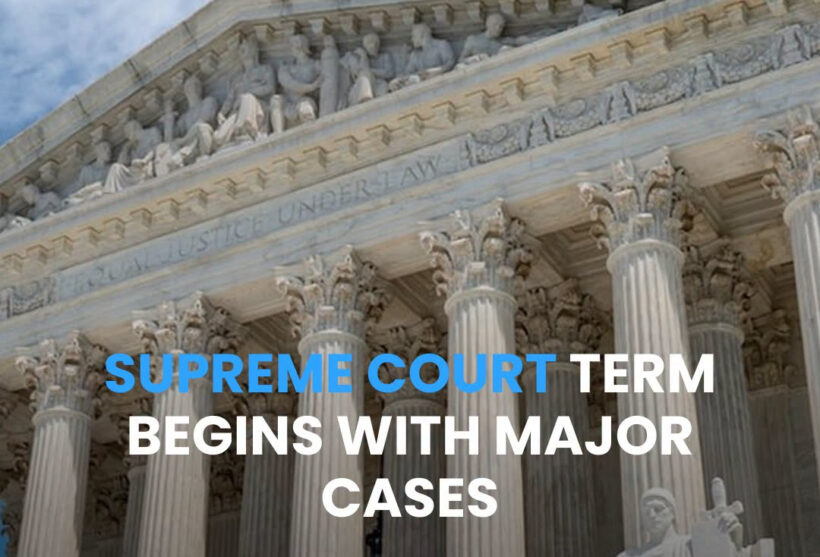
(UPI) – The U.S. Supreme Court reconvened Monday just before midterm elections and is set to decide several major cases, including one from Arizona on whether states are allowed to require proof of citizenship to register to vote, and whether states can remove non-citizens from voter rolls right before a federal election.
Republican National Committee vs. Mi Familia Vota deals with proof-of-citizenship requirements for voters and state authority to remove non-citizens from the voter rolls.
The high court is asked to rule on two questions.
First, does the National Voter Registration Act prohibit the state of Arizona from requiring applicants for voter registration to show proof-of-citizenship?
Second, does the National Voter Registration Act prohibit Arizona from canceling the registrations of voters who are not U.S. citizens within 90 days of a federal election?
Proof-of-citizenship requirements for voting are a key policy President Trump has pursued during his second term, to fulfill a promise he made to constituents.
Arizona’s legislature [implemented laws requiring] proof-of-citizenship before Trump’s return to office, approving new policies for voting in 2022. Those policies were immediately challenged by Mi Familia Vota and other advocacy groups, who argued that the National Voter Registration Act prohibits such measures from taking hold.
The initial lawsuit also referenced a 2018 consent decree [a decree made by a judge with the consent of all parties] in the state that settled a challenge to the state’s voter registration rules. The settlement, between [the left-leaning] Campaign Legal Center and Arizona’s [Republican] secretary of state and Maricopa County, recognized that undue burdens were being placed on voters when registering to vote.
Under the settlement, local election officials are required to accept voter registrations without proof-of-citizenship.
In an amicus brief, the Republican State Leadership Committee noted “The key question presented in the case is whether the National Voter Registration Act or a federal consent decree entered by a single state executive official can prevent a state from requiring proof of U.S. citizenship in its voter registration process. [We] argue the answer is no.”
Lower courts have sided with the plaintiffs in this case and the Republican National Committee is appealing to the Supreme Court, seeking to put proof-of-citizenship requirements in place.
The case is set to be argued on Dec. 8.
Why this is being argued:
- The “Quiet Period” Conflict: The National Voter Registration Act (NVRA) mandates a 90-day “quiet period” before a federal election, which restricts states from executing large, systematic database non-citizen voter roll removal programs to minimize the risk of mistakenly disenfranchising eligible citizens.
- Arizona’s Law (H.B. 2243): Enacted in 2022, this law directs local county recorders to continuously cross-reference voter registration rolls against state and federal databases to remove noncitizens—requiring these checks to continue even during the 90-day window.
- The Legal Stance: The Ninth Circuit Court of Appeals previously ruled that the NVRA’s 90-day rule blocks Arizona’s voter list maintenance program. The RNC is challenging that interpretation, arguing that the 90-day quiet period only applies to validly registered voters and should not shield individuals who were never legally eligible to vote from being removed.
Read an explanation of “Republican National Committee v. Mi Familia Vota” at ballotpedia.
Compiled from an article published at UPI on Oct. 5 by Joe Fisher with Ballotpedia and an Oct. 5 Google AI Overview.
Questions
1. In Republican National Committee vs. Mi Familia Vota, what two questions has the Supreme Court agreed to decide?
2. A consent decree is a decree made by a judge with the consent of all parties. How did a 2018 consent decree settle a challenge to Arizona’s voter registration rules?
3. What is the National Voter Registration Act’s 90 day “Quiet Period”?
4. How is the RNC (Republican National Committee) challenging the Ninth Court’s ruling?
5. Mi Familia Vota is a left-leaning organization that opposes proof-of-citizenship requirements to register to vote.
-A Pew Research Center survey reported that 82% of Hispanic Americans support requiring voters to show a photo identification at their polling place.
-Advocacy reports note that for many first-generation or naturalized Hispanic immigrants, presenting formal identification or proof of eligibility is often seen as routine. This is largely because strict voter identification or national registry systems are a common and well-established practice across most countries of origin in Latin America.
-Mi Familia Vota strongly opposes voter ID laws and proof-of-citizenship requirements, claiming they are forms of voter suppression. The organization argues that these policies do not protect election security but are instead “schemes” intended to disenfranchise eligible voters, particularly within Latino, immigrant, and low-income communities.
What do you think of Mi Familia Vota attempts to block Arizona’s 2022 state law requiring documentary proof of citizenship? Explain your answer.
6. a) When will the Supreme Court hear this case?
b) Why do you think the justices did not make this a priority?
OPTIONAL: The Supreme Court airs audio and posts transcripts of Oral Arguments. Follow these cases when they are held at:
https://www.supremecourt.gov/oral_arguments/live.aspx
Background
On the Supreme Court:
- Approximately 7,500 cases are sent to the Supreme Court each year. Out of these, only 80 to 100 are actually heard by the Supreme Court. To pick which cases they will hear, the Justices get together to decide if a case is worthy of being brought before the Court. In other words, does the case really involve Constitutional or federal law? Secondly, a Supreme Court ruling can affect the outcome of hundreds or even thousands of cases in lower courts around the country. Therefore, the Court tries to use this enormous power only when a case presents a pressing constitutional issue.
- The Supreme Court convenes, or meets, the first Monday in October. It stays in session usually until late June of the next year. When they are not hearing cases, the Justices do legal research and write opinions. On Fridays, they meet in private (in “conference”) to discuss cases they’ve heard and to vote on them. …
- Most cases do not start in the Supreme Court. Usually cases are first brought in front of lower (state or federal) courts. Each disputing party is made up of a petitioner and a respondent.
- Once the lower court makes a decision, if the losing party does not think that justice was served, he or she may appeal the case, or bring it to a higher court.
- In the state court system, these higher courts are called appellate courts.
- In the federal court system, the lower courts are called U.S. District Courts and the higher courts are called U.S. Courts of Appeals.
- If the higher court’s ruling disagrees with the lower court’s ruling, the original decision is overturned. If the higher court’s ruling agrees with the lower court’s decision, then the losing party may ask that the case be taken to the Supreme Court. But…only cases involving federal or Constitutional law are brought to the highest court in the land.
EXPLANATION OF PROCEDURE FOR ORAL ARGUMENTS IN THE SUPREME COURT:
- A case selected for argument usually involves interpretations of the U. S. Constitution or federal law. At least four Justices have selected the case as being of such importance that the Supreme Court must resolve the legal issues.
- An attorney for each side of a case will have an opportunity to make a presentation to the Court and answer questions posed by the Justices. Prior to the argument each side has submitted a legal brief – a written legal argument outlining each party’s points of law. The Justices have read these briefs prior to argument and are thoroughly familiar with the case, its facts, and the legal positions that each party is advocating.
- Beginning the first Monday in October, the Court generally hears two one-hour arguments a day, at 10 a.m. and 11 a.m., with occasional afternoon sessions scheduled as necessary. Arguments are held on Mondays, Tuesdays, and Wednesdays in two-week intervals through late April (with longer breaks during December and February). The argument calendars are posted on the Court’s Website under the “Oral Arguments” link. In the recesses between argument sessions, the Justices are busy writing opinions, deciding which cases to hear in the future, and reading the briefs for the next argument session. They grant review in approximately 100 of the more than 10,000 petitions filed with the Court each term. No one knows exactly when a decision will be handed down by the Court in an argued case, nor is there a set time period in which the Justices must reach a decision. However, all cases argued during a term of Court are decided before the summer recess begins, usually by the end of June.
- During an argument week, the Justices meet in a private conference, closed even to staff, to discuss the cases and to take a preliminary vote on each case. If the Chief Justice is in the majority on a case decision, he decides who will write the opinion. He may decide to write it himself or he may assign that duty to any other Justice in the majority. If the Chief Justice is in the minority, the Justice in the majority who has the most seniority assumes the assignment duty. (from supremecourt.gov)
On the Role of Judges:
Judges are like umpires in baseball or referees in football or basketball. Their role is to see that the rules of court procedures are followed by both sides. Like the ump, they call ‘em as they see ‘em, according to the facts and law-without regard to which side is popular (no home field advantage), without regard to who is “favored,” without regard for what the spectators want, and without regard to whether the judge agrees with the law. (from the American Bar Asociation)
- “The role of a judge is to be a neutral interpreter of already established law, not legislator of new law or social policy. A judge can have his or her own opinions, even strong ones, and still read the law neutrally. Fundamentally, judges are expected to not bring their personal politics and philosophies to the bench. Judges are expected to read the law in its clear intent and apply it without regard to result. Changing the law should be left to the people and their legislators.”
Sean Rushton, Committee for Justice Executive Director, from the WashingtonPost.- “One of the big confusions in the…Senate fight over the confirmation of judicial nominees is that this is an issue about ‘liberal’ judges versus ‘conservative’ judges. The vastly more important issue is whether people who go into court should expect their cases to be decided on the basis of the law or on the basis of the particular judge’s own philosophy…Liberals have rooted for judicial activism because this activism has favored liberal causes and liberal views on such issues as abortion, the death penalty, gay marriage, and racial quotas. But activism can be used by any judge for any purpose.”
Thomas Sowell, Hoover Institution
NOTE: …It is crucial…to have a president who understands the judiciary’s proper role. As Ronald Reagan once noted, “[The Founders] knew that the courts, like the Constitution itself, must not be liberal or conservative.” For Reagan and for the Founders, judges were to be selected based on their ability to put political preferences aside and interpret the Constitution and laws based on their original meaning. Rather than scrutinizing judicial nominees based on their perceived political leanings, [every] president should appoint judges who apply the law regardless of their own policy preferences. (from “Misunderstanding the Role of Judges” by Deborah O’Malley)
Resources
Read brief bios on the current Supreme Court justices at: supremecourt.gov.
The court convened this year on October 5, and hears oral arguments Mon., Tues., Wed. throughout the year.
For links to the cases the Supreme Court will hear in October 2026, see the calendar page (and go here for November cases). Read RNC vs. Mi Familia Vota, case 25-1017 here.
Daily “Answers” emails are provided for News Stories, Tuesday’s World Events and Friday’s News Quiz.