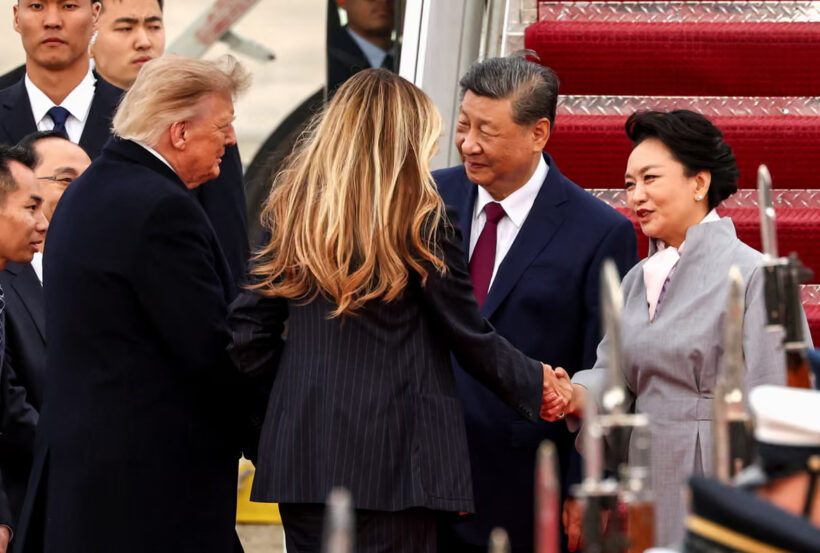
Chinese President Xi Jinping and his wife Peng Liyuan arrived at Joint Base Andrews, Maryland on September 23, 2026 and were greeted by President Trump and First Lady Melania Trump. (Photo: Kevin Lamarque/Reuters)
redo Jump to...
print Print...
(by Steven Nelson, NY Post) WASHINGTON — President Trump personally welcomed Chinese President Xi Jinping to the US on Wednesday evening — as the nations kicked off a three-day state visit by announcing a trade truce lasting through Jan. 10.
Trump, joined by First Lady Melania Trump, made the unusual decision to greet Xi at Joint Base Andrews — a gesture not made by Xi when Trump visited Beijing in May. [Xi did, however, invite the president to Beijing’s Zhongnanhai Garden – home to the Communist Party’s headquarters. For foreign dignitaries, invitations here are often viewed as a sign of closeness and recognition].
The last time an American president greeted a world leader at JBA* (Joint Base Andrews) was in 1962 when John F. Kennedy met British Prime Minister Harold Macmillan. (*JBA is a major U.S. military installation and the base for Air Force One.)
Trump stood at the bottom of the steps to Xi’s plane and shook his hand before escorting him down a red carpet — with a B-1 Lancer bomber making a flyover as the American national anthem played.
Six F-16s and six F-22s were lined up on the tarmac, showcasing US military might.
Trump told reporters as he returned to the White House that it was “a great greeting, and I think they appreciate it — tremendous people.”
Treasury Secretary Scott Bessent, meanwhile, appeared on Fox News to announce that the US and China agreed not to escalate tariffs until at least 2027.
“We will extend what we call the ‘Busan Agreement,’ the economic detente between the two countries that was scheduled to end on Nov. 10 — that is going to be extended until Jan. 10,” Bessent said.
“There are some deliverables that have not been perfect on the Chinese side, so we also want to see, now that we’ve sat down and told them our expectations.”
Xi’s visit is expected to touch on a wide range of tensions in the US-China relationship, including tariffs, fentanyl exports, artificial intelligence and Beijing’s role in conflicts ranging from Iran to Ukraine.
Trump has repeatedly said he believes a strong personal relationship between the leaders can notch benefits for the American people, though it’s unclear what concrete agreements may come.
[As is usual for official state visits], Xi will be treated to a state dinner at the White House on Thursday… . The relationship between Trump and Xi has had ups and downs, featuring warm in-person greetings but souring during the COVID-19 pandemic in 2020 and during last year’s US-China trade war.Trump, seeking to force a new trade deal that rebalances the US trade deficit and to punish China’s export of illicit fentanyl, ramped up tariffs on China last year, and Xi retaliated in kind.
The trade clash saw US tariffs on Chinese goods near 150% — before a cooling off following a meeting last October meeting between Trump and Xi in South Korea, where Xi agreed to do more to quash fentanyl exports that killed about 488,000 Americans over the past decade, peaking in 2022 and 2023.
China threatened during the tit-for-tat ramp-up to impose restrictions on rare earth materials, and the US stopped advanced chip sales that Beijing could use to give it a key boost in the artificial intelligence race.
A senior US official told reporters ahead of Xi’s visit that the Trump administration is dissatisfied with Xi’s actions to reduce fentanyl smuggling.
“It does not appear that China has elevated this issue,” the official said. “China is the overwhelming, predominant supplier of precursor chemicals to the cartels in Mexico and remains so. And they have done a number of anecdotal things, including a few arrests recently, but we’d like to see much more systemic change.”
Fentanyl deaths — which Trump cited in his initial wave of tariffs last year — have dipped in the US, but remain elevated and factors such as the availability of test strips and overdose antidotes and improved border detection may have eased the impact. Still, about 35,000 Americans died in the past year.
Trump’s personal warmth with Xi has in the past been coupled with shows of American strength — with the president often recounting a 2017 visit by Xi to Mar-a-Lago. The men were enjoying dessert as Trump revealed that the US had just conducted airstrikes on Syria.
“We had the most beautiful piece of chocolate cake that you’ve ever seen, and President Xi was enjoying it,” Trump remembered afterward. “He was eating his cake. And he was silent.”
Published at NYPost on Sept. 23. Reprinted here for educational purposes only. May not be reproduced on other websites without permission.
Questions
1. The first paragraph of a news article should answer the questions who, what, where and when. (In this article, the 1st and 2nd paragraphs.) List the who, what, where and when of this news item. (NOTE: The remainder of a news article provides details on the why and/or how.)
2. Who was the last president to greet a world leader for a state visit at Joint Base Andrews?
3. What announcement did U.S. Treasury Secretary Scott Bessent make this week regarding China?
4. What topics are President Trump and Xi Jin Ping expected to discuss during Xi’s visit this week?
5. a) What did President Xi agreed to do during a meeting with President Trump in South Korea in October?
b) Did Xi follow through on his promise? Explain.
c) Why do you think Xi Jin Ping is viewed as responsible for China’s part in the fentanyl crisis in the U.S.?
6. President Trump is being criticized by some for his decision to personally greet President Xi at JBA, as well as speaking in a complimentary manner about him.
-Communist China and its leader for life Xi Jin Ping is an adversary of the U.S.
-President Trump knows the threat China poses to America. He has said we need to beat China in its quest for AI dominance and global supremacy. He has taken many steps in Latin America (Panama Canal, Shield of the Americas, Chile’s fiber-optic cable connection with China, China’s deep water port in Peru, China’s control over Venezuela…) to stop China.
Regarding Trump’s strategy with Xi, Google AI notes:
- According to statements from the First Lady on September 23, President Trump wanted to personally greet Xi on American soil to show maximum respect and foster a positive bilateral dynamic.
- The president has frequently praised Xi publicly, stating in early September 2026 that Xi is a “great gentleman” and emphasizing that they “get along great” despite intense commercial rivalry.
- As part of Trump’s “Dealmaker” strategy, political analysts suggest Trump’s warm welcome is intended to soften Beijing’s stance ahead of high-stakes discussions on trade tariffs and manufacturing dominance.
- By managing the relationship warmly, Trump aims to establish stable bilateral dialogue regarding artificial intelligence and technological competition.
a) Do you think Trump’s strategy will ultimately be successful in making a deal with Communist China on trade, AI, etc.?
b) Ask a parent the same question.
Background
Xi’s visit will take place over three days:
- Wednesday (Sept. 23) — Xi and his wife Peng Liyuan arrived at Joint Base Andrews in Maryland where President and Mrs. Trump greeted them
- Thursday (Sept. 24) — Trump and First Lady Melania Trump host Xi and Peng at the White House. An arrival ceremony will be followed by a military inspection in the White House’s Rose Garden; Bilateral meeting between Trump and Xi; State dinner attended by US and Chinese officials as well as tech leaders. Trump and Xi will both speak
- Friday (Sept. 25) — Xi and Peng attend private tea at the White House with the Trumps; The couples tour the National Archives, where the US’s founding documents, like the Declaration of Independence and Constitution, are preserved; Xi and Peng will then depart from Joint Base Andrews
Diplomatic arrival protocols for foreign heads of state or government visiting the U.S. follow established procedures managed primarily by the U.S. Department of State’s Office of the Chief of Protocol, in coordination with the military, U.S. Secret Service, and other agencies.
Foreign leaders usually land at Joint Base Andrews in Maryland for visits to the Washington, D.C., area.
Who greets the arriving leader: Under normal protocol, the greeters include the U.S. Chief of Protocol (or a Protocol Officer), senior military leaders (such as the base commander), the U.S. ambassador to the visiting country, the visiting country’s ambassador to the United States, and occasionally a Cabinet official or the Vice President. A State Department Protocol Officer is specifically present for arrivals of current chiefs of state or heads of government.
Ceremonial elements on the tarmac:
- A red carpet is unrolled from the aircraft stairs.
- A military honor cordon (21 personnel for a head of state; 19 for a head of government) lines the carpet, drawn roughly equally from the Army, Navy, Air Force, Marine Corps, and Coast Guard ceremonial units.
- Color teams present the U.S. flag and the visitor’s national flag.
- The U.S. Air Force Band plays an arrival fanfare, followed by the national anthems of both countries.
- Flower presenters: It is customary for one or more American schoolchildren (often a girl or two children) to present a bouquet of flowers to the visiting leader and/or their spouse as a gesture of welcome. This is a longstanding soft-power and hospitality element of the protocol.
- Other possible elements include a military band performance and, on elevated occasions, additional displays such as a flyover.
- The visitor is then escorted to their vehicle for travel into Washington (often to Blair House or another official residence).
Formal White House Arrival Ceremony
The full official welcoming ceremony with maximum military honors usually occurs the following day on the South Lawn of the White House, hosted by the U.S. President. This typically includes:
- A 21-gun salute.
- Review of troops/honor guard.
- Playing of national anthems.
- Speeches or remarks.
- Larger formations of military personnel.
Key Protocol Notes and Variations
- Personal greeting by the U.S. President at the airport is extremely rare and represents a significant elevation of protocol. Standard practice is that the President waits at the White House.
- Reciprocity, the nature of the bilateral relationship, and political signaling often influence how elaborately the arrival is staged (e.g., length of the red carpet, presence of the First Lady, military displays, or the President’s personal attendance).
- Cultural considerations apply to details such as flower colors/types (yellow bouquets are common and generally positive in many contexts, though symbolism can vary by culture).
- In the specific case of Chinese President Xi Jinping’s arrival at Joint Base Andrews on Wed, September 23, 2026, the protocol was elevated: President Trump and First Lady Melania Trump personally greeted Xi and Peng Liyuan on the tarmac, accompanied by the standard military honor elements and two American children presenting yellow flower bouquets.
The formal White House South Lawn ceremony is scheduled for the following day (Sept. 24).
These procedures emphasize dignity, reciprocity, security, and hospitality while allowing flexibility for the specific diplomatic relationship.
(from a Sept. 23 Grok query for U.S. diplomatic protocols)
Resources
From BBC, September 23, 2026:
From WTOP:
During his first term in office,
- President Trump visited Beijing during his Asia trip, and
- Xi Jin Ping met with President Trump for a summit at Mar-a-Lago, Trump’s “Southern White House.”
During his 2nd term, President Trump traveled to Beijing for a state visit in May 2026:
Daily “Answers” emails are provided for News Stories, Tuesday’s World Events and Friday’s News Quiz.