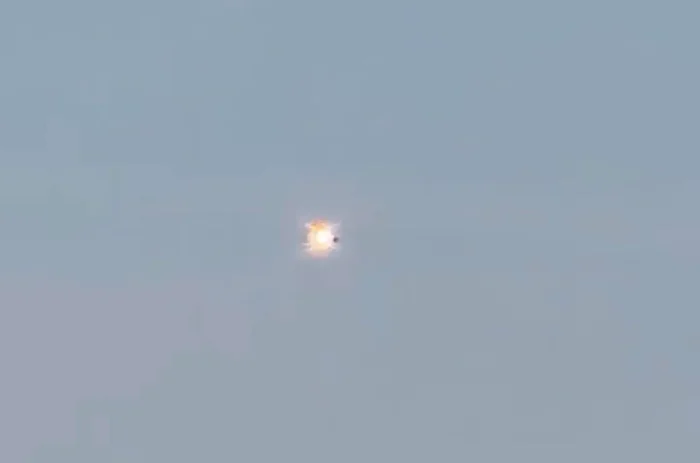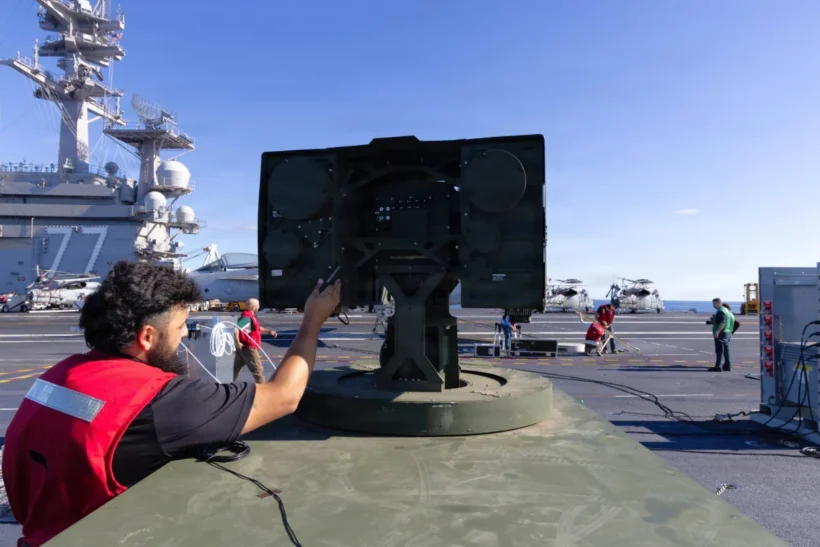
A member of the joint U.S. Navy, U.S. Army, and AeroVironment, Inc. team makes adjustments to the containerized LOCUST Laser Weapon System (LWS) on the flight deck of the aircraft carrier, USS George H.W. Bush, for a live-fire test. During the live-fire event, LOCUST LWS effectively detected, tracked, engaged, and neutralized multiple unmanned aerial vehicles marking a milestone toward fielding operational directed energy capabilities. (Photo: Brian Brooks, U.S. Navy)
redo Jump to...
print Print...
(by Dylan Malyasov, Defence Blog) – The U.S. Navy conducted a live-fire test of AeroVironment’s LOCUST Laser Weapon System aboard the aircraft carrier USS George H.W. Bush (CVN 77 – Carrier Vessel Nuclear).
Military technology writer Jared Keller, author of the Los Angeles-based Laser Wars newsletter, was among the first to flag the test after official imagery surfaced publicly. Photos published to DVIDSHub show a containerized LOCUST Laser Weapon System set up on the flight deck of the Nimitz-class aircraft carrier USS George H.W. Bush for a live-fire test conducted on October 5, 2025, in the Atlantic Ocean. …
During the live-fire event, LOCUST effectively detected, tracked, engaged, and neutralized multiple unmanned aerial vehicles, marking a milestone toward fielding operational directed energy capabilities, the Navy stated in the caption accompanying the official imagery. The Navy released the photos in April 2026, coinciding with the opening of the annual Sea-Air-Space exposition — the service’s premier naval industry conference — drawing renewed attention to its directed-energy ambitions.
The LOCUST platform detects and tracks drones using multi-band radio frequency and provides 360-degree scanning. Using its high-powered optical laser, the system can shoot and burn through a target mid-air, disabling enemy attack or reconnaissance assets. The system can also be fitted with optional cameras to expand the field of view. LOCUST’s power rating is generally understood to be in the 20-kilowatt range, fully in line with a system intended to defeat smaller drones. LOCUST has also been demonstrated with a 26-kilowatt power rating, though how much further it could be scaled within the existing form factor remains unclear.
What makes the USS George H.W. Bush test particularly notable is the platform on which it was carried out. Aircraft carriers are the Navy’s most valuable surface assets — floating air bases whose flight decks are crowded, high-tempo operational environments. Demonstrating that a containerized, plug-and-play laser weapon can be set up and fired from that environment without disrupting flight operations represents a meaningful step toward practical fleet integration. The containerized form factor also allows the system to be rapidly deployed to various ship classes without requiring permanent structural modifications.
The LOCUST system combines precision optical and laser hardware with advanced software, algorithms, and processing to enable and enhance the directed energy kill chain, which includes tracking, identifying, and engaging a wide variety of targets with its hard-kill high-energy laser. Unlike conventional munitions, laser systems impose a near-zero cost-per-shot, making them particularly attractive for countering drone swarms — a threat that has emerged as one of the defining tactical challenges of modern warfare, from the battlefields of Ukraine to Red Sea maritime corridors.
Published at Defence Blog on April 21, 2026. Reprinted here for educational purposes only. May not be reproduced on other websites without permission.
Questions
1. The first paragraph of a news article should answer the questions who, what, where and when. (In this article, the 1st and 2nd paragraphs). List the who, what, where and when of this news story. (NOTE: The remainder of a news article provides details on the why and/or how.)
2. When did the Navy release the photos of the LOCUST Laser Weapon System set up on the aircraft carrier?
3. What can the LOCUST do?
4. How does the LOCUST work?
5. Explain why the location of the test (on the USS George HW Bush) is so remarkable.
Background
- AeroVironment, the Arlington, Virginia-based defense contractor best known for its family of small tactical unmanned systems, has been developing LOCUST as part of the broader U.S. military push to field affordable, scalable counter-UAS capabilities.
- The Army Multi-Purpose High Energy Laser initiative, contracted with AV’s subsidiary BlueHalo in 2023, represents an ongoing prototyping effort to protect small ground units against aerial drones. As of December 2025, the U.S. Army was known to have taken delivery of palletized LOCUST systems as well as ones mounted on Joint Light Tactical Vehicles and Infantry Squad Vehicles, with the Army having at least deployed palletized versions overseas operationally in the past.
- The Navy’s test aboard CVN 77 extends that cross-service momentum into the maritime domain, where the drone threat has taken on particular urgency. Houthi forces in Yemen have employed drone and missile salvos against commercial and naval vessels in the Red Sea since late 2023, forcing the Navy to expend costly interceptor missiles against cheap unmanned platforms — an asymmetric exchange that laser weapons are designed to reverse.
- A directed-energy system capable of neutralizing drones for the price of a few dollars in electricity, rather than hundreds of thousands of dollars per interceptor missile, fundamentally shifts that cost calculus.
- The timing of the photo release — timed to Sea-Air-Space 2026 — signals that the Navy is prepared to show progress on directed energy even as senior officials acknowledge the road ahead is long.
- Acting Chief of Naval Operations Adm. James Kilby recently told reporters at the Sea-Air-Space expo that he is not ready to commit to buying directed energy systems at scale until there is a reliably consistent output in an action, adding there is no push to immediately deploy lasers but that he wants them to develop to the right level. That measured posture makes the CVN 77 test all the more significant — it is the kind of operationally relevant data point the Navy needs before committing to fleet-wide integration. (from the Defence Blog article above)
Daily “Answers” emails are provided for News Stories, Tuesday’s World Events and Friday’s News Quiz.