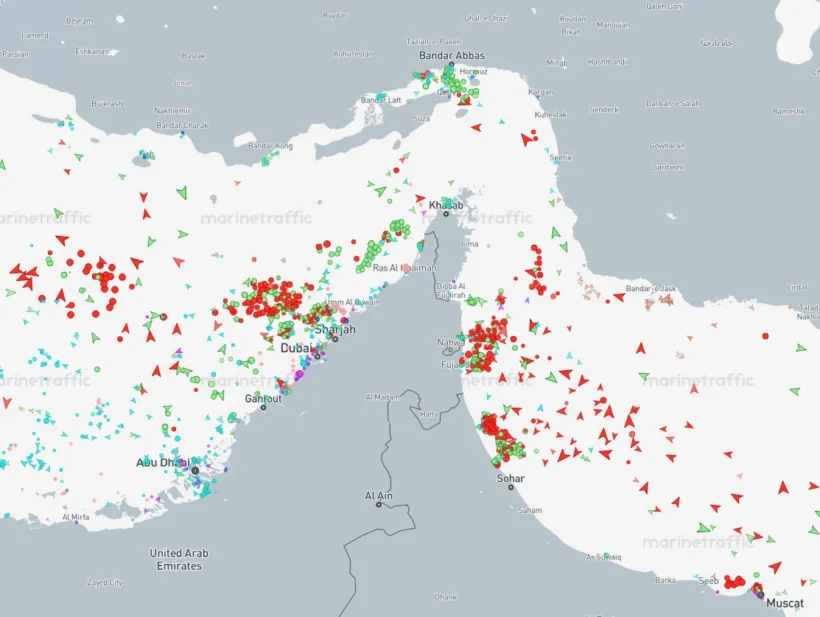
Commercial traffic in the Strait of Hormuz on April 14, 2026. Marine Traffic image
redo Jump to...
print Print...
(by Brad Lendon, CNN senior global military affairs reporter) — The United States’ blockade of Iranian ports has been “fully implemented” and put a halt to most of Tehran’s economic activity in just a day and a half, the head of US Central Command said Wednesday.
“An estimated 90% of Iran’s economy is fueled by international trade by sea [primarily by oil exports, Iran’s main source of revenue]. In less than 36 hours since the blockade was implemented, US forces have completely halted all economic trade going into and out of Iran by sea,” CENTCOM Commander Adm. Brad Cooper said in a statement on social media.
US Central Command (CENTCOM) said earlier no vessels have breached the blockade since its implementation.
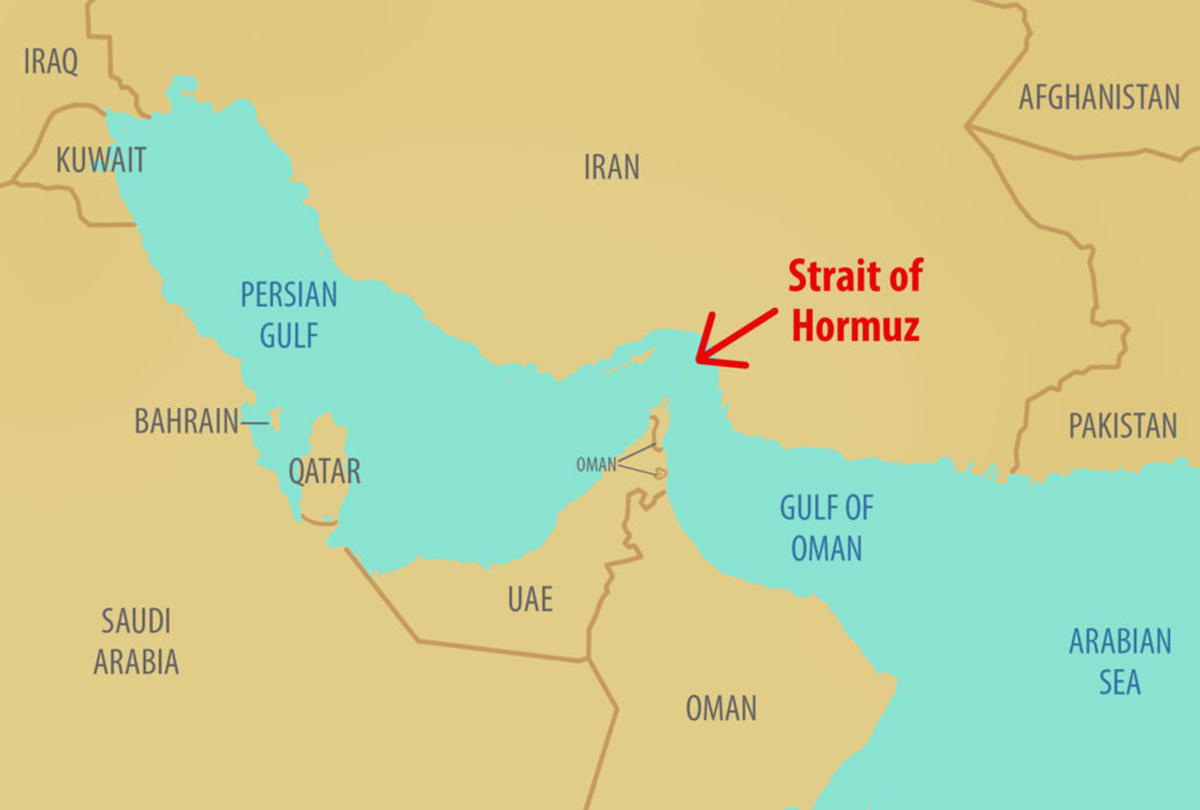
At the same time, reports are emerging of some commercial traffic transiting the Strait of Hormuz, the strategic chokepoint between Iran and Oman through which 20% of the world’s oil exports and 80-90% of Iran’s oil exports travel.
But that commercial traffic doesn’t automatically negate Cooper’s claim.
Two key points:
- As stated by CENTCOM, the blockade covers all Iranian ports, both inside and outside of the Strait of Hormuz, but not the strait itself. Traffic not related to Iran may cross. Blockading an international waterway is illegal under maritime law.
- In enforcing the blockade, US forces can interdict ships carrying Iran-linked cargo tens of thousands of miles away. A commercial ship can be targeted in international waters long after it leaves the strait.
Analysts say modern technology allows blockade enforcement at great distances.
“(The US doesn’t) have to put ships in the Persian Gulf to blockade Iran,” said Carl Schuster, a former US Navy captain.
He noted the 12+ ships CENTCOM says are on blockade duty. Most, if not all, of them are outside the strait. They can carry sophisticated tracking and reconnaissance gear linked to air and space systems.
And at least in the early days of this blockade, oil tankers aren’t going to get far. A fully laden tanker may travel at less than 20 mph. That’s not much faster than the speed of an average bicycle rider.
The US Navy also has the size and scope to pursue any ship getting outside of the Persian Gulf for weeks, anywhere in the world.
“The US blockade on Iranian ports does not have a defined geographic boundary, and the United States can interdict vessels almost anywhere in international waters until they arrive at their final port,” the Institute for the Study of War (ISW) said Tuesday.
Earlier this year, as Washington put pressure on the regime of [narco-terrorist dictator] Nicolás Maduro in Venezuela, US forces seized a Venezuelan tanker in the Indian Ocean, thousands of miles from its originating port.
“Be careful not to interpret (blockade) too literally as a physical interdiction of the strait itself,” said Bjorn Hojgaard, CEO of ship management company Anglo-Eastern.
The ISW also noted the US did grant exceptions from its blockade to humanitarian shipments, and allowed an undetermined “grace period” for neutral ships in Iranian ports to leave.
Six ships that may have been attempting to beat the blockade were stopped, and turned around at the direction of US forces, according to a CENTCOM statement Tuesday.
Meanwhile, CENTCOM said it was employing more than a dozen warships, over 100 aircraft and more than 10,000 personnel in blockade enforcement.
Schuster, the former Navy captain, gave a breakdown of roles for the vessels CENTCOM said were part of the blockade.
- Aircraft carrier: Carries surveillance aircraft and fighter jets for combat air patrols. Also houses a significant command, control, communication and intelligence center.
- Amphibious assault ship: Also conveys surveillance and attack aircraft, another command, control, communication and intelligence center, and hundreds of Marines who can board commercial ships.
- Amphibious transport dock: Will carry more Marines, helicopters, and Osprey transports.
- Dock landing ship: Comes with heavy-lift helicopters and more Marines.
- Destroyers: “They have the sensors, speed and weaponry to detect, intercept and if need be, board, seize and take the offending ship elsewhere,” Schuster said.
- Littoral combat ship: These can conduct mine countermeasures and tracking.
Schuster said the makeup of that force, much of it operating well back from the Strait of Hormuz and the Iranian coast, leaves Tehran with limited options to respond.
The small attack boats of the Islamic Revolutionary Guard Corps (IRGC) navy are designed for operating in the close confines of the strait and the Persian Gulf, not the open waters of the Arabian Sea and beyond.
Iran likely retains some ballistic and anti-ship cruise missiles despite weeks of US aerial bombardment of the country. But even when they had those in larger numbers, none are known to have hit any US warships operating in the Arabian Sea.
US President Donald Trump said last month that Iran had fired 101 missiles at the aircraft carrier USS Abraham Lincoln, but all of them were taken out.
Published at CNN on April 15. Reprinted here for educational purposes only. May not be reproduced on other websites without permission.
Questions
1. What is CENTCOM?
2. How successful was the US blockade of Iran’s ports in just the first 36 hours?
3. What percent of Iran’s economy comes from Iranian oil exports by sea?
4. CNN notes: “As stated by CENTCOM, the blockade covers all Iranian ports, both inside and outside of the Strait of Hormuz, but not the strait itself. Traffic not related to Iran may cross. Blockading an international waterway is illegal under maritime law.”
What percent of Iranian sea trade has the US halted with its blockade of Iranian ports?
5. Is non-Iranian commercial traffic able to transit the Strait of Hormuz?
6. Explain why the U.S. doesn’t have to station our ships directly in the Strait of Hormuz to prevent Iran-linked cargo ships from getting to their destinations.
7. During a ceasefire, the U.S. and Iran negotiated peace talks in Pakistan. After the Iranian regime refused to end its quest for nuclear weapons as part of a deal end the war, the U.S. imposed a blockade on Iranian ports – using economic means to force Iran to come to an agreement. Iran has been holding the world economy hostage with its control of the Hormuz Strait.
Reuters reports: The Strait of Hormuz is recognized under international law as a free, international waterway allowing transit passage. While historically open, it is currently a flashpoint with Iran attempting to impose tolls, create a “tollbooth” system, or restrict traffic, which the U.S. and other nations reject, aiming to keep it open to global commerce.
The dispute has transformed the area from a free, international transit route into a restricted channel with significant security risks for international shipping.
What do you think of President Trump’s strategy to blockade Iranian ports to end the regime’s unlawful control over the Strait, through which 20% of the world’s energy supplies are transported?
Background
Suez vs. Hormuz: Why do you pay for one — and fight over the other?
Iran’s recent threats to impose “fees” on vessels transiting the Strait of Hormuz raise an obvious question: if ships pay substantial sums to pass through the Suez Canal, why is it considered extortion in Hormuz?
The answer lies in one fundamental distinction – both geographic and legal.
- The Suez Canal is a man-made waterway. Egypt constructed it, maintains it, and operates it within its full sovereign territory. Legally, it functions as a toll road. Ships pay for the use of infrastructure built and maintained by a sovereign state. This arrangement is legitimate, regulated, and grounded in international agreements such as the Constantinople Convention of 1888.
- The Strait of Hormuz, by contrast, is a natural maritime passage. Under the United Nations Convention on the Law of the Sea (UNCLOS), vessels enjoy the right of continuous transit passage through international straits. This is a fundamental principle of international law that even bordering states — Iran and Oman — cannot suspend, restrict, or condition upon payment. They may enforce safety and environmental regulations, but they do not “own” the passage.
Therefore, when Iran attempts to levy fees or threatens to close the strait, it is not exercising a legitimate sovereign right — it is attempting to monetize coercion. It transforms a protected international right of navigation into a geopolitical pressure tool. In practical terms, any such demand for payment amounts to state-backed extortion. (Doron Peskin, YNet)
Resources
April 15, 2026 – Audio of US Navy’s broadcast WARNING to vessels in Iran released:
CENTCOM Audio of U.S. Naval Vessels Executing Blockade on Strait of Hormuz AND Trump comments:
U.S. Navy STOPS ships from leaving Iranian ports The National News Desk, April 15, 2026:
Daily “Answers” emails are provided for News Stories, Tuesday’s World Events and Friday’s News Quiz.