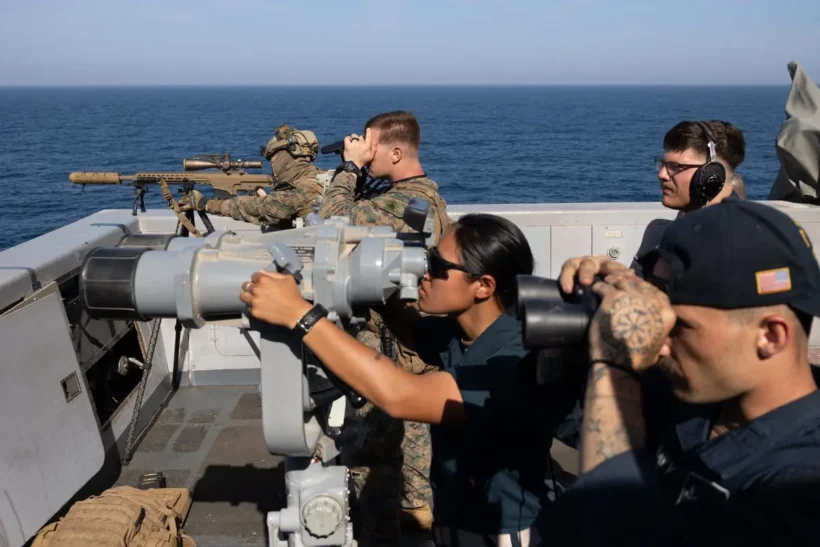
U.S. Marines from the 31st Marine Expeditionary Unit, and Sailors assigned to amphibious transport dock ship USS New Orleans (LPD 18) support blockade operations against Iran, on April 16. US Central Command
redo Jump to...
print Print...
(by Caitlin Doornbos, NY Post) – The US is reportedly weighing plans to board and seize Tehran-linked oil tankers worldwide — eyeing a dramatic escalation against Iran at sea.
Those discussions come as tensions spike in the Strait of Hormuz, where Iranian forces fired on multiple commercial vessels Saturday and declared the vital shipping lane under their “strict control,” The Wall Street Journal reported.
That saber-rattling sent shipping firms scrambling — just a day after Iranian Foreign Minister Abbas Araghchi insisted the strait was open for business, a claim President Trump had welcomed. [Araghchi wrote in an X post Friday: “In line with the ceasefire in Lebanon, the passage for all commercial vessels through Strait of Hormuz is declared completely open for the remaining period of ceasefire.”].
Behind the scenes, US officials say the Pentagon is preparing to intercept and take control of commercial vessels tied to Iran — potentially far beyond the Middle East, the outlet reported.
The strategy is aimed at choking Tehran’s economy — with the hope it forces the Iranian regime to reopen the strait and bend in nuclear talks, according to the report.
[After] Trump [announced] Friday that Iran had agreed to hand over its stockpile of highly enriched uranium — an assertion Iranian officials quickly [denied]. Sticking points remain over how long Tehran would halt enrichment and whether it would regain access to billions in frozen funds.The US has already blocked 23 ships from leaving Iranian ports as part of a growing naval barricade, US Central Command posted on X Saturday.
Expanding that effort globally would put Iran-linked tankers — including those suspected of hauling weapons or sanction-busting oil — directly in Washington’s crosshairs.
“The US will actively pursue any Iranian-flagged vessel or any vessel attempting to provide material support to Iran,” Joint Chiefs Chairman Gen. Dan Caine said Thursday, warning that so-called “dark fleet” ships are also fair game.
The stepped-up campaign — dubbed “Economic Fury” by Trump officials — could draw in US forces well beyond the Gulf, according to the Journal.
All of it is unfolding as a fragile cease-fire ticks toward its Wednesday expiration. Recent talks in Pakistan failed to produce a breakthrough, and there’s no date set for a second round.
Even so, both sides are hedging.
Iran is believed to still have thousands of short- and medium-range missiles and has begun pulling launchers out of underground storage, though heavy US strikes have dented its ability to quickly rebuild, US officials told the Journal.
Defense Secretary Pete Hegseth said US forces are “maximally postured” if fighting resumes — but officials remain wary of putting boots on the ground.
For now, the White House appears focused on economic pressure.
Iran exports roughly 1.6 million barrels of oil a day — much of it to China through small independent refineries, the outlet reported — making its shipping network a prime target.
The Treasury Department has already rolled out fresh sanctions on ships, companies and figures tied to Iran’s shadow oil trade, while US prosecutors are gearing up to go after anyone caught buying or selling sanctioned crude, according to the report.
The US has already shown it has the capacity to carry out that playbook — tracking and seizing vessels tied to Venezuela in far-flung waters — and officials now appear ready to do the same to Iran.
Published at NewsNationNow .com on April 18. Reprinted here for educational purposes only. May not be reproduced on other websites without permission.
Questions
NOTE TO STUDENTS: Before answering the questions, read the “Background” and watch the videos under “Resources” below.
1. What announcement did Iranian Foreign Minister Abbas Araghchi make on Friday?
2. a) What actions did Iranian forces take on Saturday in the strait?
b) What official declaration did Iran’s Islamic Revolutionary Guard Corps (IRGC) and military command make?
3. What actions is the U.S. preparing to take in response to Iran backtracking/violating their vow to completely open the strait?
4. What is the aim of the latest U.S. announcement in response to Iran’s flip flop on opening the strait?
CHALLENGE: Latest news from Sunday: the U.S. Navy did warn and then board an Iranian ship. Read/watch one of the following April 17 commentaries by historian Victor Davis Hanson:
- “How Trump Outsmarted Iran While Critics Rooted Against America and the Media Melted Down“
- “Trump’s Weeklong Strategy to Bleed Iran Dry“
a) The purpose of an editorial/commentary is to explain, persuade, warn, criticize, answer, entertain, praise or inspire . What do you think is the purpose of this editorial? Explain your answer.
Opinion question. Answers vary.
b) Do you agree with Mr. Hanson? Explain your answer.
Opinion question. Answers vary.
Background
U.S.-Iran relations:
- April 8-22, 2026: The U.S. and Iran agreed to a 2 week ceasefire. (Iran had effectively restricted or closed the strait earlier in the conflict – starting late February/early March 2026 with mines, attacks on ships, and IRGC declarations). The April 8 ceasefire was supposed to allow safe reopening, but Iran launched ballistic missile attacks toward Israel minutes after the ceasefire, and also launched missiles and drones toward Gulf countries.
- On April 11, two U.S. Navy guided-missile destroyers transited the strait and the U.S. announced they would begin clearing the strait of mines placed there by Iran.
- April 11-12 Iran and the U.S. engaged in peace talks in Pakistan and were very close to a deal when the talks failed.
- Iran then closed the Strait of Hormuz and imposed a toll on any ships they did allow to pass through with oil they had sold.
- On April 13, the U.S. began a blockade of all maritime traffic entering or exiting Iranian ports (along the Arabian Gulf/Gulf of Oman coastline). This followed the collapse of U.S.-Iran talks in Islamabad.
The blockade targeted vessels of all nations going to or from Iranian ports/coastal areas. It did not fully block the Strait of Hormuz for ships heading to non-Iranian ports (e.g., those of other Gulf countries). U.S. Navy forces enforced it with warships, turning back or intercepting non-compliant vessels. - April 17: Iran’s Foreign Minister announced the strait was “completely open” to commercial vessels for the remainder of the ceasefire between Israel and Lebanon.
- April 18: Iran’s Islamic Revolutionary Guard Corps (IRGC) and joint military command officially declared the Strait of Hormuz closed again – or returned to “strict management and control” under Iran’s armed forces.
Resources
WATCH: “US navy is preparing to board Iran-linked vessels” – April 18, 2026, News Nation
On April 19, President Trump issued the following statement on Truth Social:
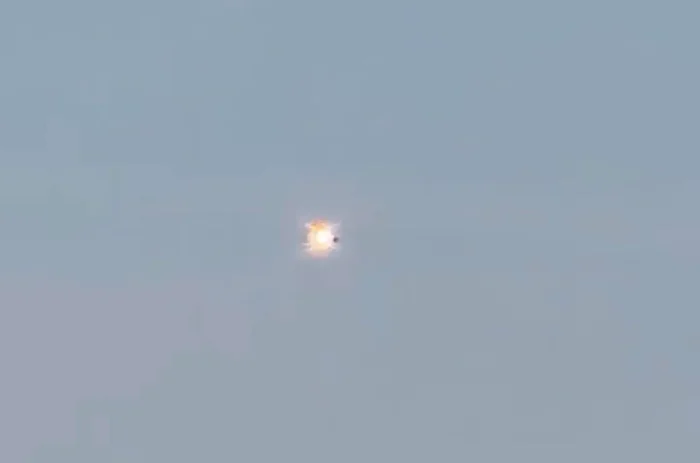
“Today, an Iranian-flagged cargo ship named TOUSKA, nearly 900 feet long and weighing almost as much as an aircraft carrier, tried to get past our Naval Blockade, and it did not go well for them. The U.S. Navy Guided Missile Destroyer USS SPRUANCE intercepted the TOUSKA in the Gulf of Oman, and gave them fair warning to stop. The Iranian crew refused to listen, so our Navy ship stopped them right in their tracks by blowing a hole in the engine room.
Right now, U.S. Marines have custody of the vessel. The TOUSKA is under U.S. Treasury Sanctions because of their prior history of illegal activity. We have full custody of the ship, and are seeing what’s on board!”
President DONALD J. TRUMP
WATCH: “US Navy fires on and seizes Iranian ship attempting to breach blockade” – April 19, 2026 – Sky News
Daily “Answers” emails are provided for News Stories, Tuesday’s World Events and Friday’s News Quiz.