redo Jump to...
print Print...
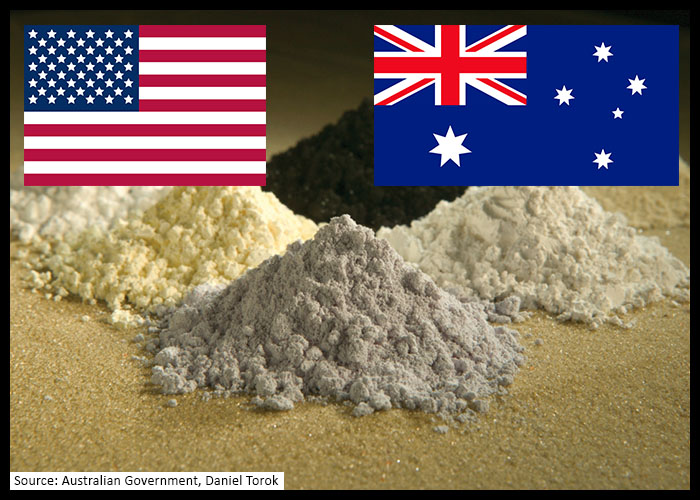
(by Natalie Sherman, BBC News) – The US and Australia have signed a deal intended to boost supplies of rare earths and other critical minerals, as the Trump administration looks for ways to counter China’s dominance of the market.
Australian Prime Minister Anthony Albanese said the deal would support a pipeline of $8.5 billion “ready-to-go” projects that would expand his country’s mining and processing abilities.
It includes $1 billion to be invested by the two countries in projects in the US and Australia over the next six months, a framework text says.
The US and Australia have been working on these issues since Trump’s first term, but Albanese said the latest agreement would take the partnership to the “next level.” …
China currently controls about 70% of rare earths mining and 90% of the processing of the materials, which are found in everything from defense equipment to computer chips and cars.
US companies rely heavily on the materials, making them vulnerable this year as China has taken steps to restrict access to supplies in response to new US tariffs* and other tensions. … [*In the early 2000s, China began restricting its rare earth industry to gain greater control over what it considered a strategic resource. The restrictions included a decrease in export quotas, which disrupted the global market and raised prices. During a diplomatic incident with Japan in 2010, China was accused of informally banning rare earth exports to that company. This move was widely seen as a demonstration of China’s willingness to use its dominance of the rare earth market for geopolitical leverage and caused a major global price spike.” from Google AI].
Albanese said the agreement was aimed at speeding investment in three types of projects, including US investments in processing facilities in Australia. [The agreement is aimed at three types of projects: joint ventures between the two countries, US-led investments in Australia, and Australian-led projects].
The two countries also agreed to work together on issues such as pricing, permitting, and rules for government review of the sales of companies and projects in the sector.
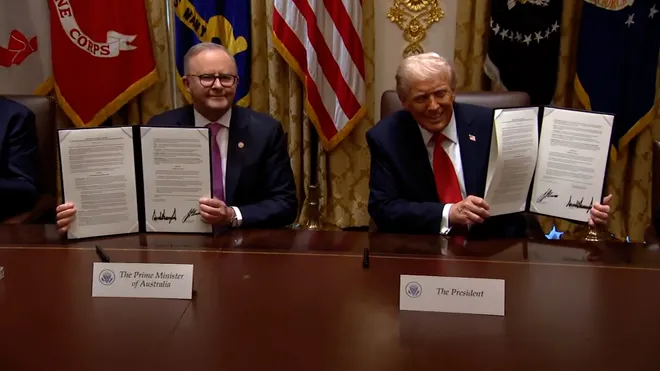
President Trump and Australia’s Prime Minister Anthony Albanese signed the landmark Critical Minerals Framework deal at the White House in Washington, DC, on October 20, 2025.
The US separately said it would invest in the construction of a 100 tonnes-per-year advanced gallium refinery in Western Australia and was preparing to offer some $2.2 billion in financing to advance critical minerals projects via its Export-Import Bank.
The Trump administration in recent months has already announced a series of investments in companies such as US rare earths miner MP Materials and Canada’s Trilogy Metals and Lithium America’s, which have projects in the US.
In exchange for the support, the U.S. has received ownership stakes in the firms.
Ahead of the meeting, shares in Australian companies such as Lynas Rare Earths had jumped on the prospect of increased support. Lynas was awarded a contract by the US Defense Department a few years ago and is working on a project in Texas.
The framework published by the White House was light on details, reflecting the delicate issues at play.
Australia is a major source of critical minerals but like the US, it relies on China, its biggest trade partner, for the processing required to turn the materials into something companies can use.
Published at BBC News on Oct 20. Reprinted here for educational purposes only. May not be reproduced on other websites without permission.
Questions
NOTE to Students: Before answering the questions, read the “Background” and watch the video under “Resources” below.
1. a) What are rare earth minerals?
b) List several everyday products that your family uses in which rare earths are a necessary component.
2. Why did the U.S. and Australia sign a rare earths deal on Monday?
3. What provisions are included in the agreement?
4. a) How much of the market does China currently control?
b) Why is this a problem?
5. How is the agreement between President Trump and Australian Prime Minister Anthony Albanese viewed, according to the WCNC News video?
6. The market for technologies that require rare earths for production is growing. In the interview with rare earths company NioCorp’s CEO Mark Smith, he says that the drilling that they are doing “is being done at the absolute highest standards possible…the standards that we meet for our technical work are as high as you can find.” It is imperative for our everyday lives, as well as our national security, to have an ample supply of rare earth minerals for the products that need them.
Watch the videos and read the “Background” below.
a) What did you know about rare earth minerals before reading this article?
b) What do you learn from the Background that you think is the most important for all Americans to know? Explain your answer.
c) Whether you like President Trump or not, do you support his efforts to regain U.S. control over our rare earths mineral supply? Explain your answer.
Background
China produces 70% of the world’s rare earths today. Is it the only country that has these minerals?
- NO: From the 1960s to the 1990s, the Mountain Pass mine in California produced about 70% of the world’s rare earth elements and housed most of the refining operations in the U.S.
- The Mountain Pass mine in California was not the only rare earths refiner, but it was the only U.S. facility that combined both mining and significant refining of rare earth elements domestically.
- However, by the late 1990s and early 2000s, environmental issues, regulatory challenges, and economic pressures led to the closure of many refining capacities at Mountain Pass. By 1998, the mine ceased production of refined rare-earth compounds and shifted primarily to mining bastnäsite concentrate, which was then exported for refining, largely to China. By 2002, the Mountain Pass mine had closed, and U.S. refining capacity was dismantled.
Can rare earth minerals still be found in the U.S.?
- YES: The U.S. has substantial reserves of rare earth minerals in the ground, including some of the highest-grade deposits found anywhere globally, but most are currently undeveloped or only recently identified.
- Estimates vary, but some recent analyses suggest that the U.S. holds enough rare earth minerals to eventually rival or even surpass China, depending on how quickly mining and processing infrastructure develops.
- Significant deposits have been discovered in Montana (Sheep Creek), Wyoming (Halleck Creek and Bear Lodge), and California (Mountain Pass), among other places. Montana’s Sheep Creek deposit, for example, contains some of the highest-grade ore ever found in the U.S., and Wyoming’s discoveries are considered among the world’s largest.
What is preventing us from mining and refining the plentiful rare earth deposits that have been discovered?
- Lengthy and complicated permitting processes for rare earth mining and refining in the U.S. are imposed at both the federal and state levels, with the federal process being particularly time-consuming and complex.
- Federal permits can take 7 to 10 years on average to obtain, with some projects facing timelines beyond a decade.
- While strict federal and state government regulations aimed to protect the environment and public health, they also made domestic extraction and processing prohibitively expensive compared to China, where Chinese Communist state-sponsored and lax [little to no] environmental enforcement allowed rapid scaling up of production.
Overall, the U.S. permitting system is widely regarded as one of the longest and most cumbersome globally, particularly at the federal level, significantly hindering rare earth mining and refining development in the country.
The combined federal-state regulatory regime, along with high litigation risk, creates an environment where projects are delayed extensively compared to other mining nations like Australia or Canada. [Recognizing the essential need for the U.S. and our allies not to be reliant on China for rare earths, the Trump administration is working] to reform and accelerate permitting.
(The above was adapted from answers to “Why did the u.s. give up our rare earths mining and refining to China” and “Does the u.s. have a lot of rare earths minerals in the gorund” and others to Perplexity AI on Oct. 24, 2025)
Rare earth minerals are a group of 17 metallic elements…found on the periodic table.
Despite their name, they are relatively plentiful in the Earth’s crust, but are often dispersed and rarely found in mineable concentrations.
Their unique…properties make them essential to modern technology and industrial applications.
The following products cannot be manufactured without rare earth minerals, due to their essential roles in performance, efficiency, or functionality:
- Smartphones (miniature magnets, screens, speakers, vibration motors)
- Electric vehicle motors
- Wind turbines (permanent magnet generators)
- Computer hard disk drives
- MRI scanners (medical imaging)
- Fiber-optic communication cables
- Television and LED screens (phosphors for color, brightness)
- Rechargeable batteries (nickel-metal hydride, some lithium-ion)
- Catalytic converters for automobiles
- Compact fluorescent lamps (CFLs) and energy-efficient LEDs
- Hybrid and electric vehicle batteries
- F-35 fighter jets (magnets, laser targeting, stealth alloys)
- Submarines (navigation, propulsion magnets)
- Precision guided missiles (navigation, optics)
- Satellites (magnets, communication components)
- Lasers for medical and industrial use
- PET scan (positron emission tomography) detectors
- Portable X-ray machines
- High-performance headphones and speakers
- Optical glass and specialty camera lenses
(from a Perplexity AI, Oct, 26, 2025 search: “List 20 products that cannot be produced without rare earth minerals”)
Read “Rare earth processing plant in TX aimed at reducing reliance on China” from April 2021.
Daily “Answers” emails are provided for News Stories, Tuesday’s World Events and Friday’s News Quiz.