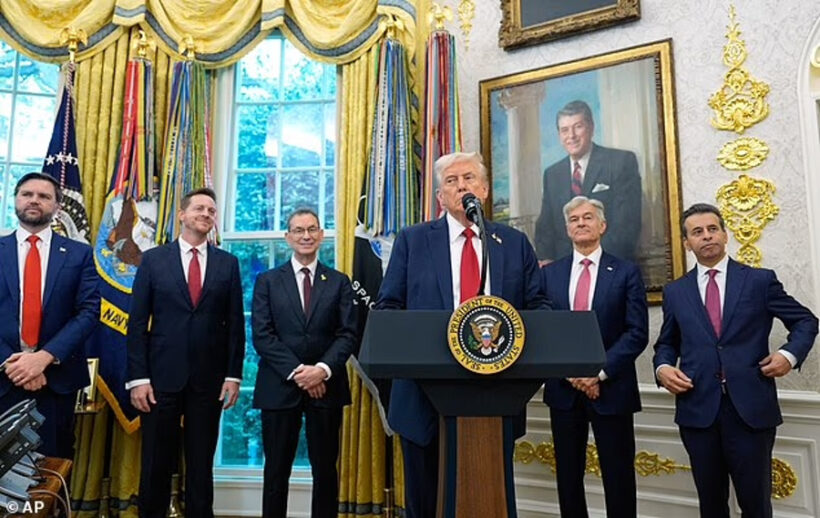
September 30, 2025: President Trump is pictured alongside, from left, Vice-President JD Vance, HHS secretary senior advisor Chris Klomp, Pfizer chief executive Albert Bourla, CMS administrator Dr Mehmet Oz and FDA commissioner Dr Marty Makary
redo Jump to...
print Print...
(by Lisa Hornung, UPI) — President Donald Trump announced Tuesday that he has secured a deal with drugmaker Pfizer to lower its prescription prices. Trump made the announcement alongside several health officials, including HHS Secretary Bobby Kennedy Jr., Dr. Mehmet Oz, Administrator for the Centers for Medicare & Medicaid Services (CMS), Dr. Marty Makary, FDA Commissioner, and Albert Bourla, CEO of Pfizer.
The White House also announced a new direct-to-consumer website to sell prescription drugs at discounted rates, calling it TrumpRX, the administration said in a statement. The president didn’t elaborate on how it will work, [and the launch date for the website has not yet been given].
“This is a really big announcement,” Trump said. “This is something that most people said was not doable.” He said more deals with other drugmakers would follow.
Trump signed an executive order in May to get “most-favored nation status” (MFN) with pharmaceutical companies, and the administration has been negotiating with drug companies since then.
“Starting today, the United States will no longer subsidize the healthcare of foreign countries, which is what we were doing,” Trump said at the time. “They paid a small fraction for the same [prescription] drug we pay many, many times more for.”
[The discounts Americans will receive match the lowest prices that developed countries like the UK, France, and Germany pay for the same medicines. Of note: insulin and epinephrine prices for low-income or uninsured patients are sharply reduced under these policies].
The MFN status means that “foreign nations [developed nations] can no longer use price controls to freeride on American innovation by guaranteeing MFN prices on all new innovative medicines Pfizer brings to market,” a Sept. 30 White House fact sheet said. “The agreement requires Pfizer to offer medicines at a deep discount off the list price when selling directly to American patients.”
The fact sheet lists three examples of Pfizer’s medications and their discounts:
- Eucrisa, a topical ointment for atopic dermatitis, will be made available at an 80% discount to patients purchasing directly. Eucrisa retails at $856.80, according to Amazon Pharmacy, bringing it down to $171.36.
- Xeljanz, an oral medication for rheumatoid arthritis, psoriatic arthritis, and ulcerative colitis, will be available at a 40% discount. Xeljanz retails at $6,559.20 per month. With a 40% discount, the price will be $3,935.52 per month.
- Zavzpret, a treatment for migraines, will be sold at a 50% discount. Zavzpret retails at $1,223.64, making it $611.82.
“In case after case, our citizens pay massively higher prices than other nations pay for the same exact pill, from the same factory, effectively subsidizing socialism [abroad] with skyrocketing prices at home,” Trump said in a statement. “So we would spend tremendous amounts of money in order to provide inexpensive drugs to another country. And when I say the price is different, you can see some examples where the price is beyond anything — four times, five times different.”
In July, Trump sent letters to pharmaceutical companies asking them to lower prices within 60 days, the Washington Post reported [and listing steps they should take to bring U.S. prices down to equal the lower prices European countries pay.] …
Pfizer also said it will announce an $70 billion investment in research and development as well as domestic manufacturing, the White House said.
Abridged from a UPI report published on September 30. Reprinted here for educational purposes only. May not be reproduced on other websites without permission.
Questions
NOTE: Before answering the questions, read the Background and watch the videos below.
1. The first paragraph of a news article should answer the questions who, what, where and when. List the who, what, where and when of this news item. (NOTE: The remainder of a news article provides details on the why and/or how.)
2. What is TrumpRx?
3. a) Define subsidize and developed nation.
b) How have Americans been subsidizing the healthcare of other countries – including developed nations?
4. What is MNF in the context of this announcement?
5. Is Pfizer the only pharmaceutical company that will offer lower, fairer prices to Americans?
6. The UK has socialized medicine. Most medical care is low-priced or “free.” The UK government’s National Health Service negotiates directly with drug manufacturers to control prices and limit government spending on branded medicines. They refuse to pay more than a certain amount for various prescription medications. Other developed nations in Europe and Canada have similar policies. These countries have been able to give free (but subpar) healthcare to their citizens by setting the prices they will pay for drugs. The pharmaceutical companies make up for these price controls by charging exorbitant prices to the U.S. The U.S. subsidizes these countries, as well as by paying for Research and Development of all new medicines, which the other countries then benefit from as well.
Do you support President Trump’s push to get pharmaceutical companies to charge Americans fair prices (only as much as other developed nations pay)? Explain your answer.
7. The NY Times notes: “TrumpRx direct cash purchases may not always be as advantageous for insured patients, who often have lower out-of-pocket costs through insurance, but it offers uninsured and underinsured Americans a new option for obtaining discount medications.”
From the UPI article: “Today’s deal only applies ‘to one company [Pfizer] and one program [Medicare],'” Drew Altman, president and CEO of KFF, a health policy research group, told NBC. “Most Americans buy drugs through their insurance plan, so that would mainly help the uninsured.”
The UPI reporter appears to dismiss “the uninsured” as well as the underinsured. List types of people/jobs etc. where people have to pay for their own medical insurance and their prescription medications.
Background
President Trump’s RX plan is a major initiative announced in September 2025 aimed at lowering prescription drug prices for Americans by partnering with Pfizer (with the expectation other drug companies will partner also) and launching a direct-to-consumer purchasing site called TrumpRx.
The plan is expected to save lots of money for everyday people who need prescription medications regularly.
Key Components
- The TrumpRx website will allow Americans to buy many Pfizer medications and some other brands at an average discount of 50%, paying cash directly instead of going through insurance.
- Pfizer will supply almost all its drugs to Medicaid at prices matching those offered in Europe and other comparable countries, targeting low-income Americans.
- Newly launched medicines in the U.S. by Pfizer will also be offered at these discounted rates.
- Pfizer receives three years of exemption from national security-related tariffs in exchange for cutting prices and investing in domestic manufacturing in the U.S..
- The plan incorporates Trump’s “Most-Favored-Nation” policy, which compels pharmaceutical companies to offer U.S. consumers the same or better prices than those given to foreign countries. (from a Perplexity AI serach)
The Trump RX plan aims to end Americans’ subsidizing of foreign drug discounts, making U.S. drug prices more fair compared to those paid abroad and bringing relief from inflated prices driven by global “free riding” on U.S. pharmaceutical innovation. (WhiteHouse.gov)
Resources
President Trump, September 30, 2025:
Dr. Marty Makary, September 30, 2025:
Dr. Oz, September 30, 2025:
Pfizer CEO, Albert Bourla, September 30, 2025:
Daily “Answers” emails are provided for News Stories, Tuesday’s World Events and Friday’s News Quiz.