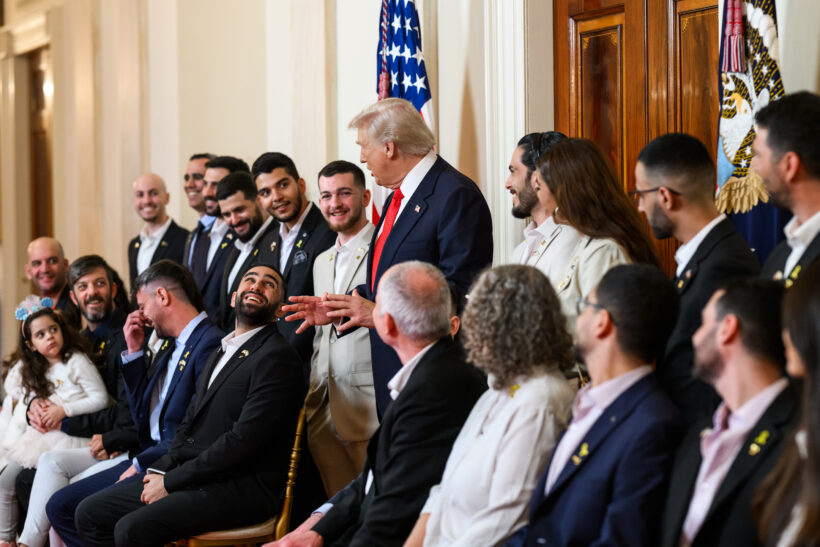
President Trump meets with 26 of the freed hostages at the White House on Nov. 20, 2025.
redo Jump to...
print Print...
(YNet News) – A month after their release in a US-brokered deal, 17 of the 20 last living hostages to be released arrived at the White House on Thursday to personally thank President Donald Trump for his role in securing their release.
The group was joined by previously released hostages, including Noa Argamani and Ilana Gritzewsky, and included nearly all of the captives who had been held in Gaza for more than two years. Three former hostages — Alon Ohel, Maxim Herkin and Rom Braslavski — remained in Israel.
Ahead of the meeting with the president, the group met senior U.S. officials, including Special Envoy to the Middle East Steve Witkoff — one of the architects of the deal — and Commerce Secretary Howard Lutnick, according to the Israeli Embassy in Washington.
During the meeting with Trump, former hostages Gali and Ziv Berman presented him with a mezuzah from their burned home in Kibbutz Kfar Aza, where they were abducted. “It’s the original mezuzah from the door of the house that was burned during the Hamas massacre,” the family said.
“We came to say thank you to the president of the United States for the many actions he took for our release,” the Berman twins said in a statement. “At the same time, it’s important to remember that the mission is not yet complete. There are three deceased hostages still being held in Gaza. Until everyone returns, we cannot begin our rehabilitation as a society and as a nation.”
The pair also gave Trump a letter, which read: “This mezuzah was lovingly removed from the door of Gali’s room in our home in Kibbutz Kfar Aza, a community that endured unspeakable horrors on October 7, 2023. The mezuzah survived. Gali survived. And now, this sacred item is presented to you, for helping to save his life.”
With deep respect and heartfelt gratitude, we present you with a small yet powerful symbol of protection and faith, salvaged from the devastation of tragedy, as a gesture of honor and appreciation for your actions in bringing back the hostages. May it stand as an enduring testament to courage, to faith, and to the eternal friendship between our peoples.”
As part of the visit, former hostage Eitan Mor prepared a unique gift for the president — a dreidel – in honor of the upcoming Hanukkah holiday. In an accompanying letter, Eitan’s father, Tzvika, explained the significance of the gesture.
“I want to express our deepest gratitude for your unwavering leadership and support in bringing our loved ones home,” he wrote. “Our children were among the hostages held in Gaza for 738 endless days.”
Tzvika, who headed the Forum of Hope, stated that the forum’s goal — securing the hostages’ release without capitulating to Hamas — was achieved thanks to Trump’s determination to use force. “In our tradition it is written, ‘I will bless those who bless you, and whoever curses you I will curse.’ Your actions embodied this eternal truth. When courage was needed, you chose strength. When clarity was required, you offered resolve. And when families like mine were desperate for hope, you helped make it real.”
“As a token of our appreciation, my family and I wish to present you with this Hanukkah dreidel,” the letter continued. “This simple object carries the ancient Maccabean victory in the Land of Israel, when light triumphed over darkness and faith overcame fear. As a father and grandfather, I hope you will spin this dreidel with your grandchildren, sharing with them the joy of family, the love passed down through generations and the reminder that our greatest victories — past and future — are born from the power of hope for our children.”
During his meeting with the freed hostages, President Trump told the group:
“You are not a hostage anymore — today, you are heroes, you’re truly heroes.”
“It’s an honor to get to know all of you,” the president said at the closed press event, according to clips posted by White House official Margo Martin.
“We love you all, and our country loves you all,” he added.
The 26 former hostages who traveled to the White House included Noa Argamani, Elkana Bohbot, Avinatan Or, Guy Gilboa-Dalal, Eitan Horn, Evyatar David, Iair Horn, Nimrod Cohen, Keith and Aviva Siegel, Ilana Gritzewsky, Matan Zangauker, Matan Angerst, Bar Kupershtein, Segev Kalfon, David Cunio, Sharon Aloni-Cunio with daughters Emma and Yuli, Ariel Cunio, Arbel Yehoud, Yosef-Chaim Ohana, Gali Berman, Ziv Berman, Omri Miran and Eitan Mor.
The “toughness” of Angrest, who was subjected to savage beatings because of his service in the Israel Defense Forces, was pointed out by the president.
“He went through hell,” Trump said of the freed soldier.
“Matan never broke, and today he’s a living testimony to the toughness, heart, and faith of the Jewish people,” the president added. “You’re a great inspiration to everybody, whether you’re Jewish or not.”
Trump brokered the deal to free the remaining hostages as part of his 20-point plan for Gaza. On October 13, the final 20 living hostages were released by Hamas, and Trump addressed the Knesset in a special session during a whirlwind visit. However, Hamas later violated the terms of the agreement, releasing 25 bodies out of 28 — contrary to the commitment for immediate handover. Three fallen hostages remain unreturned: Sgt. First Class Ran Gvili, Dror Or and Sudthisak Rinthalak.
Compiled from articles published at YNet News on November 20 with Jerusalem Post and NY Post. Reprinted here for educational purposes only. May not be reproduced on other websites without permission.
Questions
1. The first paragraph of a news article should answer the questions who, what, where and when. List the who, what, where and when. (NOTE: The remainder of a news article provides details on the why and/or how.)
2. A mezuzah is a small parchment scroll inscribed with verses from the Torah (the first 5 books of the Old Testament: the Five Books of Moses), placed inside a protective case and affixed to the doorposts of Jewish homes. It is a Jewish tradition stemming from God’s commandment to “write them upon the doorposts of thy house and upon thy gates” (Deuteronomy 6:9). The mezuzah serves as a reminder of God’s presence, a symbol of Jewish identity, and a way to remember the values of the Jewish faith.
What is the significance of the mezuzah former hostages – brothers Gali and Ziv Berman – presented to President Trump?
3. Under President Trump’s peace plan and ceasefire last month, the last 20 living hostages were released by the Hamas and Islamic Jihad terrorists in Gaza. Why do the Berman brothers say the mission is not yet complete?
4. What is the significance of the dreidel former hostage Eitan Mor presented to President Trump?
5. What did Trump tell the assembled group?
6. What do you know about the Hamas terrorist attack on Israel on Oct. 7, 2023? and who the hostages were and what they went through? (see “Background” below the questions for a summary)
Compare that information to the number of reports about the “Free free Palestine” protesters.
Why do you think the media:
- downplayed the plight of the hostages who were starved and abused and tortured for over two years
- claimed Israel was intentionally starving the people of Gaza
- did not report that the numerous food and aid trucks brought into Gaza to be distributed to the people for free were hijacked by Hamas who then sold the food on the black market at exorbitant prices
Background
What happened on October 7?
On October 7, 2023, thousands of armed Hamas terrorists tore down large parts of the Gaza security fence using tractors, RPGs and explosives and invaded southern Israel. Simultaneously, Hamas terrorists in Gaza fired thousands of rockets toward Israel.
Some 1,500 terrorists successfully broke through the fence in vehicles and by foot. Some used motorized paragliders to fly over the fence, and others attempted to invade through the sea, aiming for Israel’s Zikim Beach.
The terrorists split up and made their way to a number of Israeli towns and IDF bases surrounding Gaza. That is when the massacre began. They invaded the towns, shooting everything in sight. They broke into civilian homes, shooting, burning, raping and beheading. Over 1,300 civilians were murdered, and over 200 were abducted. Hamas terrorists briefly took control of about 10 Israeli towns, terrorizing and brutalizing their residents.
Simultaneously, additional terrorists drove on to the Nova Music Festival, which took place in a nearby open area. Partygoers were waking up to the sound of sirens and attempting to evacuate due to the threat of rockets. Many of them did not reach safety. The terrorists fired indiscriminately at the thousands of civilians who came from all over the world to celebrate peace through music.
They massacred hundreds, raped young women, brutalized bodies, and abducted many. 260 bodies were later found in the area of the festival, most of them belonging to young men and women—innocent youth.
IDF forces operated to neutralize the terrorists and thwart their infiltration; however, the terrorists were also ambushing IDF bases, killing soldiers and hurling grenades and explosives. Still, field observers used a sniper sighting system, tanks fired shells, and combat helicopters and special forces were deployed to the scene.
The State of Israel has never encountered such a large-scale, calculated attack on the Gaza front.
Many were lost not only during the initial attacks but also during the prolonged, bloody battles to regain control of the towns and bases surrounding Gaza, clear them from terrorists and rescue as many hostages held in Israeli territory as possible. When forces were able to regain control of the towns, they were faced with grotesque sights of Hamas’ pure violence that were left behind.
Cribs and baby carriers were found bloodstained. Families were found embracing each other, lifeless. Pets were left behind, among them a dog refusing to leave a child’s bed, waiting for its owners who will never return.
October 7th will forever be remembered as a dark day in Israel’s history and in humanity’s history. A reminder that there are humans capable of utterly inhumane things. (from idf.il/eng)
On October 7, 2023, as part of the Hamas-led attack on Israel, Hamas and other Palestinian militant groups abducted 251 people from Israel to the Gaza Strip, including children, women, and elderly people. In addition to hostages with only Israeli citizenship, almost half of the hostages are foreign nationals or have multiple citizenships. Some hostages were Negev Bedouins. The precise ratio of soldiers and civilians among the captives is unknown. The captives are likely being held in different locations in the Gaza Strip. (from wikipedia)
NOTE: On Nov. 17, 2025, the UN Security Council approved the US-backed plan for Gaza, which includes a permanent ceasefire and an international stabilization force. The resolution passed with a 13-0 vote (China and Russia abstained) supporting the Trump administration’s 20-point plan which authorizes an international stabilization force and a Board of Peace to oversee the demilitarization and reconstruction of Gaza.
Read an explanation at “Global Support for President Trump’s Bold Vision for Peace in Gaza“
Resources
President Trump speaks to recently freed Israeli hostages and their families at the White House on Thursday, Nov. 20, 2025
Former Israeli Hostage Bar Kupershtein calls Trump an emissary of God. Kupershtein was 21 and working as a security guard at the Nova Music Festival when he was taken hostage by Hamas terrorists on October 7, 2023
From an interview with CNN before traveling to DC:
From the age of 16, Kupershtein ran the family falafel business after his father was seriously injured in an accident. Bar, who was 21 and working as a security guard at the Nova Music festival on Oct. 7, stayed behind during the terror attack, aiding the wounded partygoers, until he was ultimately shot and kidnapped by Hamas. Despite the enormous hardship he endured, he says he would do the exact same thing again.
“I was responsible for the safety of all the partygoers”’ he said. “If I ran away and saved myself, knowing that others were there and I could have helped them –– I wouldn’t have been able to live with myself.” Survivors have called him a hero. “I just did my job,” he insists.
“In your head, you count every day, that’s how you keep yourself busy,” he told CNN. In the beginning, he recalls, blindfolded and forbidden from speaking, counting was one of the only activities available. Days became weeks, months, two years.
“There were moments when they tried to execute us, when they starved us, when they abused us, whether with beatings, physically, verbally, depriving us from basic human conditions,” he recounts. …
“God gave me the strength to be strong. I truly believed and knew that I would get out safe and sound,” he said. “From day one, I had this inner feeling. I kept telling myself not to give up and stay strong – for the family – because one day I will get out and go back to being Bar. I told myself that it can’t get any worse than this – so just endure it.”
“I wasn’t very religious beforehand, only traditional, but in captivity, one really connects to God, you talk to him. He saved me – not once or twice. Every day that I stayed alive was a miracle.”
Daily “Answers” emails are provided for Daily News Articles, Tuesday’s World Events and Friday’s News Quiz.