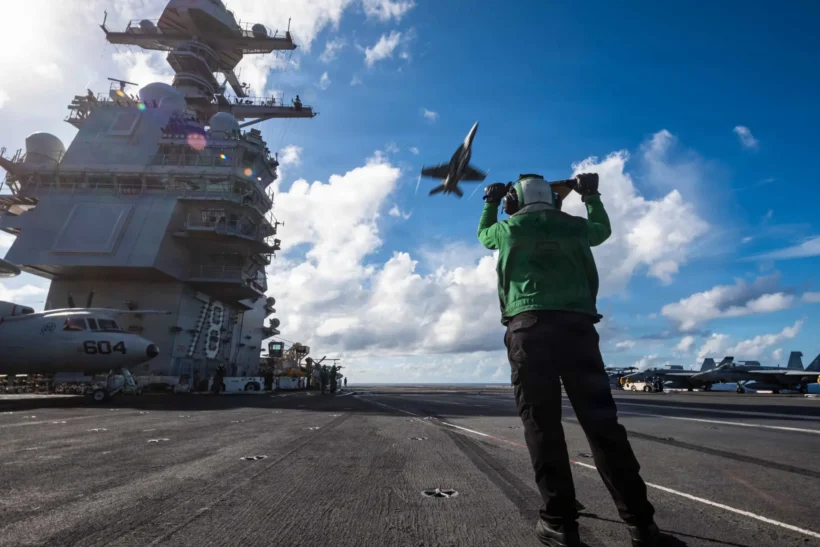
A sailor aboard the world’s largest aircraft carrier, the USS Gerald R. Ford, works on the flight deck during flight operations earlier this month.
redo Jump to...
print Print...
(by Antonio María Delgado, Miami Herald) — President Trump gave Venezuelan dictator Nicolás Maduro a strongly worded ultimatum as tensions flared with the South American nation — telling him to resign and leave or else, according to a report.
During a call between Trump and Maduro the week of Nov. 16, Washington demanded that Maduro and his top allies leave Venezuela immediately to allow the restoration of democratic rule, while regime leaders proposed handing political control to the opposition but retaining command of the armed forces. Maduro also reportedly sought global amnesty for all of his alleged crimes.
Trump’s refusal on both counts was said to be swift as he followed up with an offer that Maduro may not be able to refuse: Leave now or else. According to sources, the U.S. message to Maduro was direct: Safe passage would be guaranteed for him, his wife Cilia Flores, and his son – only if he agreed to resign right away.
After the phone call between Trump and Maduro failed to reach an agreement, the US president announced he was closing the airspace around the South American country, as America’s largest warship, the USS Gerald F. Ford — and a Marine expeditionary unit, capable of amphibious invasion — float offshore.
Then, speaking to service members during a Thanksgiving call, the president said the U.S. Armed Forces would “very soon” begin land-based operations to disrupt what he described as Venezuelan drug-trafficking networks.
The call reportedly saw Trump’s and Maduro’s teams go over the details of what a surrender from the Venezuelan strongman would be like, given that the State Department has a bounty of $50 million for information leading to his arrest and/or conviction.
One source said the president’s call with Maduro, viewed as a last-ditch effort to avoid a direct confrontation, stalled over three issues.
“First, Maduro asked for global amnesty for any crimes he and his group had committed, and that was rejected,” said the source, speaking on the condition of anonymity. “Second, they asked to retain control of the armed forces — similar to what happened in Nicaragua in ’91 with Violeta Chamorro. In return, they would allow free elections.”
…The third sticking point was timing: Washington insisted Maduro resign immediately, and Caracas refused.
…After Trump’s announcement on Saturday that Venezuelan airspace should be considered “closed in its entirety,” the Maduro government attempted to place another call to Washington but received no response.
The airspace announcement, widely interpreted in Venezuela as a prelude to an imminent attack, further jolted an already-tense standoff. Addressing “Airlines, Pilots, Drug Dealers, and Human Traffickers,” Trump offered no operational details but warned that the directive required immediate attention. His post came amid a rapid escalation in U.S. military posture toward Caracas and rising fears of conflict across the Caribbean.
“To all Airlines, Pilots, Drug Dealers, and Human Traffickers, please consider THE AIRSPACE ABOVE AND SURROUNDING VENEZUELA TO BE CLOSED IN ITS ENTIRETY. Thank you for your attention to this matter!” Trump wrote on Truth Social.
By Sunday afternoon, a FlightRadar24 map showed that there were no international planes flying over Venezuela.
The president’s declaration capped a week in which the administration signaled it was preparing a more aggressive phase against the Cartel de los Soles.
On Monday, the State Department formally designated the Cartel de los Soles as a Foreign Terrorist Organization, placing Maduro, Interior Minister Diosdado Cabello, and Defense Minister Vladimir Padrino López in the same legal category as leaders of al-Qaeda and ISIS.
US Navy Secretary John Phelan said of the fight against Venezuelan drug traffickers:
“Drugs kill more Americans than we’ve ever lost in wars. So I think at the end of the day, the president has correctly identified this as an attack on the country, which it is.”
There were more than 105,000 drug overdose deaths in the US in 2023, according to the latest available data from the Centers for Disease Control and Prevention. That’s nearly double the more than 58,000 American servicemen who died in the Vietnam War.
While the White House blames Venezuelan gangs for trafficking illegal opiates and cocaine to the US, a 2019 DEA report found that most fentanyl — the leading source of American overdose deaths — comes from Mexico, through precursors shipped from China.
Venezuela was one of 23 nations that Trump declared “major drug transit or major illicit drug producing countries” in September — along with China, India, Mexico and the Dominican Republic. (See the list and details at state.gov. To read more about President Trump’s priorities to protect the United States from the scourge of illicit drugs, click here.)
The expanding legal framework has coincided with a significant buildup of U.S. military hardware near Venezuela’s borders. For more than two months, American naval and air assets have surged into the Caribbean, including the Nov. 16 arrival of the USS Gerald R. Ford, the world’s largest aircraft carrier.
At least 10 additional warships, a nuclear submarine and F-35 fighter jets are also deployed. U.S. commanders say the missions support counter-narcotics operations, but regional observers note the level of firepower far exceeds typical interdiction activity.
Compiled from a report published at Miami Herald on Nov. 30, 2025 with the NY Post by Ronny Reyes. Reprinted here for educational purposes only. May not be reproduced on other websites without permission.
Questions
NOTE TO STUDENTS: Before answering the questions, read the “Background” below and watch the video under “Resources.”
1. What did President Trump demand Venezuela’s socialist dictator Nicholas Maduro do during a phone call the week of Nov. 16?
2. How did Maduro respond to Washington’s demands?
3. What actions did/will the Trump administration take against the Maduro regime following Maduro’s ongoing denial of involvement in Venezuela’s illegal drug trade, and subsequent refusal to resign immediately?
4. a) What is the result of Trump’s announcement closing the airspace?
b) Why do you think the Maduro regime then attempted to call the U.S.?
5. What cartel does Maduro and his administration run and/or allow to operate in Venezuela?
6. a) How many countries did President Trump name “major drug transit or major illicit drug producing countries”?
b) President Trump’s policies to combat illegal drug trafficking/use include: (see whitehouse.gov)
- Decreasing the domestic availability of illicit drugs by stopping the flow of drugs across our borders and into our communities
- Reduce the initiation of drug use, particularly among young people
- Providing treatment that leads to long-term recovery
Do you support the president’s policies to end drug trafficking into the U.S. and/or with his policies in Venezuela in this case (and to help those Americans suffering from drug addiction)? Explain your answer.
7. What type of military vessels/aircraft have been sent to the waters around Venezuela?
8. On Thursday, Trump said maritime operations had already destroyed more than 20 vessels and resulted in more than 80 deaths since Sept. 1, [noting] the United States had halted “85%” of the maritime flow. Venezuelan groups, he said, were “sending poison” northward that kills “thousands of people a year.”
In the video (under “Resources” below), Jesse Watters asserts that Democratic politicians have supported military strikes on other countries, but oppose action against Venezuela’s narcoterrorist dictator Nicholas Maduro because Trump is the president taking the action. Do you agree with this assertion? Explain your answer.
Background
What to know about Nicholas Maduro:
- Venezuela’s socialist president Nicholas Maduro, in power since 2013, is widely considered a dictator and leads an authoritarian government characterized by electoral fraud, serious human rights abuses, rampant corruption, and severe economic hardship.
- A 2018 Amnesty International report “accused Nicolas Maduro’s government of committing some of the worst human rights violations in Venezuela’s history.”
- According to estimations by the UN and Human Rights Watch, under Maduro’s administration, more than 20,000 people have been subject to extrajudicial killings and seven million Venezuelans have been forced to flee the country (with a population of 29 million).
- More than 50 countries do not recognize Nicolás Maduro as the legitimate president of Venezuela, a position supported by a majority of countries since 2019. The number of non-recognizing countries is significant, including the European Union, the United States, and several Latin American nations.
- In the 2024 presidential election, tallies from most polling stations show opposition candidate Edmundo González winning in a landslide over Maduro, with González earning approximately 65–70% of the vote and Maduro approximately 30–31% of the vote.
- Recognition of Maduro as the legitimate president is limited to a small group of allies (fewer than 10), mostly authoritarian or ideologically aligned states: Russia (strategic partner), China (main creditor-Venezuela owes them billions), Cuba, Bolivia, Nicaragua, Honduras, Iran, North Korea, Syria and Turkey (NATO member; Erdogan called Maduro, praised “peaceful” process) (from Wikipedia, Grok and Perplexity AI)
On July 25, 2025, the U.S. Treasury sanctioned the Venezuelan cartel headed by illegitimate president Nicholas Maduro:
- Based in Venezuela, the *Cartel de los Soles (Cartel of the Suns) is headed by Nicolas Maduro Moros and other Venezuelan high-ranking individuals in the Maduro regime who corrupted the institutions of government in Venezuela, including parts of the military, intelligence apparatus, legislature, and the judiciary, to assist the cartel’s endeavors of trafficking narcotics into the United States.
- The cartel’s name is derived from the sun insignias often portrayed on the uniforms of Venezuelan military officials.
- The Cartel de los Soles supports Tren de Aragua in carrying out its objective of using the flood of illegal narcotics as a weapon against the United States. Additionally, the Cartel de los Soles has provided support to the Sinaloa Cartel of Mexico. (treasury.gov)
Venezuela is a dictatorship, not a democracy: While it was once a stable democracy in Latin America, (and also the wealthiest country in Latin America) Venezuela has transitioned into an authoritarian regime under the leadership of Hugo Chávez (president from 1999 until his death in 2013) and his successor, Nicolás Maduro. This shift is characterized by electoral fraud, suppression of human rights, and a lack of free press, leading to its poor ranking on international measures of freedom and civil liberties. (from Google AI Overview)
From Perplexity AI’s answer to question: “How did the socialist policies of Chavez and Maduro destroy Venezuela’s economy?”:
- The socialist policies of Hugo Chávez (president of Venezuela from 1999 until his death in 2013) and his successor Nicholas Maduro severely damaged Venezuela’s economy through aggressive nationalization, rigid price and currency controls, and unsustainable social spending that created market distortions, shortages, and hyperinflation.
- Chávez’s government seized over a thousand companies across key sectors—agriculture, oil, utilities, banking, manufacturing, and food distribution — replacing experienced management with political appointees.
- State control led to inefficient operations, collapsing production, and frequent blackouts and water shortages as government-run enterprises could not deliver basic services or maintain infrastructure.
- Food production dropped 75% in two decades while the population rose by 33%, creating a recipe for chronic shortages and hunger.
- …The socialist policies of Chávez and Maduro destroyed Venezuela’s economy by undermining private enterprise, causing market failures, diminishing production, fueling corruption, and creating a dependence on spending that collapsed when oil revenues fell.
Daily “Answers” emails are provided for Daily News Articles, Tuesday’s World Events and Friday’s News Quiz.