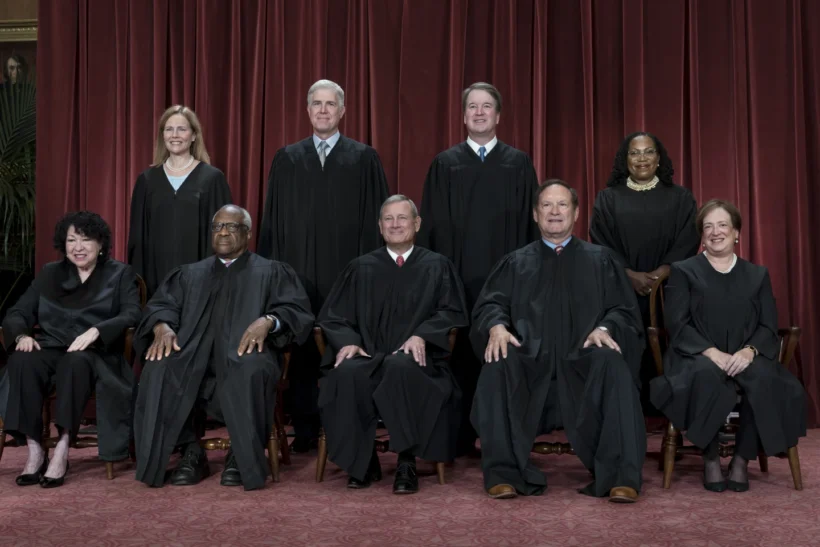
Justices of the Supreme Court, Oct. 7, 2022. (Seated from left) Associate Justice Sonia Sotomayor, Associate Justice Clarence Thomas, Chief Justice John Roberts, Associate Justice Samuel Alito and Associate Justice Elena Kagan, (Standing behind from left) Associate Justice Amy Coney Barrett, Associate Justice Neil Gorsuch, Associate Justice Brett Kavanaugh and Associate Justice Ketanji Brown Jackson. (Photo: Olivier Douliery/AFP via Getty Images)
redo Jump to...
print Print...
(by Jack Birle, Washington Examiner) – Among the dozens of cases the Supreme Court will hear in the coming months, three cases it has agreed to hear could have wider ramifications for campaigns, elections, and who controls the House of Representatives. Two of the cases have been scheduled for October hearings, while the other has yet to be scheduled but will be heard by the justices in the upcoming term, long before the midterm elections in November 2026.
1 – Bost v. Illinois
The first case the Supreme Court will hear in the next term that could significantly affect forthcoming elections deals with whether federal candidates have standing to challenge state regulations of the federal elections they are running in. With Bost v. Illinois State Board of Elections, Rep. Mike Bost (R-IL) sued Illinois officials over a state law that allows mail-in ballots to be collected 14 days after Election Day, as long as they are postmarked by Election Day.
The case the justices will hear in oral arguments on Oct. 8 does not concern the legality of the Illinois mail-in ballot law but whether Bost is able to sue, as a federal candidate, over those state election laws. The lower district and appeals courts rejected Bost’s assertions of standing, leading him to the Supreme Court for a question that could either open up or shut down various election procedure challenges by candidates.
Bost argues the lower court’s rulings were “flatly wrong” and that “no one has more of a concrete and particularized interest in the rules governing an election than the candidates running in it.” The Illinois Board of Elections argues Bost has failed to show any material harm to him caused by the law and that the lawsuit should not hold up.
Honest Elections Project Vice President Chad Ennis…believes that, should the high court rule in favor of Bost, it could help the issue of late-arriving ballots make its way to the Supreme Court in the future, with the argument that extending the deadline past Election Day violates federal law.
“The Constitution gives Congress the ability to set the time, place, and manner of federal elections,” Ennis said. “If you keep collecting ballots two weeks later, you’ve gone well past Election Day, and it’s not Election Day anymore, it’s election month.”
While a case on the legality of mail-in ballot deadlines stretching beyond Election Day itself could take years to reach the Supreme Court, the finding of standing for challenging election procedures would immediately affect challenges leveled as Nov. 3, 2026, marches closer.
The following summary of Bost v. Illinois was published by Oyez:
“Michael Bost, a multi-term U.S. Representative from Illinois’s 12th District, along with Laura Pollastrini and Susan Sweeney, political activists who served as presidential electors in 2020, challenged Illinois’s mail-in ballot receipt procedure. Under Illinois law, election officials can receive and count mail-in ballots for up to fourteen days after Election Day if the ballots are postmarked or certified by Election Day. Plaintiffs argued this procedure violates federal election statutes by impermissibly extending Election Day beyond the federally mandated date. They claimed the counting of these “untimely” ballots dilutes their votes and forces them to expend additional campaign resources to monitor ballot counting for two weeks after Election Day.” (from ballotpedia)
And from the Supreme Court website: Question presented:
Federal law sets the first Tuesday after the first Monday in November as the federal Election Day… Several states, including Illinois, have enacted state laws that allow ballots to be received and counted after Election Day. Petitioners contend these state laws are preempted under the Elections and Electors Clauses [Article 1, Section 4 Clause 1 of U.S. Constitution]. Petitioners sued to enjoin [prohibit by court order] Illinois’ law allowing ballots to be received up to fourteen days after Election Day.
The sole question presented here is whether Petitioners, as federal candidates, have pleaded sufficient factual allegations to show Article III standing to challenge state time, place, and manner regulations concerning their federal elections.
2 -Louisiana v. Callais
A week after the Supreme Court hears arguments in Bost v. Illinois, it will hear arguments in Louisiana v. Callais. The oral arguments slated for Oct. 15 will center on whether Louisiana’s creation of a second minority-majority* congressional district violates the 14th or 15th Amendment, a ruling that could have implications beyond the Pelican State. [*A majority-minority district is a district in which a racial minority group or groups comprise a majority of the district’s total population].
The case held a first round of oral arguments earlier this year. Still, the justices punted on a decision and scheduled a second round of oral arguments around a sharper question. The new question the justices want answers to from the parties has teed up the case as possibly being the decision where the Supreme Court strikes down Section 2 of the Voting Rights Act of 1965. Conversely, the high court could also uphold the provision of the VRA and rule that creating a second minority-majority district is constitutional.
Section 2 of the VRA and the Supreme Court’s 1986 ruling in Thornburg v. Gingles, which set the current parameters for Section 2 lawsuits, have paved the way for the creation of court-ordered minority-majority congressional districts for minority groups that make up a significant amount of a state’s population. Because of the significant black minority populations in the Southern states and the Democratic Party’s dominance with black voters, Section 2 lawsuits have led to the creation of various deep-blue districts in [red] states like Louisiana and Alabama.
In 2023, the Supreme Court ruled that Alabama’s proposed congressional map violated Section 2 of the VRA, mandating the creation of a second black majority district for the state. The 5-4 decision in Allen v. Milligan did not strike down Section 2, but Louisiana, in its brief to the Supreme Court for the Callais case, told the justices it believes Section 2’s “race-based mandate is unconstitutional.”
Louisiana, the GOP-dominated legislature of which created the second black-majority district after a court order, said in its brief to the court that it is seeking clarity on how to proceed with redistricting. While the court’s ruling may not overturn Section 2, the Pelican State wants to avoid endless court battles over its legislative map, which [usually] only changes once a decade.
“In all events, the States desperately need clarity that so far has been absent from this Court’s redistricting cases. Absent that clarity, nothing will change in the extraordinary expenditure of time, money, and resources that the States (and the courts) face after every redistricting cycle,” Louisiana Attorney General Liz Murrill said in her brief to the court.
If the high court strikes down Section 2’s racial gerrymandering requirements, it could set off another wave of redistricting and net Republicans seats in various Southern states. With the tight battle for the House of Representatives, it could be the difference between Republican House Speaker Mike Johnson (R-LA) and Democratic House Speaker Hakeem Jeffries (D-NY) in the next Congress.
3 – NRSC v. FEC
(National Republican Senatorial Committee v. Federal Election Commission)
While the Supreme Court has yet to schedule its arguments for NRSC v. FEC, the justices’ ruling is slated to have the most immediate effect on campaigns. The Federal Election Commission’s coordinated spending limits between political parties and candidates have remained in place despite the Supreme Court lifting different limits as unconstitutional in recent years, but the NRSC case could open the floodgates to more coordinated spending.
The National Republican Senatorial Committee [NRSC], the GOP’s Senate campaign wing, argues to the Supreme Court that the limits the FEC places on coordinating spending between political parties and candidates violate that party’s First Amendment rights. The NRSC also rejects the claims by the FEC that the limits work to prevent corruption.
“Since their inception, these coordinated party expenditure limits have been a form of speech rationing in search of a rationale. Given that they were enacted to reduce what incumbents saw as wasteful and excessive campaign spending by political parties, the government has spent decades casting about for a way to recharacterize them as an anti-corruption measure,” the NRSC’s brief to the high court said.
“But because no one seriously claims that parties are trying to bribe their candidates, the government has been forced to rely on a quid pro quo-by-circumvention defense — namely, that the limits will somehow prevent donors from laundering bribes to candidates through the political parties,” the NRSC added, arguing the Supreme Court has previously rejected this rationale.
The Supreme Court striking down the limits on how parties coordinate spending with candidates could flood increasingly expensive campaigns with more money, thanks to the political parties.
“If you lift the limits, it would allow more money to come into the system, and it would allow the candidates’ parties to receive more money, and it would allow the parties to spend more money,” Dan Greenberg, senior research fellow at the Cato Institute, told the Washington Examiner.
With the Democratic and Republican parties becoming weaker in recent years, lifting the limits on coordinated spending could give the political parties some power.
“We live in an era of American history where parties are incredibly weak, and I think that if these regulations were struck down, it would certainly help parties to become relatively stronger,” Greenberg said.
Decisions in all three cases are expected by the end of June 2026, but cases argued early in the term tend to be decided months earlier than June. The Supreme Court could also take up additional election-related cases as it continues to agree on cases for this term over the coming months.
Published at Washington Examiner on September 22. Reprinted here for educational purposes only. May not be reproduced on other websites without permission.
Questions
1. In Bost v. Illinois:
a) Define the legal term standing.
b) What is at issue in Bost v. Illinois?
c) When will the Supreme Court hold oral arguments in the case?
d) For what reason is Rep. Bost suing Illinois officials? – What outcome is he looking for?
e) How does the Illinois Board of Elections argue against Rep. Bost’s claim?
f) What article/clauses of the U.S. Constitution will the Supreme Court consider in this case?
2. There are varying results on Google Gemini for the number of states that accept mail-in ballots received after Election Day, as long as they are postmarked by or before Election Day. (Check state elections webpages for accuracy) These listed include:
-Alaska: accept ballots received up to 10 days after election day, if postmarked by election day
-California: 17 days
-Colorado: varies, generally up to several days
-Illinois: varies, generally a few days
-Maryland: varies, generally a few days
-Massachusetts: 3 days
-Michigan: Up to 14 days
-Nevada: 7 days
-New Jersey: varies, generally a few days
-New York: varies, generally a few days
-North Carolina: Up to 9 days (recent legal changes may apply)
-Ohio: varies, generally a few days
-Oregon: varies
-Pennsylvania: Up to 3 days (subject to legal challenges)
-Texas: 1 day for domestic, up to 5 days for overseas voters
-Utah: varies depending on county
-Virginia: 3 days
-Washington: 21 days
-Wisconsin: 6 days
Illinois, Maryland, New Jersey, New York, Ohio, Oregon, Texas, Utah, Virginia, Washington, and DC have provisions to receive ballots after Election Day with varying grace periods, typically a few days to a week.
a) Should states accept mail-in ballots received after Election Day, as long as they are postmarked by or before Election Day? Explain your answer.
b) Ask a parent the same question.
3. What date is the court hearing oral arguments in Louisiana v. Callais?
4. What constitutional amendments are being considered in Louisiana v. Callais?
5. a) A section of what law might be struck down if the Supreme Court rules against it?
b) Define gerrymandering.
c) Do you support gerrymandering requirements to protect the voting rights of racial minorities, or do you think states should use an independent redistricting commission rather than state legislatures to reduce partisan influence, as has been suggested? Explain your answer.
6. In NRSC v. FEC, the Supreme Court notes: “A political party exists to get its candidates elected. Yet Congress has severely
restricted how much parties can spend on their own campaign advertising if done in cooperation with those very candidates.” and adds:
“The question presented is: Whether the limits on coordinated party expenditures [on candidates] in [elections] violate the First Amendment…”
a) What is the NRSC?
b) What argument is the NRSC making in its case to the Supreme Court?
OPTIONAL: The Supreme Court airs audio and posts transcripts of Oral Arguments. Follow these cases when they are held at: supremecourt.gov/oral_arguments/live.aspx.
Background
On the Supreme Court:
- Approximately 7,500 cases are sent to the Supreme Court each year. Out of these, only 80 to 100 are actually heard by the Supreme Court. To pick which cases they will hear, the Justices get together to decide if a case is worthy of being brought before the Court. In other words, does the case really involve Constitutional or federal law? Secondly, a Supreme Court ruling can affect the outcome of hundreds or even thousands of cases in lower courts around the country. Therefore, the Court tries to use this enormous power only when a case presents a pressing constitutional issue.
- The Supreme Court convenes, or meets, the first Monday in October. It stays in session usually until late June of the next year. When they are not hearing cases, the Justices do legal research and write opinions. On Fridays, they meet in private (in “conference”) to discuss cases they’ve heard and to vote on them. …
- Most cases do not start in the Supreme Court. Usually cases are first brought in front of lower (state or federal) courts. Each disputing party is made up of a petitioner and a respondent.
- Once the lower court makes a decision, if the losing party does not think that justice was served, he or she may appeal the case, or bring it to a higher court.
- In the state court system, these higher courts are called appellate courts.
- In the federal court system, the lower courts are called U.S. District Courts and the higher courts are called U.S. Courts of Appeals.
- If the higher court’s ruling disagrees with the lower court’s ruling, the original decision is overturned. If the higher court’s ruling agrees with the lower court’s decision, then the losing party may ask that the case be taken to the Supreme Court. But…only cases involving federal or Constitutional law are brought to the highest court in the land.
EXPLANATION OF PROCEDURE FOR ORAL ARGUMENTS IN THE SUPREME COURT:
- A case selected for argument usually involves interpretations of the U. S. Constitution or federal law. At least four Justices have selected the case as being of such importance that the Supreme Court must resolve the legal issues.
- An attorney for each side of a case will have an opportunity to make a presentation to the Court and answer questions posed by the Justices. Prior to the argument each side has submitted a legal brief – a written legal argument outlining each party’s points of law. The Justices have read these briefs prior to argument and are thoroughly familiar with the case, its facts, and the legal positions that each party is advocating.
- Beginning the first Monday in October, the Court generally hears two one-hour arguments a day, at 10 a.m. and 11 a.m., with occasional afternoon sessions scheduled as necessary. Arguments are held on Mondays, Tuesdays, and Wednesdays in two-week intervals through late April (with longer breaks during December and February). The argument calendars are posted on the Court’s Website under the “Oral Arguments” link. In the recesses between argument sessions, the Justices are busy writing opinions, deciding which cases to hear in the future, and reading the briefs for the next argument session. They grant review in approximately 100 of the more than 10,000 petitions filed with the Court each term. No one knows exactly when a decision will be handed down by the Court in an argued case, nor is there a set time period in which the Justices must reach a decision. However, all cases argued during a term of Court are decided before the summer recess begins, usually by the end of June.
- During an argument week, the Justices meet in a private conference, closed even to staff, to discuss the cases and to take a preliminary vote on each case. If the Chief Justice is in the majority on a case decision, he decides who will write the opinion. He may decide to write it himself or he may assign that duty to any other Justice in the majority. If the Chief Justice is in the minority, the Justice in the majority who has the most seniority assumes the assignment duty. (from supremecourt.gov)
On the Role of Judges:
Judges are like umpires in baseball or referees in football or basketball. Their role is to see that the rules of court procedures are followed by both sides. Like the ump, they call ‘em as they see ‘em, according to the facts and law-without regard to which side is popular (no home field advantage), without regard to who is “favored,” without regard for what the spectators want, and without regard to whether the judge agrees with the law. (from the American Bar Asociation)
- “The role of a judge is to be a neutral interpreter of already established law, not legislator of new law or social policy. A judge can have his or her own opinions, even strong ones, and still read the law neutrally. Fundamentally, judges are expected to not bring their personal politics and philosophies to the bench. Judges are expected to read the law in its clear intent and apply it without regard to result. Changing the law should be left to the people and their legislators.”
Sean Rushton, Committee for Justice Executive Director, from the WashingtonPost.- “One of the big confusions in the…Senate fight over the confirmation of judicial nominees is that this is an issue about ‘liberal’ judges versus ‘conservative’ judges. The vastly more important issue is whether people who go into court should expect their cases to be decided on the basis of the law or on the basis of the particular judge’s own philosophy…Liberals have rooted for judicial activism because this activism has favored liberal causes and liberal views on such issues as abortion, the death penalty, gay marriage, and racial quotas. But activism can be used by any judge for any purpose.”
Thomas Sowell, Hoover Institution
NOTE: …It is crucial…to have a president who understands the judiciary’s proper role. As Ronald Reagan once noted, “[The Founders] knew that the courts, like the Constitution itself, must not be liberal or conservative.” For Reagan and for the Founders, judges were to be selected based on their ability to put political preferences aside and interpret the Constitution and laws based on their original meaning. Rather than scrutinizing judicial nominees based on their perceived political leanings, [every] president should appoint judges who apply the law regardless of their own policy preferences. (from “Misunderstanding the Role of Judges” by Deborah O’Malley)
Resources
Read brief bios on the current Supreme Court justices at: supremecourt.gov.
The court convenes this year on October 6, and hears oral arguments M, T, W throughout the year.
For links to the cases the Supreme Court will hear in October, see the calendar page (and go here for November cases)
Watch a June 2, 2025 report from WQAD-News8:
Watch a June 3, 2025 report from FOX-32-Chicago:
Daily “Answers” emails are provided for Daily News Articles, Tuesday’s World Events and Friday’s News Quiz.