redo Jump to...
print Print...
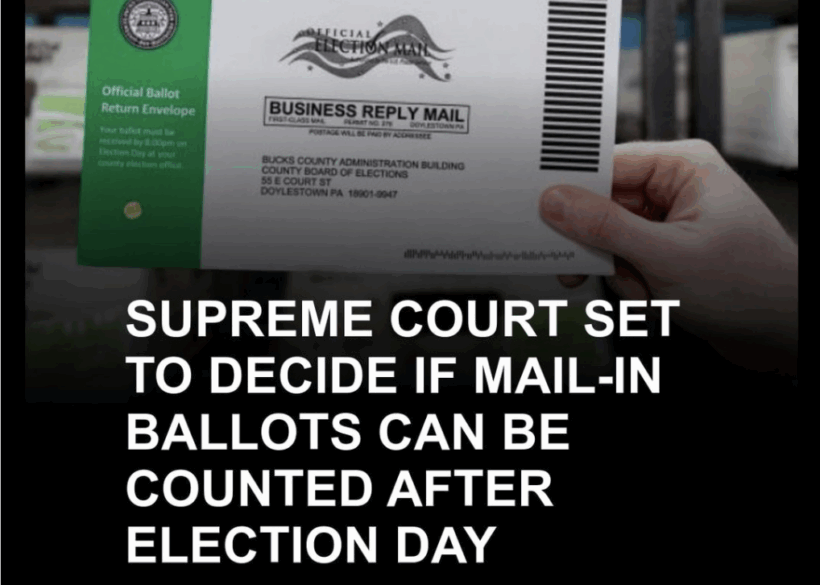
(by John Fritze, CNN) — The Supreme Court agreed Monday to decide whether states may count mail-in ballots received after Election Day, taking up a Republican-led lawsuit that could affect [deadlines for late arriving ballots] in more than a dozen states across the country.
It is the latest of several high-profile voting cases to make it on to the Supreme Court’s docket this year as the justices are asked to deal with controversies dating back over the past several elections.
Fifteen states allow regular mail ballots to be accepted after Election Day, including presidential battleground Nevada. [A few] of the nation’s battleground states – including Michigan, Pennsylvania and Wisconsin – require ballots to be received by Election Day. [The other battlegrounds in addition to Nevada – North Carolina, Georgia and Arizona – accept ballots after Election Day]. …
A Mississippi law, enacted during the Covid-19 pandemic, allows ballots to be received up to five days late, so long as they are postmarked by Election Day. The Republican National Committee and others sued over that law, [arguing] the provision violated a federal law that [sets] the date for [federal] elections.
“With rare outliers, [until very recently], the states mandated that ballots must be received by election officials by election day,” the RNC told the Supreme Court in written arguments this year. “But recently, an increasing number of States – including Mississippi – have deviated from that practice by permitting at least some ballots to be received after election day.”
Officials in Mississippi, where Trump carried more than 60% of the vote, have questioned the RNC’s logic. An election, they told the Supreme Court, is the choice of an official.
“Voters make that choice by casting – marking and submitting – their ballots by election day. The election has then occurred, even if election officials do not receive all ballots by that day,” Mississippi officials said in written arguments. “Under Mississippi law, voters cast their ballots by election day.”
…The…5th US Circuit Court of Appeals ruled last year that Mississippi was violating federal law by counting mail ballots that arrived after Election Day, but the court notably stopped short of blocking the state’s policy before the 2024 presidential election. …
A majority of the [high] court last month indicated it would likely back a Republican congressman from Illinois who is challenging a state law that allows mail-in ballots to be received after Election Day, a decision that would let him proceed with a…lawsuit that lower courts had rejected.
Published at CNN on Nov 10. Reprinted here for educational purposes only. May not be reproduced on other websites without permission.
Questions
1. The first paragraph of a news article should answer the questions who, what, where and when. List the who, what, where and when of this news item. (NOTE: The remainder of a news article provides details on the why and/or how.)
2. a) Define battleground states (also called swing states).
b) Which of the 7 battleground states accept mail-in ballots days after Election Day?
3. a) How long after Election Day does Mississippi law allow ballots to be received and counted?
b) When did Mississippi enact the law?
c) For what extenuating circumstances did Mississippi enact the law?
4. Read the “Background” below the questions. Do you think the states that permitted ballots received several days after Election Day to count should now revert back to pre-2020 laws? Explain your answer.
5. The case involves the question: Does federal law permit states to count ballots received after Election Day? Ask a parent or grandparent their opinion.
6. President Trump, Republicans and conservatives oppose accepting ballots after Election Day. Democrats, liberals and progressives support counting ballots for days after Election Day. Why do you think this is so? Ask a parent the same question.
Background
On absentee / mail-in ballots and which voters could use them:
- For over 100 years, states in the U.S. primarily allowed absentee ballots to be mailed in for absentee voters who had a valid reason such as illness, disability, travel, military service…
- Allowing voters to request absentee ballots began during the Civil War era in the 1860s. The practice was started to allow soldiers who were away from home fighting to vote by mail.
- Over the next 100+ years, states gradually expanded absentee voting but required a valid excuse. Absentee ballots were mailed in and had to be received by election day.
- In 1978 California became the first state to allow any registered voter to request an absentee ballot without needing to provide a reason. This shift marked the beginning of broader “no-excuse” absentee ballot requests, which gradually expanded in many states over the following decades.
- Today, fourteen states require voters to provide a valid excuse to vote absentee/by mail. Twenty-eight states allow any eligible voter to cast an absentee/mail-in ballot. Eight states have automatic mail-in ballot systems.
These eight states currently mail ballots to EVERY voter automatically, not just those who request an absentee ballot:
- Oregon (began in 1998), Washington (2011), Colorado (2013), Utah (2020), Hawaii (2019), Nevada (2020), California (2022), Vermont (2021), Washington DC (2023).
–From Perplexity AI, Nov. 11, 2025 and from Ballotpedia’s Absentee/mail in voting page (scroll down for map)
Read about All-Mail Voting (every voter receiving a ballot in the mail without requesting one) at Ballotpedia.
On mail-in ballots received after Election Day:
- Prior to 2020, very few states allowed any receipt of ballots after Election Day outside a handful of Western states like Washington and Utah, which pioneered mail-in systems in the 2010s.
- As of 2025, 19 states and the District of Columbia allow mail-in ballots to be received after Election Day (if they are postmarked by Election Day), most between 5 to 7 days after the election – and states vary whether they count business days or calendar days after Election Day for ballots to be counted that are postmarked by Election Day.
This mix of rules means the exact deadline date can vary according to how days are counted after Election Day.
Why is the RNC challenging Mississippi’s law on mail in ballot received after Election Day and not other states?
The Republican National Committee (RNC) is focusing on Mississippi’s law allowing mail-in ballots received after Election Day because the legal dispute specifically originated there, following a challenge to legislation passed by the state’s Republican legislature in 2020. Although similar [extensions] for [accepting late] mail ballots exist in over 30 states and Washington, D.C., the Mississippi case advanced far enough through the courts—ultimately resulting in a federal appellate decision striking down the law—prompting an appeal to the Supreme Court.
The Supreme Court’s ruling on this case could impact all states with similar laws by clarifying whether federal law permits states to accept ballots received after Election Day.
Why Not Challenge All States Directly?
- Legal process requires the RNC (or any party) to bring challenges in specific jurisdictions, so the initial focus was on Mississippi where the law was debated and litigated.
- Mississippi’s appellate-level ruling created a clear “case or controversy” for Supreme Court review, making it procedurally feasible to set a national precedent.
- The Supreme Court’s decision will address the broader question and could resolve conflicting rules in all affected states at once, rather than needing separate challenges in each jurisdiction.
In summary, the RNC did not ask the Supreme Court to review every state’s law because the Mississippi challenge progressed far enough to present the central legal question, thus allowing the Supreme Court to set a nationwide rule that would affect all states with similar ballot receipt policies.
(from Perplexity AI, Nov. 10, 2025)
Resources
Read President Trump’s March 25, 2025 Executive Order “Preserving and Protecting the Integrity of American Elections”
Watch a November 10, 2025 report from The National News Desk:
Daily “Answers” emails are provided for Daily News Articles, Tuesday’s World Events and Friday’s News Quiz.