redo Jump to...
print Print...
(by Lori Ann LaRocco, CNBC) — Since 2024, the big crude oil tanker that U.S. forces seized Wednesday off the coast of Venezuela has shown a “clear pattern” of spoofing its location to hide where it actually was, according to a leading energy consulting firm.
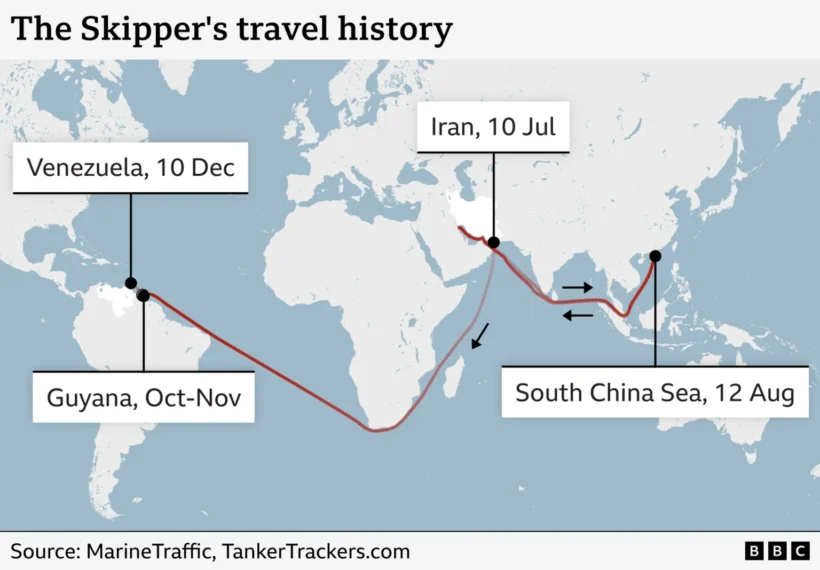
And data suggests that since 2022 the Guyana-flagged tanker identified as Skipper has carried sanctioned oil from Iran and Venezuela. [Note: The Guyanese government stated that the Skipper was “falsely flying the Guyana Flag as it is not registered in Guyana”].
The oil industries of both [Iran and Venezuela] are under U.S. sanctions, and Skipper has been under sanction by the U.S. Office of Foreign Assets Control (OFAC) since 2022 [when it was sailing under the name Adisa, and was accused of being part of an “international oil smuggling network”].
Matt Smith, head U.S. analyst at the consulting firm Kpler* said Skipper was covertly loaded with 1.1 million barrels of oil in mid-November. [*Kpler tracks global flows, storage levels, and inventories for crude oil, refined products (LPG, LNG), dry bulk, and metals. It offers ship tracking, congestion data, and freight analytics. It combines satellite imagery, port data, and AI with human analysis for high-precision data].
Smith said the ship appeared to be headed for Cuba, though it has been stopped offshore Venezuela since it was loaded.
In the past two years, there have been a total of more than 80 days in which there is evidence of Skipper engaging in so-called AIS spoofing to obscure its location, according to Kpler data.
AIS, or automatic identification system, provides real-time information about a ship’s location and includes the vessel’s name, course, speed, classification, call sign and registration number, according to the U.S. Coast Guard’s website. [Under a UN treaty, all ships above a certain tonnage must have the AIS onboard tracker].
During the time that the Skipper’s real location was hidden on the AIS network, there were multiple ship-to-ship transfers of cargo, according to Kpler data.
The Skipper displayed “a clear pattern of deceptive operations that went far beyond what its AIS transmissions claimed,” said Dimitris Ampatzidis, Kpler’s manager for risk and compliance.
In 2024, three AIS spoofings by the Skipper were recorded in Egypt, Iran, the Mediterranean Sea, Ghana and Nigeria, according to Kpler.
“Falsified positions were broadcast, particularly through extended AIS spoofing episodes,” said Ampatzidis. “The Skipper engaged in activities entirely inconsistent with its declared voyage, including sanctioned [prohibited/restricted] loadings in Iran and Venezuela.
“These behaviors form a coherent picture: a vessel intentionally engineered to operate outside transparency, using digital manipulation and covert logistics to mask sanctioned crude flows under the appearance of normal maritime traffic,” Ampatzidis said.
Port call data from 2025 shows that the Skipper transported oil out of the ports of Jose in Venezuela and Kharg Island in Iran, according to Kpler data.
In 2024, port calls for Skipper included Banias Port in Syria and Kharg Island in Iran. And in 2023, Skipper visited the Port of Jose in Venezuela.
The Skipper [oil tanker] is owned by Marshall Islands-based Triton Navigation Corp., and the beneficial cargo owner, vessel manager and operator is Nigeria-based Thomarose Global Ventures Ltd., according to Kpler data.
Triton Navigation has been on the OFAC sanctions list since November 2022.
[Since 2005, the United States has imposed targeted sanctions on Venezuelan individuals and entities that have engaged in criminal, antidemocratic, or corrupt actions.“I believe that the purpose of seizing a sanctioned oil tanker is to make oil buyers and tanker owners operating in the shadow fleet* wary of loading Venezuelan crude oil, reducing the Maduro government’s revenues and ultimately hastening his exit,” said Andrew Lipow, president of Lipow Oil Associates. [*The shadow fleet (or dark fleet) are a clandestine fleet of vessels, often aging tankers, that operate outside normal maritime regulations to transport sanctioned goods (like Russian oil) or engage in illicit activities, using tactics like turning off transponders and falsifying documents to evade detection and sanctions].
“With oil prices hovering below $60 per barrel, it would appear the Trump administration is not too worried about losing Venezuelan oil supplies to the market; there is plenty of oil around,” Lipow said.
“On the other hand, China would be unhappy losing access to deeply discounted oil supplies.”
Despite the fact that the U.S. has imposed sanctions on Venezuela’s oil, it is exporting about 749,000 barrels per day this year, with at least half that oil going to China, according to data from Kpler].
The seizure of the Skipper came as President Trump has ramped up pressure on Venezuelan President Nicolás Maduro. Trump has said that Maduro’s “days are numbered.”
Published at CNBC on Dec 11. Reprinted here for educational purposes only. May not be reproduced on other websites without permission.
Questions
1. What are oil sanctions?
2. For what reasons has the U.S. imposed oil sanctions on Venezuela?
3. a) Why did the U.S. seize the oil tanker Skipper off the coast of Venezuela on Wednesday?
b) What evidence is there that it was covertly defying sanctions? (What did the Skipper tanker use AIS spoofing to do?) Be specific.
4. a) What is the automatic identification system (AIS)?
b) Define spoofing as used in the article.
5. What is OFAC and which US government department administers it?
6. Despite the fact that the U.S. has imposed sanctions on Venezuela’s oil, it is exporting about 749,000 barrels per day this year, with at least half that oil going to China, according to data from Kpler.
What is the purpose of the U.S. seizing the sanctioned oil tanker, according to Andrew Lipow, president of Lipow Oil Associates?
7. Ask a parent to read the article and give his/her opinion explaining whether he/she supports the Trump administration’s seizure of the ‘Spoof’ oil tanker violating U.S. sanctions.
Background
President Obama initiated U.S. sanctions on Venezuela starting in late 2014 and 2015, targeting specific officials for human rights abuses, corruption, and anti-democratic actions, particularly following violent crackdowns on protests, rather than broad economic sanctions, though they evolved and were later expanded by subsequent administrations. [Trump expanded sanctions, Biden dropped some and in his second term, Trump has reinstated the sanctions].
Venezuela holds the world’s largest proven oil reserves, estimated at around 17-20% of the global total (roughly 300 billion barrels), but due to sanctions and mismanagement, it contributes a much smaller percentage (around 1-1.3%) to actual global oil production, despite having more oil than Saudi Arabia or the U.S.
Almost all oil in Venezuela is controlled/owned by the government. The Venezuelan government seized private oil companies in several waves, most notably the 1976 nationalization under socialist President Carlos Andrés Pérez, bringing all oil operations under state control. Later, under socialist President Hugo Chávez, the government took over remaining foreign-run oil fields and service companies in 2007 and further seized oil service assets in 2009, intensifying state control over the energy sector. (from Google AI Overview, Dec. 10)
The US Office of Foreign Assets Control (“OFAC”) of the US Department of the Treasury administers and enforces economic and trade sanctions based on US foreign policy and national security goals against targeted foreign countries and regimes, terrorists, international narcotics traffickers, those engaged in activities related to the proliferation of weapons of mass destruction, and other threats to the national security, foreign policy or economy of the United States. (ofac.treasury.gov)
The primary countries and blocs sanctioning Venezuelan oil and related entities are the United States (US), European Union (EU), United Kingdom (UK), and Canada, targeting the state oil company PDVSA and individuals/sectors undermining democracy, though some partners (China, Russia) facilitate trade…with overall trade routes shifting to sanctioned “dark fleets” to bypass restrictions. China and Russia are key to keeping Venezuela’s oil flowing despite U.S. pressure, with China buying Venezuela’s heavily discounted crude [-Venezuela must discount it due to the sanctions]. (Google AI)
Note: The U.S. has imposed significant oil sanctions on Iran, Venezuela, and Russia, restricting their energy exports and related financial dealings, alongside sanctions on countries like Cuba, North Korea, and certain regions in Ukraine (like Crimea) affecting oil trade, with recent actions focusing heavily on targeting evasion networks and vessels for Russia and Venezuela.
Resources
Fox Business, December 11, 2025:
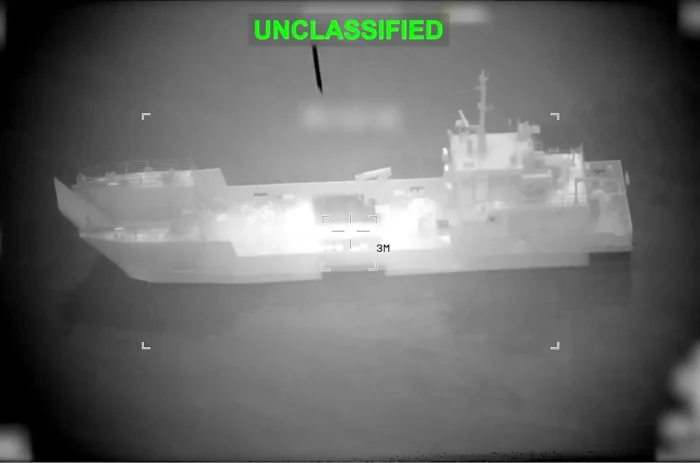
On December 10, 2025, the Federal Bureau of Investigation, Homeland Security Investigations, and the United States Coast Guard, with support from the Department of War, executed a seizure warrant for a crude oil tanker used to transport sanctioned oil from Venezuela and Iran:
Daily “Answers” emails are provided for Daily News Articles, Tuesday’s World Events and Friday’s News Quiz.