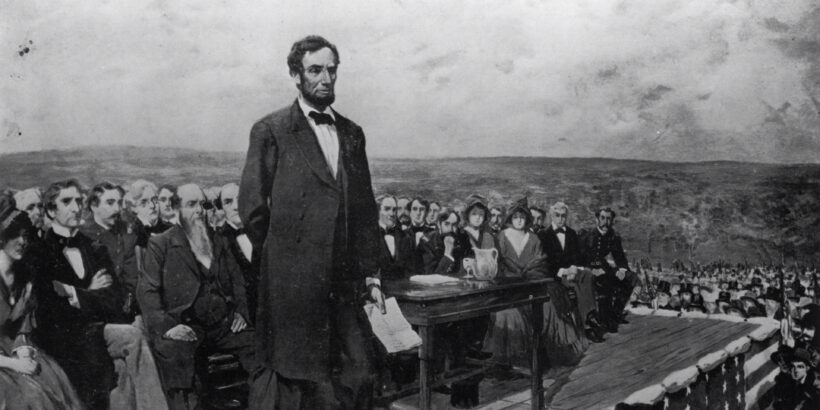
Abraham Lincoln. Gettysburg Address. Library of Congress.
redo Jump to...
print Print...
The Battle of Gettysburg was the bloodiest battle of America’s Civil War. In July 1863, a Confederate army of 75,000 men faced the 83,000-man Union Army. More men fought and died in this battle than in any other before or since on American soil. The Union suffered 23,000 casualties; the Confederacy suffered 25,000. Of those casualties, 8,520 Union soldiers were killed or missing; 9,750 Confederate soldiers were killed or missing.
Lincoln visited the battlefield to dedicate a cemetery for the victims of that great battle. His short, two-minute speech was delivered over 160 years ago on November 19, 1863.
How it happened: In October 1863, President Lincoln received the same invitation that was sent to hundreds of people, requesting attendance at a dedication of the Soldiers’ National Cemetery at Gettysburg.
Col. Clark E. Carr, a confidante of several U.S. presidents and a member of the commission that organized the event, later admitted that commissioners scrambled to send a more personal invitation after Lincoln indicated he would attend.
Asking the president to deliver a “few appropriate thoughts,” Carr said, was “an afterthought.”
The dedication’s featured speaker was Edward Everett. A former secretary of state, U.S. senator, Massachusetts governor and Harvard president whose nationwide tour helped to save Mount Vernon as a national shrine, Everett was considered the great orator of his time.
Everett spoke for over two hours. Then Lincoln got up and his speech lasted two minutes.
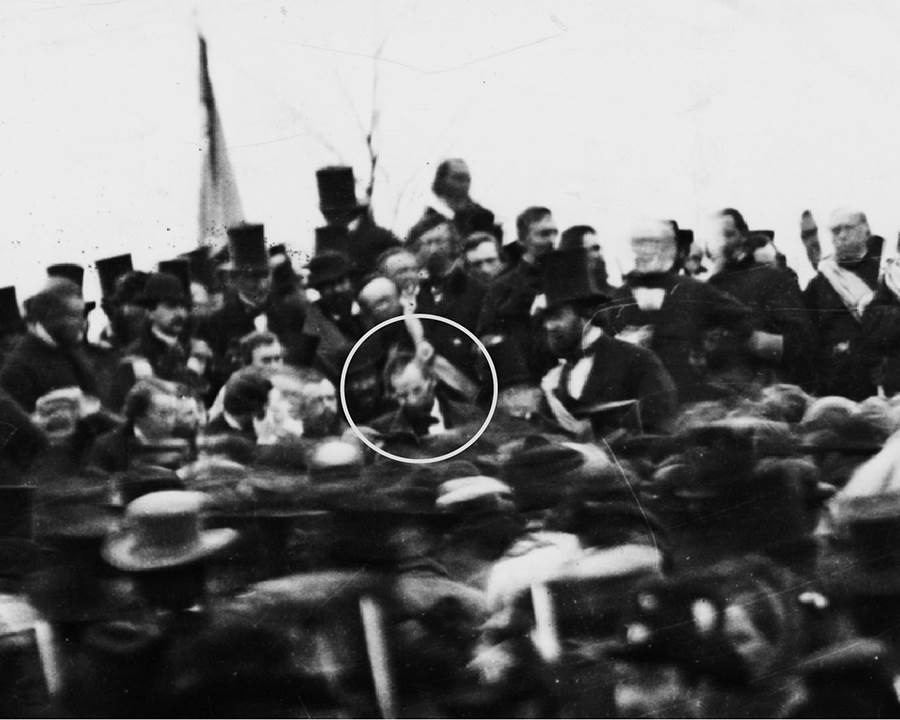
A Matthew Brady photo of the crowd at Gettysburg caught a blurry image of Abraham Lincoln before he delivered his famous address.
There are several copies of the Gettysburg Address in Lincoln’s handwriting. Each is slightly different. The Bliss Copy, presented below, is the most commonly used version and is featured on the Lincoln Memorial.
Four score and seven years ago our fathers brought forth on this continent, a new nation, conceived in Liberty, and dedicated to the proposition that all men are created equal.
Now we are engaged in a great civil war, testing whether that nation, or any nation so conceived and so dedicated, can long endure. We are met on a great battle-field of that war. We have come to dedicate a portion of that field, as a final resting place for those who here gave their lives that that nation might live. It is altogether fitting and proper that we should do this.
But, in a larger sense, we can not dedicate — we can not consecrate — we can not hallow — this ground. The brave men, living and dead, who struggled here, have consecrated it, far above our poor power to add or detract. The world will little note, nor long remember what we say here, but it can never forget what they did here. It is for us the living, rather, to be dedicated here to the unfinished work which they who fought here have thus far so nobly advanced. It is rather for us to be here dedicated to the great task remaining before us — that from these honored dead we take increased devotion to that cause for which they gave the last full measure of devotion — that we here highly resolve that these dead shall not have died in vain — that this nation, under God, shall have a new birth of freedom — and that government of the people, by the people, for the people, shall not perish from the earth.
Questions
NOTE: Before answering the questions, read the “Background” and watch the videos under “Resources” below.
1. When did the Battle of Gettysburg take place?
2. In what state did the Battle of Gettysburg take place?
3. What is the significance of this battle?
4. a) What was the date of Lincoln’s Gettysburg Address?
b) Why wasn’t President Lincoln the keynote speaker at the dedication of the cemetery, but asking him to speak was “an afterthought”?
5. Read President Lincoln’s Gettysburg Address.
a) How long was the president’s speech?
b) How long was the keynote speaker’s speech?
c) Why do you think Lincoln’s Gettysburg Address became one of the most significant in American history?
6. Consider the videos from 1929-30 of veterans speaking of a time when they were young men who fought in the Civil War (1861-64). What is your reaction?
CHALLENGE: Did you know? — High school students memorized poems and speeches as a standard practice in US schools from the 19th century until around 1960.
Memorize Lincoln’s Gettysburg Address.
Background
The Battle of Gettysburg: The Battle of Gettysburg marked the turning point of the Civil War. With more than 50,000 estimated casualties, the three-day engagement was the bloodiest single battle of the conflict.
How it ended: Union victory. Gettysburg ended Confederate general Robert E. Lee’s ambitious second quest to invade the North and bring the Civil War to a swift end. The loss there dashed the hopes of the Confederate States of America to become an independent nation.
In context: After a year of defensive victories in Virginia, Lee’s objective was to win a battle north of the Mason-Dixon line in the hopes of forcing a negotiated end to the fighting. His loss at Gettysburg prevented him from realizing that goal. Instead, the defeated general fled south with a wagon train of wounded soldiers straining toward the Potomac. Union general Meade failed to pursue the retreating army, missing a critical opportunity to trap Lee and force a Confederate surrender. The bitterly divisive war raged on for another two years.
From The American Battlefield Trust website (includes detailed maps and video)
From July 1-3, 1863, Confederate forces led by General Robert E. Lee clashed with the Union army led by General George Meade. The battle left more than 51,000 killed, wounded, or missing. Wounded soldiers were crowded into nearby buildings, and many of the dead lay in hastily dug and inadequate graves.
Pennsylvania’s Governor Andrew Curtin responded to the crisis by purchasing 17 acres of land for a proper burial ground for the Union dead. Within four months of the battle, reinterment began on the land that became Gettysburg National Cemetery.
By the time of the dedication ceremony for the cemetery on November 19, 1863, less than half the Union battle dead had been removed from their field graves. Within a few years, however, the bodies of more than 3,500 Union soldiers killed in the battle had been reinterred in the cemetery. Following the war, the remains of 3,320 Confederate soldiers were removed from the battlefield to cemeteries in the South.
Today the cemetery is the final resting place for over 6,000 honorably discharged servicemen and their dependents from the Civil War, Spanish-American War, World War I, World War II, and the Vietnam War. (from Cornell University Library)
Read more about the Battle of Gettysburg at: gettysburgpa.gov.
Read a 2013 editorial “President Skips Commemoration of 150th Anniversary of Gettysburg Address“
Resources
Civil War Soldiers Telling War Stories in 1938: Gettysburg, Pennsylvania Veteran’s Reunion
Two Civil War veterans, aged 84 and 94, talking about fighting in the Civil War. Filmed in 1929, at the time of the Civil War the two men would have been 16 years old and 26 years old when the war started in 1861.
Civil War Veterans Talking and Telling Stories: Filmed in 1930
Daily “Answers” emails are provided for Daily News Articles, Tuesday’s World Events and Friday’s News Quiz.