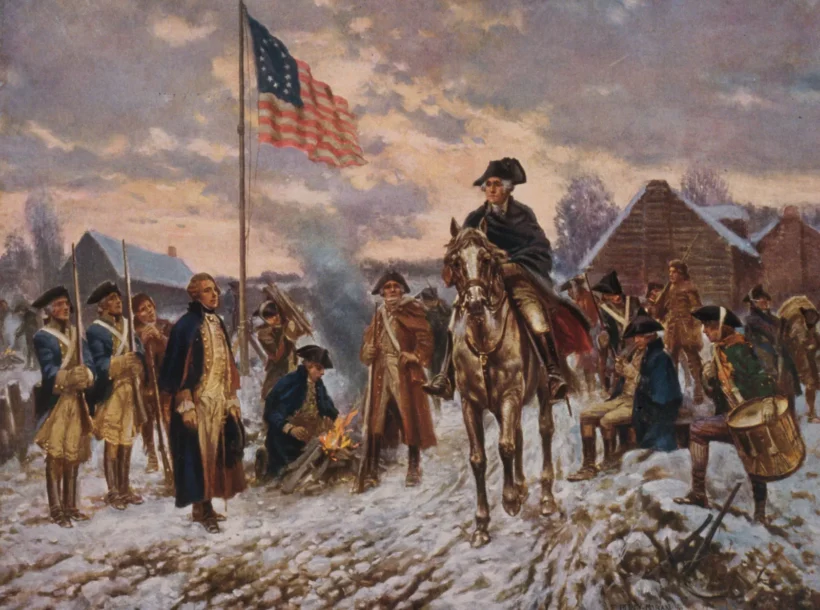
George Washington at Valley Forge (1777-1778), print of the painting by Edward Percy Moran (c. 1911).
print Print...
NOTE: Presidents’ Day, is a federal holiday held on the third Monday of February. Lincoln’s birthday (Feb. 12) and Washington’s birthday (Feb. 22) used to be celebrated separately before the two were combined into Presidents’ Day.
Today’s post is on George Washington.
(Also, see last Wednesday’s post on Abraham Lincoln.)
George Washington led the Continental Army to victory in the Revolutionary War, presided over the Constitutional Convention, set crucial precedents as the first U.S. President (like establishing the cabinet and neutrality), established the two-term tradition for presidents and ensured a peaceful transfer of power…
ON WASHINGTON’S BIRTHDAY: (from archives.gov)
- George Washington was born on February 22, 1732. Americans celebrated Washington’s Birthday long before Congress declared it a federal holiday.
- The centennial of his birth prompted festivities nationally and Congress established a Joint Committee to arrange for the occasion.
- At the recommendation of the Committee, chaired by Henry Clay of the Senate and Philemon Thomas of the House, Congress adjourned on February 22, 1832 out of respect for Washington’s memory and in commemoration of his birth.
- In 1862, prompted by a memorial from the mayor and other citizens of Philadelphia, the U.S. House and Senate commemorated the 130th Anniversary of Washington’s birth by reading aloud his Farewell Address.
- In a special joint session held in the House Chamber, the House and Senate, along with several cabinet officials, Justices of the Supreme Court and high-ranking officers of the Army and Navy, gathered to listen to the Secretary of State read the address aloud.
- Eventually, the reading of George Washington’s Farewell Address became an annual event for the Senate, a tradition that is still observed to this day.
- Washington’s Birthday, however, did not become a legal holiday until January 31, 1879 when Congress added February 22nd to the list of holidays to be observed by federal employees in the District of Columbia.
- In 1971, Congress switched Washington’s Birthday holiday from his birthdate, Feb. 22, to the third Monday in February and it evolved into being called “Presidents Day.” The day now celebrates both Washington’s birthday and President Abraham Lincoln’s birthday, which is Feb. 12.
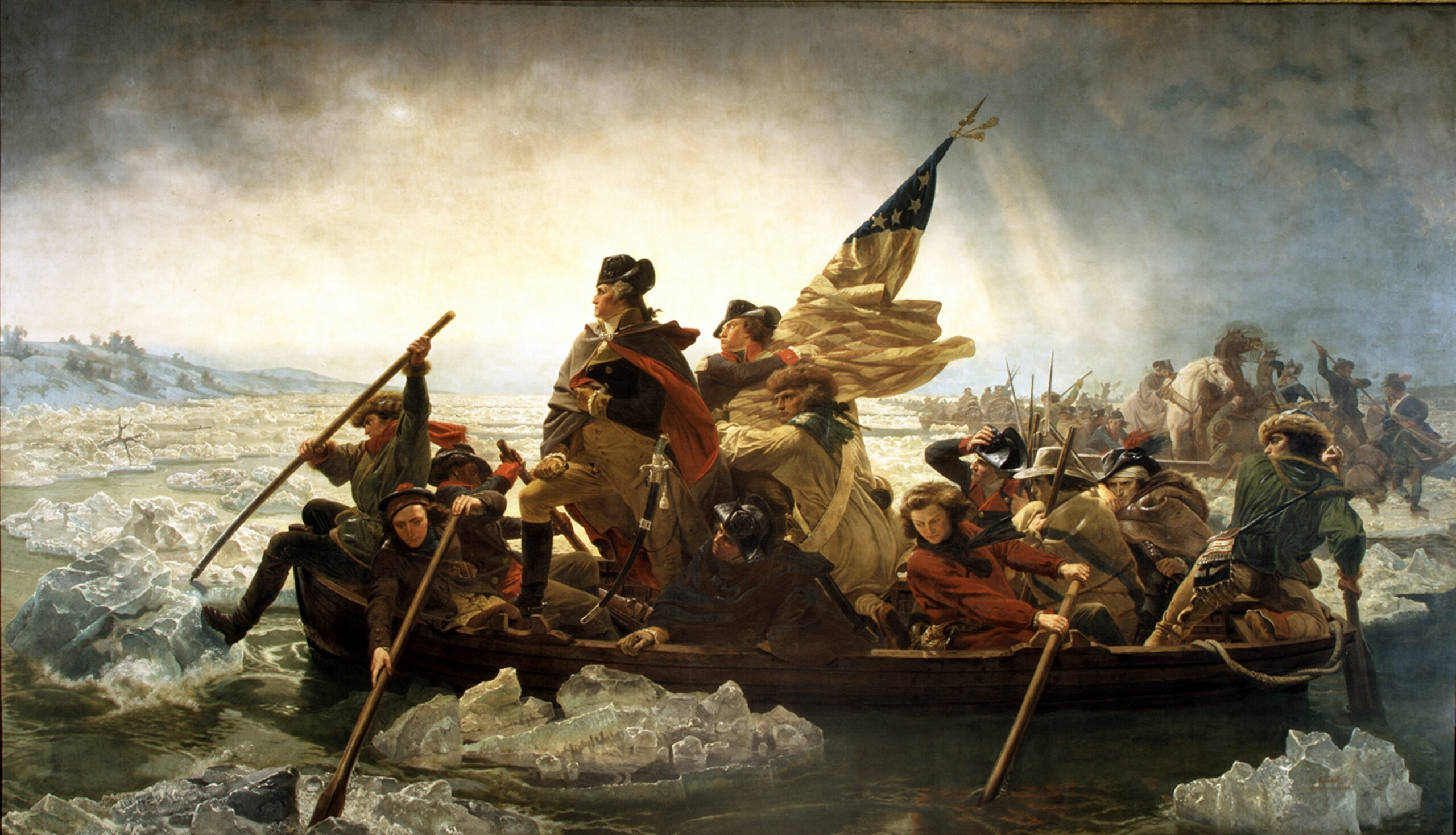
Washington Crossing the Delaware, an 1851 portrait by Emanuel Leutze depicting Washington and Continental Army troops crossing the river prior to the Battle of Trenton on the morning of December 26, 1776
GEORGE WASHINGTON AND THE CONSTITUTION:
- In 2012, George Washington’s personal copy of the Constitution, in which he had written notes, sold at auction for $9.8 million.
- The Mt. Vernon Ladies Association bought it.
- It allowed us to see, for the first time, how cautiously our first president assumed the office, his eyes not toward history but the future.
- Next to two passages explicating the signing of a bill into law, which he bracketed, Washington has written in cursive, “President.”
- He also inscribed “Presidential Powers” next to the paragraphs that lay out the president’s role as commander-in-chief, as well as his authority to grant pardons, make treaties and appoint Supreme Court justices.
- Beneath that, in the paragraph that reads, “He shall from time to time give Congress information of the state of the union,” Washington has added “required,” and it was he who established the address as an annual event.
CHALLENGE: Have you read through the entire Constitution? Read through the U.S. Constitution – for the full text, go to the U.S. Archives: archives.gov
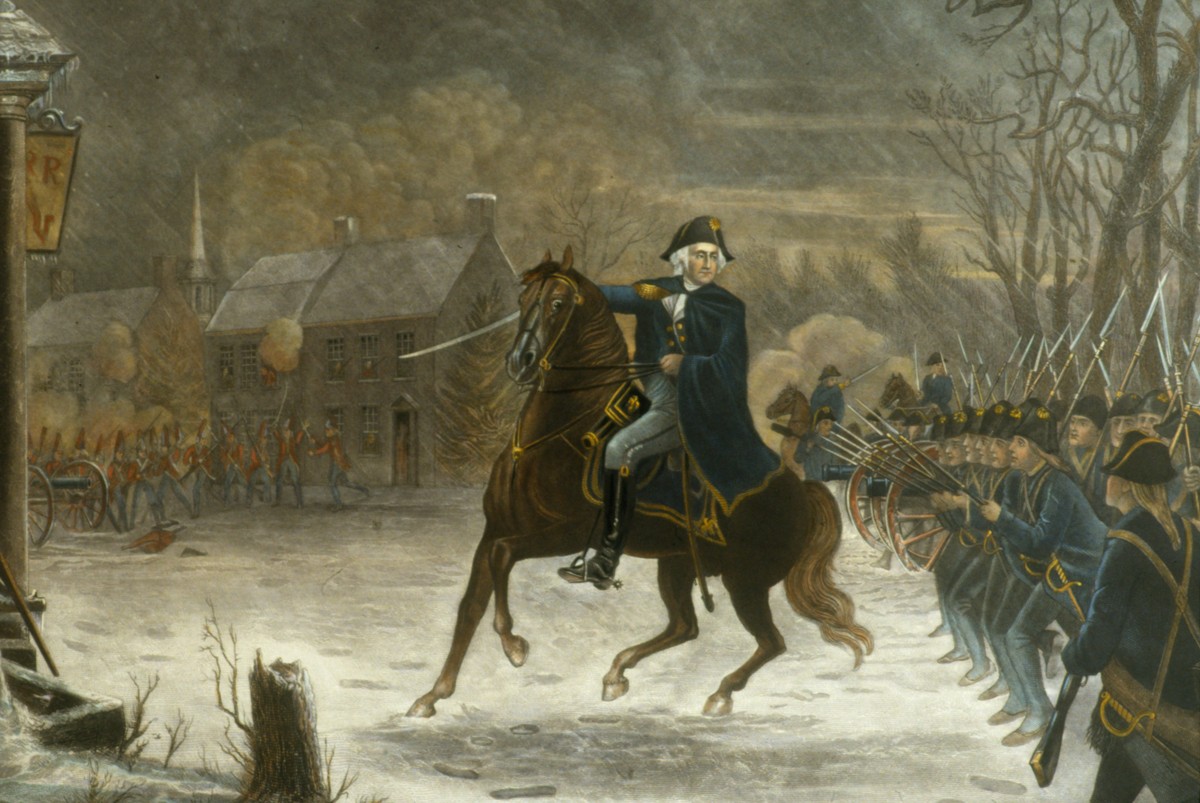
George Washington at the Battle of Trenton.
Questions
Instead of reading what others say about George Washington, read some of his own writings, or works he thought were important:
1. George Washington was inaugurated as the first President of the United States on April 30, 1789. The historic ceremony took place on the balcony of Federal Hall in New York City, which was the nation’s capital at the time.Read George Washington’s 1789 Thanksgiving Proclamation. What surprises you most about this proclamation? Explain your answer.
2. On George Washington’s letters to his wife Martha:
- Martha Washington destroyed nearly all of George’s letters to her shortly before her death in 1802. Three letters, however, did survive.
- Two are printed in The Papers of George Washington, Revolutionary War Series, vol. 1, June 18, 1775 and June 23, 1775. These letters were found by Martha Parke Custis Peter, one of Martha Washington’s granddaughters, in a drawer of a small desk that she inherited from Mrs. Washington. The June 18, 1775 letter is now held at Tudor Place, home of Martha Parke Custis Peter and her husband Thomas Peter.
- Read the transcript of the June 23, 1775 letter
- and the June 18, 1775 letter
- Read about Martha at mountvernon.org
a) Why do you think Martha Washington destroyed almost all of George’s letters?
b) What do the surviving letters tell you about the type of man President Washington was? (Which 2-3 adjectives do you think best describe his character?) Explain your answer.
3. George Washington’s RULES OF CIVILITY:
At the age of 15 George Washington copied the “110 Rules of Civility and Decent Behaviour in Company and Conversation.” These maxims were so fully lived out in George Washington’s life that historians have regarded them as important influences in forming his character. Listed below are several of the maxims George Washington followed.
a) Define “civility” and “maxim.”
b) Choose 3 maxims you think are the most important for all Americans to follow. Rewrite them in modern language.
c) Do you think our society would be better, worse, or no different if people followed George Washington’s “Rules of Civility”? Explain your answer.
#4 – In the presence of others sing not to yourself with a humming noise, nor drum with your fingers or feet.
#5 – If You Cough, Sneeze, Sigh, or Yawn, do it not Loud but Privately; and Speak not in your Yawning, but put Your handkercheif or Hand before your face and turn aside
#6 – Sleep not when others Speak, Sit not when others stand, Speak not when you Should hold your Peace, walk not on when others Stop.
#7 – Put not off your Cloths in the presence of Others, nor go out your Chamber half drest.
#14 – Turn not your Back to others especially in Speaking, Jog not the Table or Desk on which Another reads or writes, lean not upon any one.
#18 – Read no Letters, Books, or Papers in Company but when there is a Necessity for the doing of it you must ask leave: come not near the Books or Writings of Another so as to read them unless desired or give your opinion of them unask’d also look not nigh when another is writing a Letter.
#22 – Shew not yourself glad at the Misfortune of another though he were your enemy.
#23 – When you see a Crime punished, you may be inwardly Pleased; but always shew Pity to the Suffering Offender.
#38 – In visiting the Sick, do not Presently play the Physicion if you be not Knowing therein.
#40 – Strive not with your Superiers in argument, but always Submit your Judgment to others with Modesty.
#53 – Run not in the Streets, neither go too slowly nor with Mouth open go not Shaking yr Arms kick not the earth with yr feet, go not upon the Toes, nor in a Dancing fashion.
#56 – Associate yourself with Men of good Quality if you Esteem your own Reputation; for ’tis better to be alone than in bad Company.
#71 – Gaze not on the marks or blemishes of Others and ask not how they came. What you may Speak in Secret to your Friend deliver not before others.
#72 – Speak not in an unknown Tongue in Company but in your own Language and that as those of Quality do and not as the Vulgar; Sublime matters treat Seriously.
#89 – Speak not evil of the absent for it is unjust.
#95 – Put not your meat to your mouth with your knife in your ha[nd ne]ither spit forth the stones of any fruit [pie] upon a dish nor cas[t an]ything under the table.
#108 – When you Speak of God or his atributes, let it be seriously & [with] reverence. honour & obey your natural parents altho they be poor.
#109 – Let your Recreations be Manfull not Sinfull.
CHALLENGE: Choose 5-10 maxims from the link above. Make a short video illustrating your choices. (see “Resources” below for a video done by a group of University of Virginia students several years ago)
Resources
- For more information on George Washington, go to MountVernon.org.
- Read The Bulletproof George Washington detailing God’s protection of George Washington.
- George Washington’s tomb is at Mt. Vernon. Read/watch Famous Visits to Washington’s Tomb.
- Read an editorial “George Washington’s Advice” and answer the questions.
- Read Washington’s Farewell Address at Senate.gov. (It’s long, but take the time to do so!) What impresses you most about this address?
- Take a quiz: How well do you know George Washington? at battlefields.org.
- Did you know Frenchmen fought with the Continental Army during the Revolutionary War?
Read about 19 year old Marquis de Lafayette here.
Watch the video below. What do you think of the video below made by University of Virginia students to explain/illustrate the intended meaning of some of George Washington’s “Rules of Civility”?
Daily “Answers” emails are provided for Daily News Articles, Tuesday’s World Events and Friday’s News Quiz.