redo Jump to...
print Print...
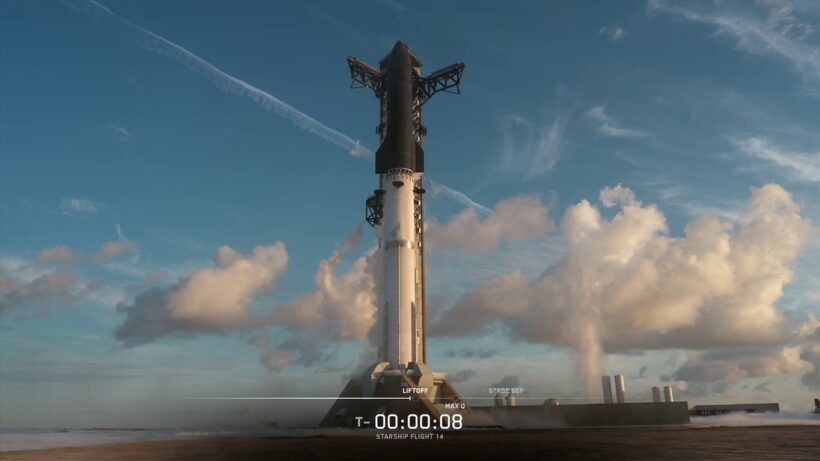
(by Addie Davis, OANN) – SpaceX’s Starship reached orbit for the first time on Monday before deploying a batch of next-generation Starlink satellites and splashing down in the Pacific Ocean.
Starship, referring collectively to the spacecraft upper stage and the Super Heavy booster rocket, launched from Texas. After delivering the upper stage into space, the Super Heavy booster returned for a controlled splashdown in the Gulf of America.
Upon achieving orbit, Starship deployed its payload of more than two dozen Starlink V3 satellites, which the company said are designed with increased capacity, data density and power generation — compared to the thousands of Starlink satellites already in orbit.
Originally scheduled for a 10-hour mission, Starship was reportedly brought down early, completing a three-hour flight before reentering the atmosphere and splashing down in the Pacific Ocean.
SpaceX explained that Monday’s launch marked the first time Starship went into orbit, as other flight tests had flown suborbital trajectories.
“By going to orbit, the next phase of developing Starship to be fully and rapidly reusable can begin,” the company said.
The Starship launch system is being designed to be fully reusable with long-term goals of carrying “both crew and cargo to Earth orbit, the Moon, Mars and beyond.” Described as “the world’s most powerful launch vehicle ever developed,” Starship has the capacity to carry more than 100 metric tons and stands at a height of over 400 feet.
SpaceX pointed to the planned future of Starship as space companies have been partnering with the NASA to further space exploration and innovation.
“As the most powerful launch system ever developed, Starship will be able to carry up to 100 people on long-duration, interplanetary flights,” the company said. “Starship will also help enable satellite delivery, the development of a Moon base, and point-to-point transport here on Earth.”
NASA Administrator Jared Isaacman also took to X on Monday to congratulate the mission’s success.
“Congrats [SpaceX]! Gorgeous launch, getting Ship to orbit and managing every step in a safe, responsible, and especially inspirational way,” Isaacman said. “[NASA], along with the rest of the interested public, is excited to help where we can and for Starship missions to become routine!”
(The launch marks Starship’s 14th test flight and its first attempt to reach orbit, a major step beyond previous suborbital missions that ended with splashdowns about an hour after liftoff. All Starship flights so far have been uncrewed).
Read a description of the launch and eventual splashdown at spacex.com).
Published at One America News Network on Sept. 28. Reprinted here for educational purposes only. May not be reproduced on other websites without permission.
Questions
1. What is the significance of Starship’s Monday launch?
2. How does SpaceX’s next generation Starlink V3 differ from the current Starlink satellites already in orbit?
3. How much shorter was Starship 14’s flight than planned?
4. What are SpaceX’s long term goals for Starship?
5. What capabilities does the Starship system have, according to SpaceX?
6. Read the “Background” and watch the videos under “Resources.”
What is your reaction to the Starship program? How impressed are you by this company?
Is space exploration important to you? Does this next phase of Starship make it more or less so, or have no effect? Explain your answers.
7. Elon Musk has long been deeply hands-on with Starship development—setting aggressive timelines, reviewing technical data, influencing design decisions, and treating it as a core personal priority for multiplanetary goals (Moon, Mars, etc.).
He does not typically act as the on-console flight director (that role belongs to SpaceX’s specialized teams), but he provides high-level direction, public communication, and strategic oversight.
Reports and his own statements over the years consistently show Starship absorbing a large share of his focus compared with other projects. (from a Sept 28 Grok query)
In your opinion, how important is Elon’s hands-on leadership and public communication style to the progress of the Starship program? Explain your answer.
Background
Starship stands 407 feet (124 meters) tall and can haul more than 110 tons (100 metric tons) to Earth orbit, according to its SpaceX specs page. The rocket’s Super Heavy booster and Ship upper stage are both designed to be fully and rapidly reusable.
SpaceX thinks this combination of power and reflight will be transformative, allowing humanity to expand its footprint into the final frontier like never before. For example, Elon Musk has repeatedly cited Starship’s potential to make Mars settlement economically feasible. (from space.com)
Both rocket parts have landed – what happens to them now? (Georgina Rannard, BBC News, Sept 28)
Ultimately, SpaceX wants its rockets and spacecrafts to be reusable. SpaceX chief executive Elon Musk frequently boasts that this will be a core feature of Starship and is an important part of the company’s business model.
SpaceX has previously pulled off spectacular catches of its rocket boosters in the signature “chop-stick” maneuver – when two giant pincers catch the fiery booster as they fall back to Earth. The first time that happened was October 2024.
But in this launch, neither the booster nor spacecraft will be recovered for re-use. The booster landed in the Gulf of America, and the Starship 14 capsule splashed down in the Pacific Ocean.
SpaceX usually try to collect the booster and capsules that return to Earth to analyze what happened to them during flight – that may not be possible with the Ship today after it landed so explosively.
Resources
Jesse Watters, September 28, 2026:
Starship achieved orbit on its first attempt and successfully delivered Starlink V3 satellites to space for the first time (@SpaceX) Sept 28, 2026:
Starship Flight 14 liftoff — the first Starship flight to reach orbit:
Starship Flight 14 launch from 5 miles away: visual & audio experience almost as good as being there (@JoeTegtmeyer), Sept 28, 2026:
Liftoff of Starship Flight 14 from Starbase TX seen from 4 miles away (@StarFleetTours):
Starship Flight 14 deploys 26 Starlink V3 satellites (@LunarCitizens):
What does methane exhaust look like silhouetted against the Sun, and how violent are the acoustic energy waves from 33 Raptor engines on the Super Heavy booster (from Max Evans _@_MaxQ_) September 28, 2026:
Daily “Answers” emails are provided for News Stories, Tuesday’s World Events and Friday’s News Quiz.