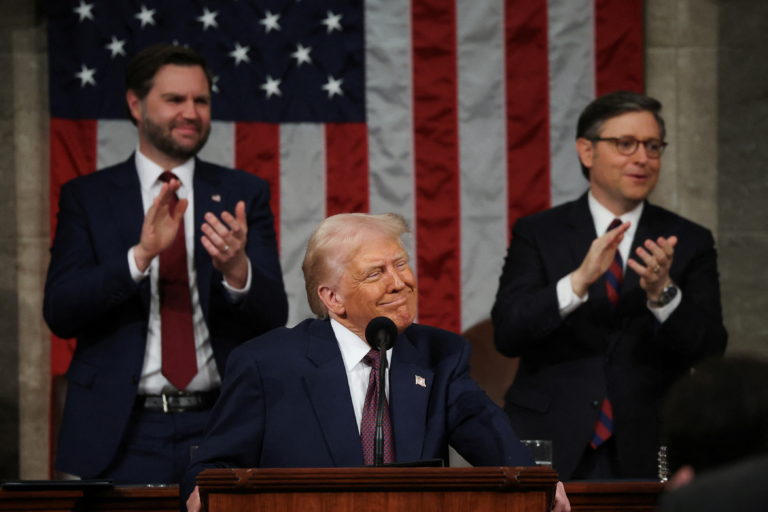
President Donald Trump addresses a joint session of Congress, March 4, 2025. Vice President JD Vance and Speaker of the House Mike Johnson (R-LA) applaud behind him.
redo Jump to...
print Print...
NOTE: The State of the Union will begin at 9pm EST on Tuesday, Feb. 24, 2026.
The president’s State of the Union address is delivered before a joint session of Congress, and includes Supreme Court justices, military leaders, Cabinet members and many guests. The speaker of the House and vice president sit behind the president while he speaks.
Traditionally, the president is in office for a year before he gives his first State of the Union address in February. In a State of the Union, the president outlines the accomplishments of his first year in office, and highlights his administration’s legislative agenda (which needs Congressional support) and his priorities for the country.
The White House hasn’t yet said what President Trump plans to talk about during Tuesday’s State of the Union address, but two things will be clear: His speech will be long, and he plans to talk about the economy.
“We have a country that’s now doing well,” Trump said during an event at the White House on Monday. “We have the greatest economy we’ve ever had. We have the most activity we’ve ever had. I’m making a speech tomorrow night, and you’ll be hearing me say that. It’s going to be a long speech because we have so much to talk about.”
While official attendees include members of Congress, the Cabinet (minus a designated survivor), Supreme Court justices, military leaders, and diplomats with reserved seating, the more notable “special guests” are everyday Americans or notable individuals seated in the gallery—often in the First Lady’s box or invited by the president, first lady, or lawmakers.
During the speech, the president often acknowledges some of these guests by name, pointing them out to illustrate points—such as heroism, victims of crime, beneficiaries of policies, survivors of tragedies, or exemplars of values like resilience or service. The goal is to connect policy proposals or themes (e.g., immigration, economy, national security, civil rights) to real people’s lives.
The tradition of inviting guests adds a human element to what could otherwise be a dry policy speech, helping advance the president’s agenda visually and narratively. It’s a bipartisan tradition, though the specific guests and themes vary by administration and political priorities.
Following their first Gold Medal win at the Winter Olympics in 46 years on Sunday, President Trump invited the U.S. Men’s Hockey team to attend the SOTU and offered to fly them to Washington on a military plane.
The speech will be aired live on C-Span and every major media outlet and is also set to stream live on the White House website, its YouTube and social media platforms.
Directly following the State of the Union, the opposing party gives a televised rebuttal speech to critique the president’s agenda, and present the opposing party’s priorities.
This year, the Democrats have chosen two people to deliver different responses: Virginia Gov. Abigail Spanberger and California Sen. Alex Padilla will give the 2026 SOTU responses in English (Gov. Spanberger) and a separate rebuttal in Spanish (Sen. Padilla).
Apart from the traditional opposing party response to the president’s policies laid out in the SOTU, Democrat lawmakers are planning a range of moves to broadcast their opposition to President Trump during his address to Congress.
Some plan to skip the event altogether, while others say they may leave in protest mid-speech.
Separate from the official Democratic response to President Trump’s SOTU, Rep. Summer Lee, D-Pa. will deliver the (democratic-socialist) Working Families Party response, offering a progressive counterpoint.
Additionally, as a way to protest President Trump, Sen. Adam Schiff (D-Calif.) is joining a growing group of Democrats [20 so far] who plan to boycott the State of the Union address and instead attend an alternative event on the National Mall, called the “People’s State of the Union,” that it is hosting with leftist advocacy group MoveOn Civic Action.
In another Democratic show of opposition to President Trump’s policies, Minneapolis Mayor Jacob Frey and Chicago Mayor Brandon Johnson will join several other Democratic elected officials and Hollywood actors in giving unofficial responses to President Trump’s State of the Union address on Tuesday night, according to a news release about the event.
Called the “State of the Swamp,” organizers are calling it a boycott of President Trump’s address.
Compiled from multiple media sources incl. Spectrum, Star Trib, Newsmax, ABC and Grok.
Questions
NOTE to students: Read the information under “Background” below before answering the questions.
1. a) What is the State of the Union address? What is the purpose of the address?
b) When and where is the State of the Union given?
2. Specifics of the speech have not been announced. What two things do we know prior to the president’s address?
3. a) List 3 policies and accomplishments you think the president is likely to note in his address.
b) Why should the president talk about his accomplishments in his address to the nation?
4. As every president’s does, President Trump’s address will focus on multiple issues. Which of the following do you think are most important for the president to include in his State of the Union address tonight? Explain your answer.
a) the economy/inflation/affordability
b) tariffs and making fair trade deals
c) border security/ICE arrests of violent criminal illegals let into the U.S. during President Biden’s open border policy/sanctuary cities
d) law and order / crime in the cities
e) securing the election/the SAVE America Act/proof of citizenship, voter ID, no paper ballots…
f) affordable prescription drug prices/healthcare
g) government shutdown/funding for DHS
h) Iran
i) Gaza – Board of Peace
j) other (explain)
5. Ask a parent what issues he/she thinks President Trump should focus on in his State of the Union, and to explain his/her answer.
CHALLENGE: WITHOUT listening to any comments by the media (during/after the speech), watch President Trump’s address to the nation and answer the following questions.
To watch the President’s address without comment, go to whitehouse.gov , the White House youtube page, or c-span.org.
To read the transcript of President Trump’s address, go to: ap.com.
(NOTE: All links will be enabled when they are available – some after the SOTU.)
1. Tone is the attitude a speaker takes towards a subject. What was the tone of President Trump’s 2026 State of the Union address?
2. What was the overall theme of the president’s speech?
3. What accomplishments from the past year did President Trump talk about in his State of the Union?
4. a) What major points did President Trump make about the economy in his address to the nation?
b) What is your reaction to this?
c) Ask a parent the same question.
5. What issue presented by President Trump was the most important to you? Did any aspect of the speech disappoint you? Explain your answers.
6. a) Do you think the President is focusing on the correct issues? Explain your answer.
b) Ask a parent the same question.
7. Overall, what did you think of the president’s State of the Union address? Explain your answer.
Background
The annual State of the Union Address is a time for a president to lay out his agenda for the nation.
“The President shall from time to time give to Congress information of the State of the Union and recommend to their Consideration such measures as he shall judge necessary and expedient.” US Constitution Article II, Section 3
- The State of the Union is an annual address presented by the President to the United States Congress. The address not only reports on the condition of the nation but also allows the president to outline his legislative agenda (for which he needs the cooperation of Congress) and his national priorities.
- By tradition, the President makes this report annually.
- While not required to deliver a speech, every president since Woodrow Wilson (in 1913) has made the State of the Union report as a speech delivered before a joint session of Congress. Before that time, most presidents delivered the State of the Union as a written report.
- Since Wilson, the State of the Union is given typically each January (or early February) before a joint session of the United States Congress and is held in the House of Representatives chamber of the United States Capitol.
- George Washington gave the first state of the union address on January 8, 1790 at the Federal Hall in New York City.
- Thomas Jefferson, the nation’s third president, did not continue this practice. In 1801, Jefferson detailed his priorities and sent written copies of his message to each house of Congress. Jefferson “was concerned that the practice of appearing before the representatives of the people was too similar to the British monarch’s ritual of addressing the opening of each new Parliament with a list of policy mandates, rather than ‘recommendations.’”
- For the next 112 years, the President’s annual message was written, not spoken.
- In the 20th Century, the oral address was revived, first with Woodrow Wilson in 1913. Like Washington, he spoke to both Houses of Congress.
- Ten years later, in 1923, Calvin Coolidge broadcast his address on radio to the entire nation.
- Franklin D Roosevelt called the speech the “State of the Union” in 1935.
- In 1947, Harry Truman, FDR’s vice president – who succeeded him as President, was the first to broadcast his State of the Union address on television.
- Since 1966, the State of the Union address has been followed by a response from a member of the opposition party.
- Since President Ronald Reagan’s State of the Union addresses, some of the President’s personal guests in the House Gallery have been publicly recognized in the course of the address.
Resources
- Watch or read President Trump’s entire speech at whitehouse.gov or c-span.org or theWhite House youtube page.
- To read pro-Trump and anti-Trump perspectives, go to a website that links to op-eds from both perspectives: RealClearPolitics.
- Who were President Trump’s special guests for the State of the Union? Read about each guest here.
- For texts of Presidential State of the Union Addresses since 1945, go to presidency.ucsb.edu.
NOTE: All links will be enabled when they are available – some after the SOTU.
Daily “Answers” emails are provided for News Stories, Tuesday’s World Events and Friday’s News Quiz.