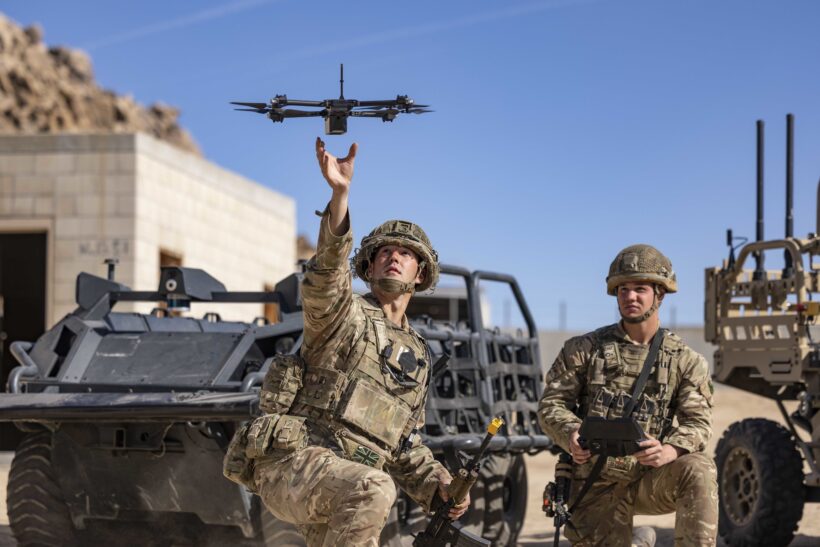
Soldiers at Fort Irwin, California utilize advanced technology including the SkyDIO unmanned aerial vehicle and different types of Remote Piloted Vehicles in collaboration with the Infantry Trials and Development Unit (ITDU). (U.S. Army photo by Staff Sgt. Matthew Lumagui)
redo Jump to...
print Print...
(Dallas Express) – The Department of War on Monday announced a sweeping Artificial Intelligence Acceleration Strategy aimed at making the U.S. military the world’s leading AI-enabled fighting force, marking a major shift in how the Pentagon develops and deploys emerging technologies.
The strategy, mandated by President Donald Trump, directs the department to become an “AI-first” warfighting organization by accelerating experimentation, cutting bureaucratic barriers, and integrating frontier AI capabilities across warfighting, intelligence, and enterprise operations.
“We will unleash experimentation, eliminate bureaucratic barriers, focus our investments and demonstrate the execution approach needed to ensure we lead in military AI,” said Secretary Pete Hegseth during his announcement from Starbase, TX, adding that the Department of War will become an AI-first force “across all domains.”
Seven Pace-Setting Projects
Central to the AI Acceleration Strategy are seven “Pace-Setting Projects,” each assigned a single accountable leader and aggressive timelines. In his announcement Monday, Secretary Hegseth said the projects “will address key opportunities for enhanced military AI advantage across Warfighting, Intelligence, and Enterprise mission areas.” The projects are designed to establish a new execution standard for military AI development and deployment. [These PSPs will address key opportunities for enhanced military AI advantage across Warfighting, Intelligence, and Enterprise mission areas:
“Warfighting:”
- 1. Swarm Forge*, which pairs elite combat units with technology innovators to test AI-enabled tactics (*Read about Swarm Forge under “Background” below the questions)
- 2. Agent Network, focused on AI-assisted battle management and decision support
- 3. Ender’s Foundry, which accelerates AI-driven simulation and operational feedback loops
“Intelligence”
- 4. Open Arsenal, intended to compress the timeline from intelligence collection to weapons development. Emphasizes open, accessible AI tools and integrations for broader military use.
- 5. Project Grant, which seeks to shift deterrence from static postures to dynamic, measurable pressure. Likely supports funding/acceleration for emerging AI capabilities or grants to innovators.
“Enterprise”
- 6. GenAI.mil, which will provide Department-wide access to advanced generative AI models for cleared personnel
- 7. Enterprise Agents, a framework for deploying secure AI agents to modernize internal workflows
Note: Not all seven of the Seven Pace-Setting Projects have been publicly named in full detail yet; Swarm Forge is the most explicitly described in DoW releases, while others appear in memos and secondary reporting as part of the set.
Wartime Approach to AI Integration
The strategy directs the Department to adopt what officials described as a wartime approach to AI integration, prioritizing speed, experimentation, and continuous iteration over traditional acquisition timelines.
“Speed defines victory in the AI era, and the War Department will match the velocity of America’s AI industry,” said Emil Michael, Under Secretary of War for Research and Engineering (USW(R&E)) and Chief Technology Officer for the DoW. “We’re pulling in the best talent, the most cutting-edge technology, and embedding the top frontier AI models [Google Gemini and xAI] into the workforce — all at a rapid wartime pace.”
The Department also announced plans to significantly expand AI compute infrastructure, unlock access to operational and intelligence data, and accelerate hiring of technical talent through special authorities and federal tech recruitment initiatives.
Policy Shift on AI Ideology
The memorandum explicitly states that Diversity, Equity, and Inclusion considerations and social ideology will not be incorporated into military AI systems, directing procurement officials to prioritize “objective, mission-first” models capable of lawful military use without ideological constraints.
Department leadership emphasized that the strategy aligns with President Trump’s broader AI policy directives and national security priorities.
Officials said the AI Acceleration strategy will be implemented immediately, with monthly progress reviews and initial demonstrations of several projects expected within six months.
Published at Dallas Express on Jan. 13, 2026. Reprinted here for educational purposes only. May not be reproduced on other websites without permission.
Questions
NOTE TO STUDENTS: Before answering the questions, read the “Background” below the questions and watch the video under “Resources.”
1. The first paragraph of a news article should answer the questions who, what, where and when. List the who, what, where and when of this news item. (NOTE: The remainder of a news article provides details on the why and/or how.)
2. What is significant about the DoW’s new strategy?
3. How does the newly announced DoW AI Acceleration Strategy aim to become an AI-first warfighting organization?
4. What are the AI Acceleration Strategy’s “Pace-Setting Projects” designed to do?
5. Read more about the Swarm Forge initiative under “Background” below the questions. Consider how far drone use has come in warfare today (e.g. Ukraine). How necessary do you think the Swarm Forge initiative is in ensuring the U.S. military’s overall dominance?
6. The strategy directs the Department to adopt what officials described as a wartime approach to AI integration.
a) What does this involve?
b) Define iteration.
7. How quickly will the AI strategy be implemented?
8. How does the DoW’s new AI strategy inspire you?
Background
The seven Pace-Setting Projects (PSPs) feature:
- A single accountable leader
- Aggressive timelines
- Monthly progress reporting (inspired by Elon’s “what have you accomplished this week?” standard)
- Real-time feedback from warfighters
- Emphasis on rapid iteration, learning from failure, and discovering new AI-native ways of fighting (not just adding AI to old methods)
Swarm Forge is one of the seven Pace-Setting Projects (PSPs). It falls under the “Warfighting” domain and serves as the flagship initiative for rapidly advancing AI-enabled combat tactics.
Key Details on Swarm Forge:
Swarm Forge is a competitive, iterative mechanism designed to discover, test, and scale novel ways of fighting both with and against AI-enabled capabilities (especially drone swarms, autonomous systems, and coordinated AI operations).
- Emphasizes rapid experimentation, real-world testing, quick failure/learning cycles, and continuous iteration to push the boundaries of AI in warfare.
- Combines America’s elite warfighting units (e.g., special operations forces, high-readiness combat teams) with top technology innovators (from private sector companies, startups, and Silicon Valley-style developers). This creates hybrid teams that field-test ideas in realistic scenarios, similar to force-on-force combat labs mentioned in Hegseth’s Starbase speech.
- Goal: Accelerate the development of lethal, overwhelming AI-native tactics that give U.S. forces decisive advantages at the tactical edge. It aims to outpace adversaries by treating innovation as fast, competitive sprints rather than slow bureaucratic processes.
Status (as of January 13, 2026) — Newly announced and in early rollout phase. A “sneak preview” video shared by the official Department of War CTO account (@DoWCTO) shows drone swarms integrated with elite units for testing and domination. The project is one of the immediate catalysts for the broader strategy, with aggressive timelines, single accountable leaders, and monthly progress reporting required.
This aligns with the overall push to make the War Department an “AI-first” warfighting force, integrating frontier models like Google Gemini (already live) and xAI’s Grok (going live later this month) to power these experiments. The strategy builds on the Trump administration’s push for military AI dominance — prioritizing speed, lethality, and “objective” models — to outpace adversaries in an era of AI-driven warfare.
Swarm Forge draws inspiration from real-world drone swarm advancements seen in recent conflicts and aims to ensure U.S. dominance in swarm-based and counter-swarm warfare. More operational details (e.g., specific units, timelines, or test locations) are expected to emerge as the project ramps up in FY2026. (Grok, Jan. 13)
Resources
Read the War Department’s press release “War Department Launches AI Acceleration Strategy to Secure American Military AI Dominance”
Read the official “Artificial Intelligence Strategy for the Department of War” at: defense.gov.
Swarm Forge sneak preview from Department of War X page January 13, 2026:
Watch Secretary of War Pete Hegseth’s speech at Starbase, Texas announcing the War Department’s “AI Acceleration Strategy” (Find the entire text of the speech below the video):
The following is the transcript of Secretary Hegseth’s Jan. 12 speech at Starbase in Texas:
Today is about how we supercharge innovation at the War Department for the era ahead.
Innovation is happening at a pace we can’t even foresee and we need the entire enterprise, our enterprise to embrace the urgency required for this moment. Since end of the Cold War the defense industrial base in our country has consolidated. This makes it difficult if not impossible for new creators of technical innovations to win business at our Department. The result is a risk-averse culture that prevents us from providing our warfighters with the best resources that America has to offer. That ends today.
Simply put, United States must win the strategic competition for 21st century technological supremacy.
Artificial Intelligence, autonomous systems, quantum, hypersonics and long-range drones. If you talk to Elon Musk long enough, he will tell you how important hypersonics and long range drones are he’s a hundred percent correct.
Space capabilities, directed energy and biotechnology are the new areas of global competition.
The challenge is that our legacy approach to technological development assumes that technology moves in a predictable linear conveyor belt from lab to design to development to prototype to test and qualified a program of record and can only be provided by a handful of companies that have consolidated dramatically.
Now while this system provided us with the weapons that won the Cold War, it is archaic and inconsistent with the novel threat environment that we face today.
At its core this old approach has the hubris to assume you could easily predict the future, that you could foresee how an invention becomes a weapon in eight easy steps – three decades from first discovery.
Our system cannot keep treating innovation as a decade’s long one-way march that dramatically reduces who and what is able to run the gauntlet at our department to get the capability to the warfighter.
Until this administration, the Trump Administration, the Department’s process for fielding new capabilities had become just one more post-cold war peace dividend relic that is not kept up with the times.
Worse than that we’ve done nothing but add layer upon layer of committees and councils that coordinated but never decided. We created endless projects with no accountable owners. We have high churn with little progress and few outputs. That sounds about like the exact opposite of SpaceX.
We treated innovation as a box to check not an outcome to deliver. In short when it comes to our current threat environment we are playing a dangerous game with potentially fatal consequences.
We need innovation to come from anywhere and evolve with speed and purpose. You see America’s open scientific community is an advantage authoritarian regimes cannot replicate. They can read our scientific papers, copy our invention or distill our AI models but they cannot replicate a culture like this one of opened and distributed research.
We need to be blunt here: we can no longer afford to wait a decade for our legacy prime contractors to deliver the next perfect system only to find that it’s delivered years behind schedule and cost 10 times what it should.
Winning requires a new playbook. Elon wrote it with his algorithm: question every requirement, delete the dumb ones and accelerate like hell. That’s why I want to make clear across the War Department and for our partners in private sector that our under secretary of War for research and engineering Emile Michael right here in front row is the War Department’s single chief technology officer. One CTO for the entire enterprise.
Novel concept. As the sole CTO, Emile will set the technical direction, lead the innovation ecosystem that will welcome progress from anywhere it resides and he’ll tell me face to face every day and frankly whether we are gaining or losing the technology innovation competition.
He’ll have the decision authority and will lead through rigorous evaluation with a focus on real measurable outcomes.
Now Congress — and we have many members of Congress with us here today — will be our partner in this. By affirming the under secretary’s role as the Department CTO we’re carrying out the core mission for R&E that Congress assigned in statute.
The last defense bill expanded the CTO’s authorities including the power to direct military departments and other components who align around clear innovative outcomes. We will use them to deliver those outcomes with speed and urgency.
An empowered CTO will inject a disruptive mindset directly into our systems, directing the power of America’s world-leading scientists and entrepreneurs, our cutting edge labs, the tech ecosystem and our capital markets to build what the warfighter needs, but to do so better, faster and cheaper. And Emil is the right man to do it.
You see this isn’t about military structure. This is about building an innovation pipeline that cuts through the overgrown bureaucratic underbrush and clears away the debris Elon style — preferably with a chainsaw — and to do so at speed and urgency that meets the moment.
As I’ve said repeatedly to every audience: the president of the United States and I have the backs of our warfighters who have to make split-second life and death decisions on the battlefield.
Now I want this audience to know that we also have the backs of innovators who share that very same urgency.
American taxpayers — especially those parents whose sons and daughters have answered call to serve – I swore in ten more today — demand ,and I demand and we demand that we arm our warfighters with overwhelming and lethal technology right now, not a decade from now.
In modern warfare the fastest innovator and iterator will be the winner. And no one can out-innovate an American entrepreneur who has been liberated from the constraints of stifling bureaucracy. That old era ends today.
We are done running a peace time science fair while our potential adversaries are running a wartime arms race. Right now from garage startups to factory floors, to board rooms across our nation, the question of how to harness innovation coming out of America’s AI ecosystem is front and center and rightfully so, because it has the potential to disrupt and transform every area of human endeavor. The same is true but in the Department of War.
President Trump’s AI Executive Order spells out our approach succinctly: it is the policy of United States to sustain and enhance America’s global AI dominance in defense of human flourishing, economic competitiveness and national security.
That, ladies and gentlemen is the War Department’s mission.
We must ensure that America’s military AI dominates so that no adversary can exploit that same technology to hold our national security interests or our citizens at risk. America First in every domain.
Last month I took the 1st step toward changing how Department does business with frontier AI technologies when we announced a rollout of Gen AI with our partners from Google and Iwant thank the Google team for leaning forward and making the investment to get their Gemini App about 3 million users in the War Department.
But today we are excited to announce next frontier AI model company that joins GenAI dot mil and that is Grok from X AI, which will go live later this month. So I want to thank you Elon and your incredible team for leaning forward with us on this as well.
Very soon have world’s leading AI models on every unclassified and classified network throughout our Department — long overdue.
To further that today at my direction we are executing an AI acceleration strategy that will extend our lead in military AI established during President Trump’s first term.
This strategy will unleash experimentation, eliminate bureaucratic barriers, focus on investments and demonstrate the execution approach needed to ensure we lead in military AI and that it grows more dominant into future. In short we will win this race by becoming an AI first warfighting force across all domains from the back offices of the Pentagon to the tactical edge on front lines.
The catalyst for acceleration is seven pace setting projects focused on mission thread across warfighting, intelligence and enterprise missions. Each with a single accountable leader, aggressive timelines and measurable outcomes that answer a familiar question Elon: what have you accomplished this week?
This is the execution standard for AI first transformation. Each of the seven pace setting projects will use the following model:
-one owner who reports monthly on their progress. These projects will not be run in a vacuum but will work directly with warfighters and transition partners to ensure we incorporate real-time operational feedback. We expect rapid iterations with failure accelerating the learning curve. These are not science projects. They are not governance boards. They are the execution standard for the entire Department.
We will not win the future by sprinkling AI on to old tactics like digital pixie dust. We will win by discovering entirely new ways of fighting. That’s why we will run continuous experimentation campaigns, quarterly force on force combat labs with AI coordinated swarms, agent based cyber defense and distributed command and control. Pushing the envelope, learning from failure at every stop — which is exactly what this place does. You see our Department doesn’t accept failure in the past and so we never fail which means we never learn. We’re flipping that dynamic.
Before talking about new rules of game let me talk a little bit more about our new team because no gain can be won without the right team.
We’re proud to announce that Mr. Cameron Stanley has been appointed the new Chief Digital and Artificial Intelligence Officer CDAO of our War Department. CAM will be leading a new team many who have forgone thank you or left lucrative careers at pioneer companies such as AWS, Databricks, Palantir, and Meta to join the fight. This team will not only provide a catalyst for change in this Department but will also act we believe as magnet for other talented members of the tech community who want to join us in doing the mission focused work to protect our great Republic.
Daily “Answers” emails are provided for News Stories, Tuesday’s World Events and Friday’s News Quiz.