
Why honor the Doolittle Raiders?
News Stories — Posted on April 17, 2026
On April 18, 1942, little more than four months after the Japanese attack on Pearl Harbor, Hawaii, 80 airmen in 16 modified North American B-25B Mitchell bombers lifted off from the aircraft carrier USS Hornet in the northwest Pacific bound for targets in Japan.
The operation marked the first Allied retaliatory strike on the Japanese Home Islands.
To plan the daring mission U.S. Army Air Forces Lt. Gen. Henry H. “Hap” Arnold had tapped Lt. Col. James H. “Jimmy” Doolittle, the famed air racer, test pilot and aeronautical engineer. Doolittle piloted the lead plane from Hornet. His co-pilot was 26-year-old Lieutenant Richard E. “Dick” Cole.
Neither Doolittle nor any of his men had flown a single combat mission.
When the mission took place, the U.S. fleet in the Pacific was still crippled by the surprise Japanese bombing attack on Pearl Harbor. There was no easy way to attack the Japanese mainland, so Doolittle helped come up with a plan to strip several B-25 bombers down into flying gas cans to give them the range to make it from an aircraft carrier to their targets in Japan.
There was one catch – after dropping their bombs, the 16 planes would not have enough fuel to fly back. Instead, the 80 combat rookies planned to continue on to friendly airfields in China. (By 1942, Japan controlled roughly 25% to 40% of China’s territory, primarily concentrating on major cities, railways, and industrialized coastal areas. The Nationalist government of Chiang Kai-shek, an ally of the U.S., moved its capital to inland Chongqing, maintaining resistance in the west.)
After training in Florida, the Doolittle task force set sail. But the aircraft had to launch 10 hours early after being spotted by a Japanese patrol boat, reducing their range even more. Several of the crews ended up bailing out of their planes after the bombing runs.
Fifteen planes either crashed or the crews bailed out over China when they ran out of fuel due to the early takeoff. One plane landed in Vladivostok, Soviet Union, where the crew was initially detained, but escaped after a year.
Ultimately, seven crewmembers died – three were killed during the mission; three others were captured and executed, and one died in captivity.
Doolittle’s co-pilot Cole, though, parachuted into a tree in China and managed to catch up with Chinese guerillas operating behind Japanese lines.
The raid did not cause a lot of physical damage in Japan, but the startled Japanese were forced to redeploy their defenses. Americans celebrated; Cole was awarded the Distinguished Flying Cross and, decades later, the Congressional Gold Medal. Doolittle was promoted and awarded the Medal of Honor.
“Knowing that we did the mission and did it like it was supposed to be done, we felt pretty good about it,” Cole said.
Cole later wrote a book about his service in the war. Proceeds from “Dick Cole’s War” go to a scholarship fund in Doolittle’s name for students in the aviation field.
He also helped make sure the Doolittle Raiders’ legacy will live on. Back in 2016, Cole helped the Air Force announce that the service’s next stealth bomber, the B-21, would officially be called the ‘Raider.’
Jimmy Doolittle officially retired from the Air Force Reserve on Feb. 28, 1959, with the rank of Lieutenant General. He died in 1993 at age 96.
Compiled from a WTVT FOX 13 article published in 2019 and from Google AI.
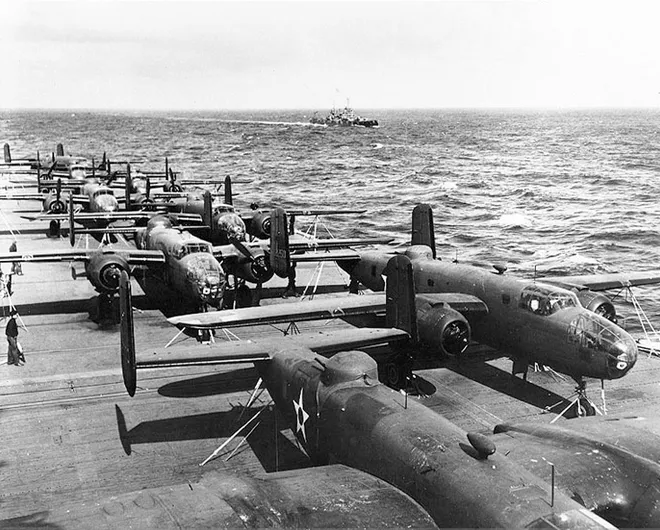
16 B-25B Mitchell medium bombers, each with a crew of five, were launched from the US Navy aircraft carrier USS Hornet, in the Pacific Ocean, off Japan.
U.S. AIR FORCE PHOTO
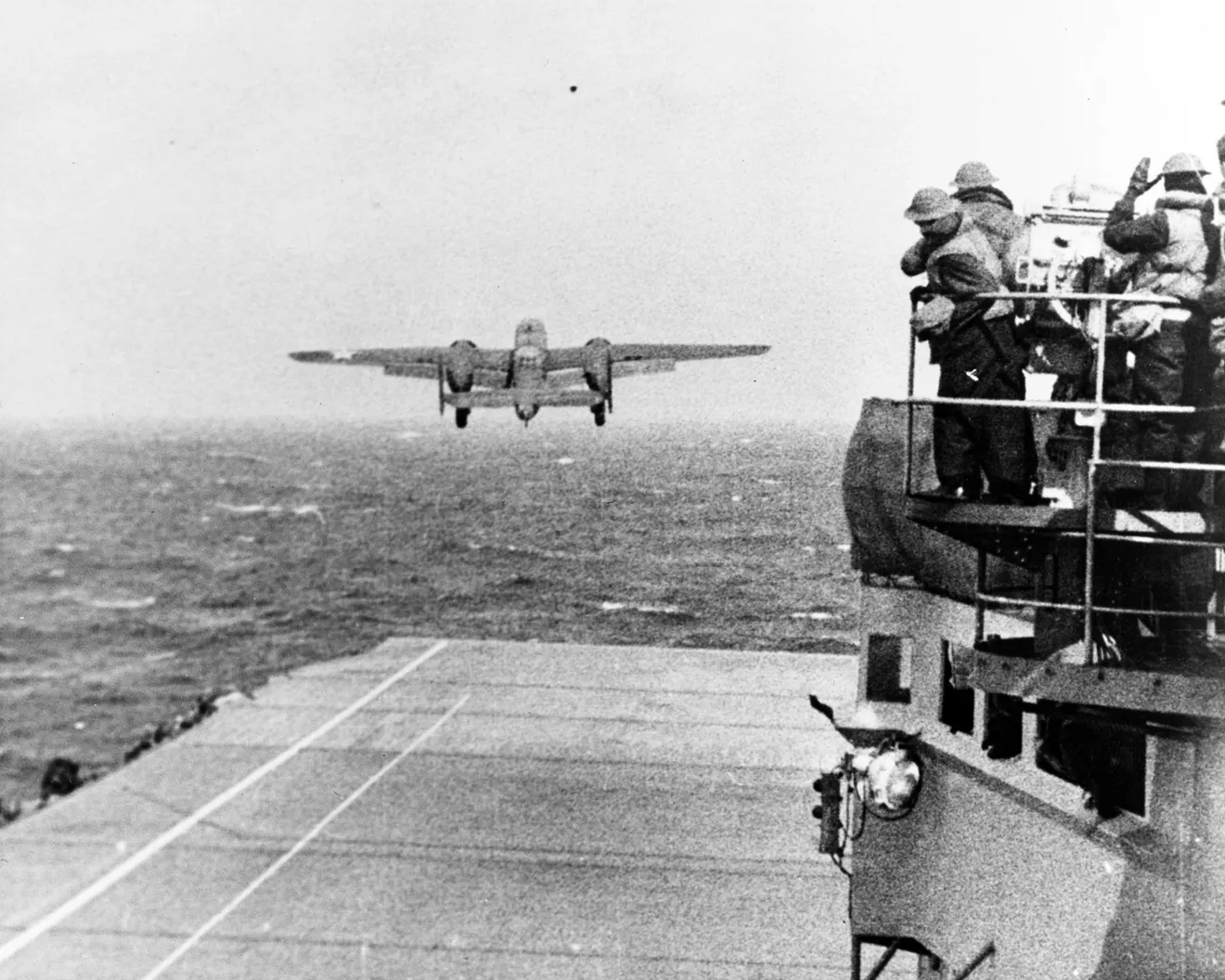
An Army Air Force B-25B bomber takes off from USS Hornet (CV-8) at the start of the raid, 18 April 1942. Note men watching from the signal lamp platform at right. Official U.S. Navy Photograph, now in the collections of the National Archives.
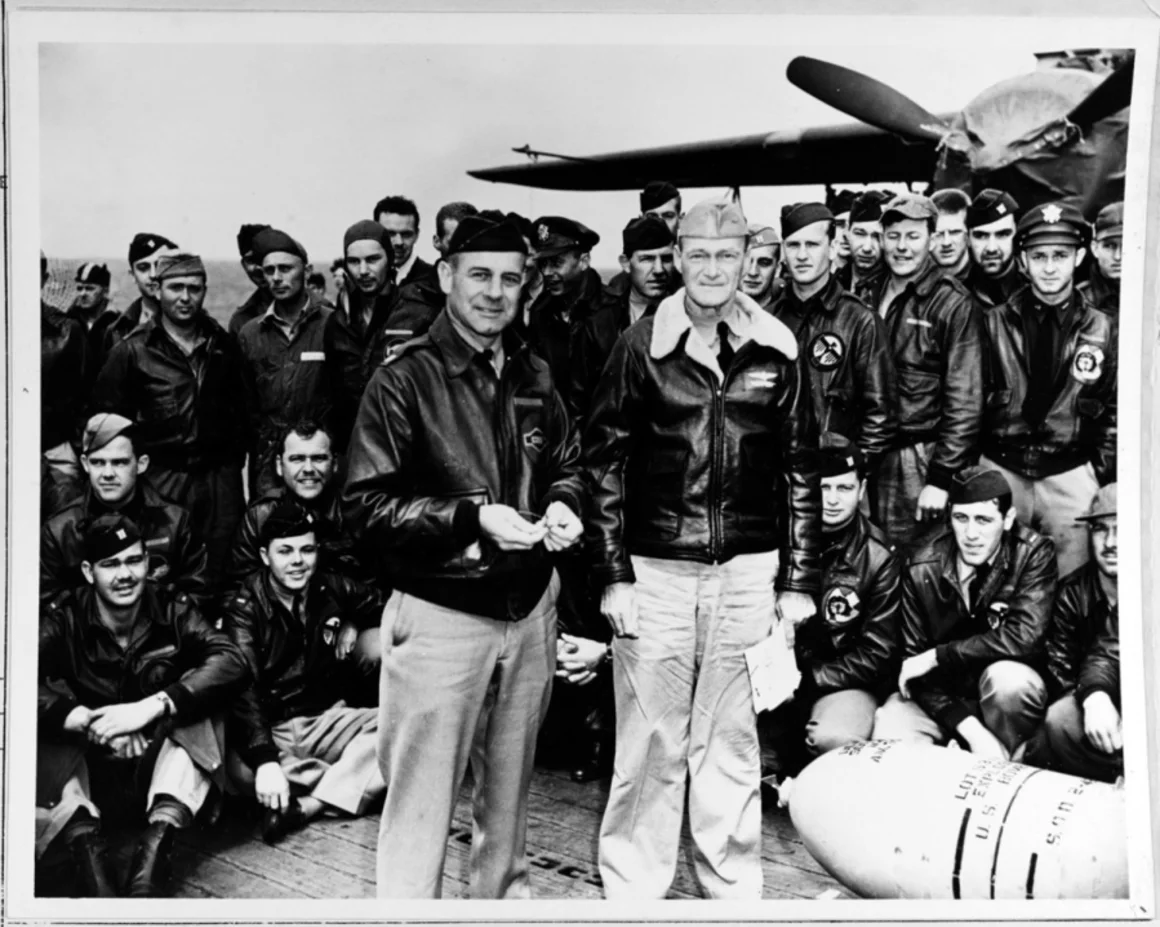
Doolittle Raiders air crew during World War II. U.S. Air Force photo.
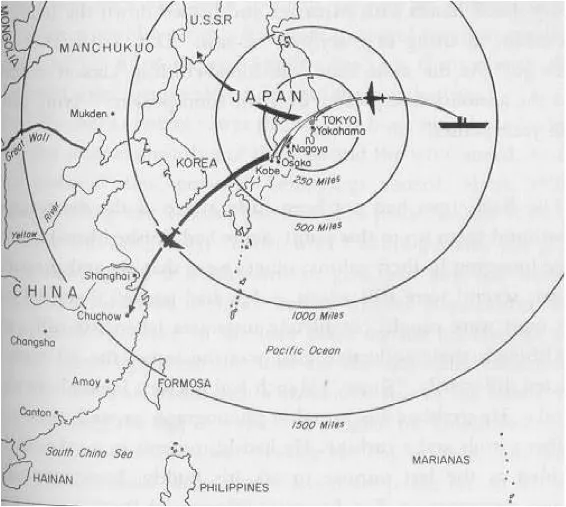
The plan for the 1942 Doolittle Raid on Japan. U.S. Air Force.
Background
The 80 pilots, navigators, engineers, bombardiers and gunners took off in B-25 Mitchell bombers from the USS Hornet in the Pacific Ocean bound for Japan. A bomber takeoff from the deck of an aircraft carrier had never been done. The crew found themselves scrambling to make a hasty takeoff, 12 hours ahead of schedule, after they were spotted by Japanese fishing boats. The early departure also meant the planes would likely run out of gas before landing in friendly China. Cole was the co-pilot in the lead plane alongside the commander of the mission, Jimmy Doolittle. (from CNN)
The Doolittle Raid, on Saturday, April 18, 1942, was an air raid by the United States of America on the Japanese capital Tokyo and other places on the island of Honshu during World War II, the first air strike to strike the Japanese Home Islands.
It demonstrated that Japan itself was vulnerable to American air attack, served as retaliation for the Japanese attack on Pearl Harbor on Sunday, December 7, 1941, and provided an important boost to American morale. The raid was planned and led by Lieutenant Colonel James “Jimmy” Doolittle of the United States Army Air Forces.
The raid had its start in a desire by President Franklin D. Roosevelt, expressed to the Joint Chiefs of Staff in a meeting at the White House on 21 December 1941, that Japan be bombed as soon as possible to boost public morale after the disaster at Pearl Harbor.
Doolittle later recounted in his autobiography that the raid was intended to bolster American morale and to cause the Japanese to begin doubting their leadership, at which it succeeded:
The Japanese people had been told they were invulnerable … An attack on the Japanese homeland would cause confusion in the minds of the Japanese people and sow doubt about the reliability of their leaders. There was a second, and equally important, psychological reason for this attack … Americans badly needed a morale boost.
The concept for the attack came from Navy Captain Francis Low, Assistant Chief of Staff for anti-submarine warfare, who reported to Admiral Ernest J. King on 10 January 1942 that he thought twin-engine Army bombers could be launched from an aircraft carrier, after observing several at a naval airfield in Norfolk, Virginia, where the runway was painted with the outline of a carrier deck for landing practice. The attack was planned and led by Doolittle, a famous military test pilot, civilian aviator and aeronautical engineer before the war. (read more at the wikipedia entry for Doolittle Raid)
About the men who took part in the mission:
- 69 of the 80 men that took off made it back alive
- 3 died during bailout/crash landings in China
- 8 were captured by the Japanese: of the captured, three (Farrow, Spatz, Hallmark) were executed by a Japanese firing squad after being tortured, and one (Meder) died in captivity; four others survived over 3 years as POWs, including torture and starvation before being liberated by American troops in August 1945, following the surrender of Japan.
- 1 crew landed in Russia but escaped through Iran a year later
Many of the 69 who returned to safety continued fighting, and several died before the war ended