
Watch: What’s going on with Iranian negotiations?
News Stories — Posted on April 21, 2026
VIDEO #1: Fox News’ Trey Yingst reports on April 20: “If the Iranians try to avoid the U.S. blockade, the ships will be boarded and seized. …The president isn’t bluffing.”
VIDEO #2: Gen. Jack Keane: “We have significant leverage going into this second round of negotiations.” [with Iran in Pakistan].
VIDEO #3: Larry Kudlow discusses the Trump administration’s Operation Economic Fury against the Iranian regime
What is the Islamic Revolutionary Guard Corps (IRGC)?
Not to be confused with Iran’s traditional armed forces, the Islamic Revolutionary Guard Corps (IRGC) is a parallel military body formed during the Islamic Revolution in 1979 that protects the clerical regime and wields significant political, economic, and military power. It maintains its own air, land, and naval branches, commands the Basij religious militia used to crush internal dissent, and reports directly to Supreme Leader Ayatollah Ali Khamenei [who was supposedly replaced by his son after being eliminated in an Israeli airstrike on Feb. 28]. It is estimated to have 190,000 active personnel. The IRGC’s elite Quds Force, responsible for extraterritorial operations, has cultivated and directed proxy militias such as Hezbollah in Lebanon, Kata’ib Hizballah and other groups in Iraq, [the Houthis in Yemen] and a broader network of Iran-aligned armed factions across the Middle East.
Reporting directly to the “Supreme Leader”, the IRGC operates independently of Iran’s regular military and has built a vast network of proxy militias, including Hezbollah in Lebanon and Hamas and Palestinian Islamic Jihad in Gaza. Through its elite Quds Force, the IRGC trains, arms, and directs these groups to carry out attacks against Israel and other U.S. allies. Beyond warfare, it controls key sectors of Iran’s economy and enforces the regime’s ideological agenda at home and abroad, making it a uniquely dangerous organization that blends military, political, and terrorist power. (from AJC.org)
Background
Democratic Senator Fetterman Says Some Democrats 'Rooting for Iran'
Sen. John Fetterman, D-Pa., said the Democratic Party's response to the war with Iran has been "very disappointing," pointing to what he described as a failure to support actions addressing Tehran's nuclear threat.
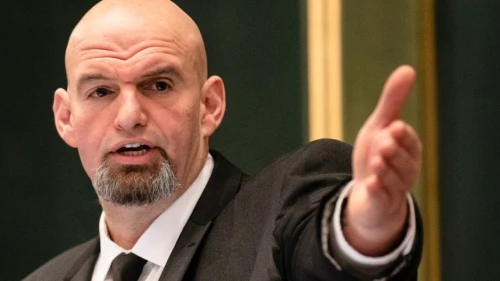
Sen. Fetterman
Fetterman made the remarks during an interview with video journalist Nicholas Ballasy, where the senator defended the legality and necessity of Operation Epic Fury.
He said that the Trump administration had followed the requirements of the War Powers Act, noting that Congress received notification within 48 hours and that the operation remains within the authorized 60-day window, with the option for a 30-day extension.
Fetterman said presidents over several decades have confronted what he described as the danger posed by Iran's nuclear ambitions, adding that the current effort reflects that long-standing policy concern.
He also pointed to global implications, including the strategic importance of oil supply routes, saying disruptions such as a blockade in the Strait of Hormuz could affect multiple countries and require a coordinated response.
"If your country consumes oil, then that makes it your war too," Fetterman said, arguing that international partners should play a more active role.
He criticized NATO allies for what he described as a lack of support, and said that their response had been "very disappointing."
Fetterman also reiterated his support for Israel, saying the country "deserves to live in security," and warned of the risks posed by a nuclear-armed Iran.
Asked about rising gas prices linked to the conflict, Fetterman acknowledged the economic impact but said such costs can accompany major national security decisions.
"Our country has always done important, hard things," he said, adding that he remains "very proud" of the U.S. military.
Fetterman also criticized fellow Democrats, saying some responses within the party have gone too far in opposition to President Trump.
"It seems like people are almost rooting for Iran. It's crazy," he said. ...
Fetterman has been the only Senate Democrat to oppose a war powers resolution aimed at limiting continued U.S. military involvement in Iran, and he also voted against recent measures to block certain arms sales to Israel. (from an April 20 Newsmax article by Jim Mishler)