
SpaceX Gets OK to Build 2 Starship Launch Pads at NASA’s Cape Canaveral
Daily News Article — Posted on December 8, 2025
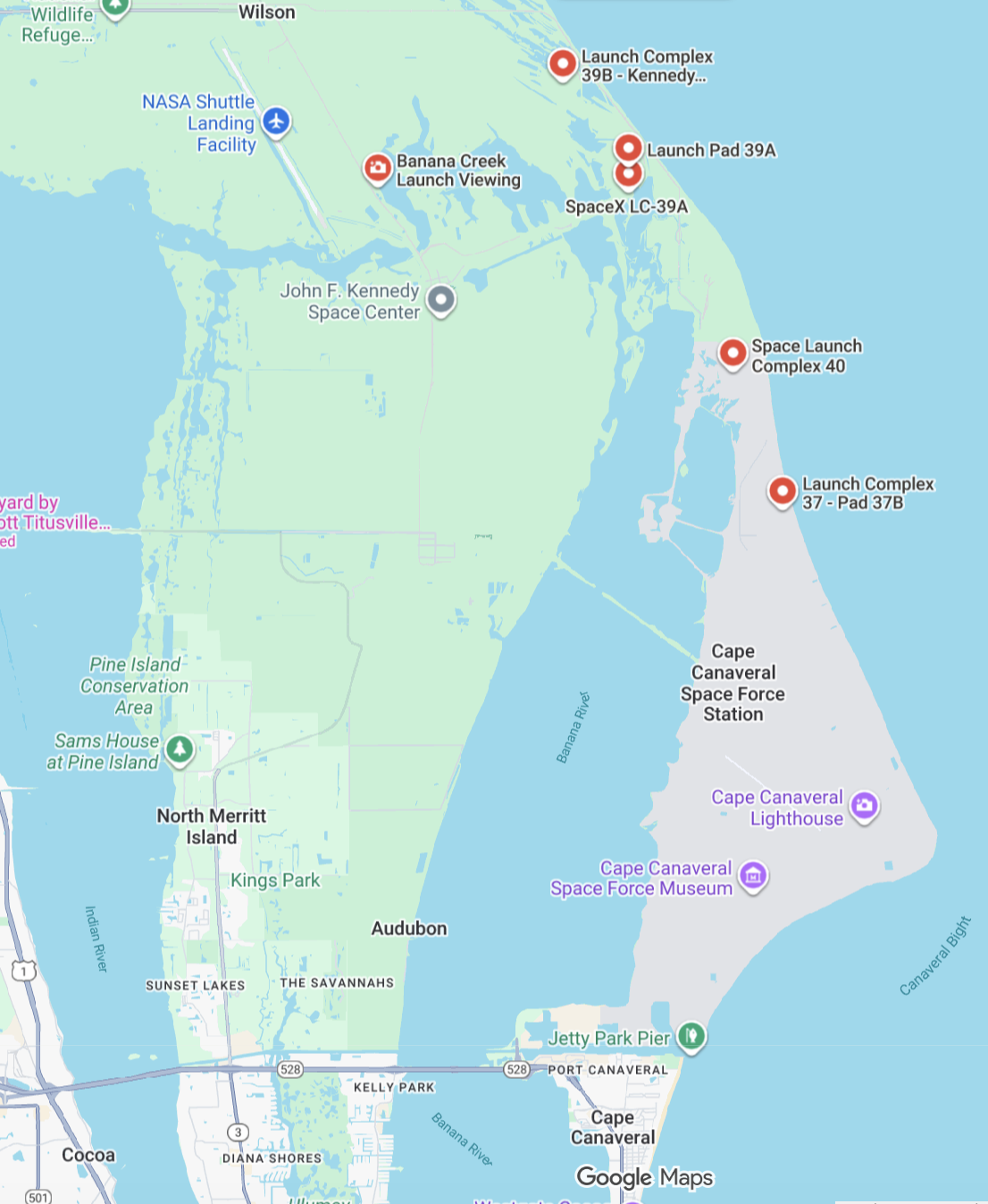
NOTE: Two locations house the space program in Florida: the Kennedy Space Center (KSC) and Cape Canaveral Space Force Station (CCSFS). The CCSFS is a part of the United States Air Force Space Command. It is adjacent to the Kennedy Space Center which is on Merritt Island, Florida.
(CNET by Joe Hindy and UPI by Mike Heuer) – SpaceX has been granted approval to build two launch pads at the Cape Canaveral Space Force Station’s Space Launch Complex 37 in Florida, the company said Monday [Dec. 1].
The new pads are to be built for launches from heavier rockets like SpaceX’s megarocket, Starship. SpaceX’s Starship can produce more than 16 million pounds of thrust from its Super Heavy reusable first stage rockets. By contrast, NASA’s Space Launch System is capable of approximately 8.8 million pounds of thrust.
The two launch pads join SpaceX’s existing launch pad at the Kennedy Space Center’s Launch Complex 39-A, which was designed to support the iconic Apollo program. (SpaceX is currently heavily modifying and rebuilding Launch Complex 39A (LC-39A) at Kennedy Space Center to support Starship alongside its existing Falcon capabilities.)
Starship is intended to carry humans to the moon in support of NASA’s Artemis missions and support future manned missions to Mars, according to Spectrum News. [SpaceX’s Starship goal is to create a fully reusable transportation system for crew and cargo to Earth orbit, the Moon, Mars, and beyond].
“With three launch pads in Florida, Starship will be ready to support America’s national security and Artemis goals as the world’s premiere spaceport continues to evolve to enable airport-like operations,” SpaceX said Monday in a post on X. The company also announced that construction has already begun on the two new launch pads.
SpaceX has been waiting almost two years for regulatory approval to build its launch pads at Space Launch Complex 37. During that time, SpaceX had to field several public hearings and investigations to ensure that the Starship launches wouldn’t pose a threat to the local fauna or flora.
Once completed, the two new launch pads will be able to host approximately 76 Starship missions and 152 landings per year, with 44 additional launches and 88 additional landings from SpaceX’s Kennedy Space Center launch pad. [A Starship launch involves two big reusable stages: the Super Heavy booster (first stage) and the Starship upper stage (the ship itself). So if the site supports 76 launches per year and both stages are recovered to Florida each time, that is up to 76 booster landings + 76 ship landings = 152 landings].
One of the major questions for these launch pads is how they could impact local travel, namely in terms of commercial airline flights.
According to regulatory filings, 120 launches and 240 landings could cause delays for thousands of commercial airline flights annually. The Air Force plans to reassess airspace concerns before giving final approval for Starship launches.
Initial plans called for using Launch Complex 39, but it was changed to Launch Complex 37 to help minimize the impacts on nearby communities.
The Federal Aviation Administration is proposing up to 44 Starship Super Heavy launches per year, which would cause about 61 days of closures or airspace, maritime activity and local activities.
Compiled from reports published at CNET and UPI on Dec. 2, 2025.
Questions
1. What capability will SpaceX's two new launch pads in Cape Canaveral have compared to NASA's existing Space Launch System at the nearby Kennedy Space Center?
2. Where / how is SpaceX's existing launchpad used? What improvements is SpaceX making to this launch pad?
3. What is Artemis - what is the purpose of Artemis?
4. What is SpaceX's goal for Starship?
5. How can there be more landings than launches per year? (Up to 76 Starship missions/launches and 152 landings per year)
6. What concerns does the community have about the expansion of the program?
7. SpaceX wants to build a city on Mars. Read about it at the SpaceX website.
Would you make the 3-4 month to almost 2 year trip to Mars and live there if given the opportunity? Explain your answer. (Note: StudentNewsDaily's editors will give it a pass :)
CHALLENGE: Do an internet search: Why is SpaceX moving its rocket launches from Texas to Florida? Be specific.
Background
Did you know?...
- Astronauts have stayed in Low Earth Orbit (LEO) since 1972, with the International Space Station (ISS) continuously occupied, but no humans have traveled beyond LEO (to the Moon or further) since the Apollo 17 mission in December 1972.
- NASA and its partners plan to retire the ISS by the end of 2030, de-orbiting it into the Pacific Ocean to make way for commercial space stations
- Future missions like NASA's Artemis program aim to return humans to the Moon.
- The Artemis program has already completed its first major milestone, the uncrewed Artemis I mission in late 2022, which successfully flew around the Moon, setting records and testing the SLS rocket and Orion spacecraft.
- The program is now moving forward with the next steps: Artemis II, a crewed lunar flyby planned for no later than April 2026, and Artemis III, aiming for the first human landing on the Moon's South Pole, with subsequent missions building the Lunar Gateway. (from Google AI)
About SpaceX, its Falcon 9 and new Starship:
SpaceX: The company founded by Elon Musk, focused on space transport.
Starship (System): The whole reusable launch system (Super Heavy booster + Starship upper stage).
Starship (Vehicle): The upper stage itself, designed to carry crew and cargo.
Super Heavy: The powerful first-stage booster for Starship.
SpaceX also developed previous rockets like the Falcon 9 and Falcon Heavy, but Starship is their current, most powerful, and ambitious project.
Currently, SpaceX relies heavily on its Falcon 9 rocket for frequent launches, primarily for deploying Starlink satellites, government/commercial payloads, and even crewed missions, even as its Starship system develops, with Falcon 9 still handling most current orbital needs and contracts. The Falcon 9 remains the backbone of their launch cadence, known for its reliability and reusability, even with the eventual goal of Starship taking over.
Key Uses of Falcon 9 Today:
- The majority of Falcon 9 missions are dedicated to launching batches of Starlink internet satellites.
- Falcon 9 launches various satellites for other companies and agencies, including NASA.
- The Falcon 9's Dragon capsule transports astronauts and supplies to the International Space Station.
- SpaceX achieved over 90 Falcon 9 launches in 2023, demonstrating its high operational tempo.
- Falcon 9 will continue to fill gaps and serve existing contracts until Starship fully matures and scales up, so it's far from retired.
- Falcon 9's ability to land and reuse first-stage boosters significantly reduces costs, making it economically viable.
NOTE: SpaceX has launched its giant Starship rocket multiple times for integrated test flights from Starbase, Texas, with the 11th orbital test flight occurring in October 2025, aiming for rapid reusability and Mars missions, but these are tests, not operational Starship deliveries yet, with development focused on future flights and NASA Artemis missions. (from Google AI Overview)