Russia and Belarus start war games after drone incursions into Poland, Romania
News Stories — Posted on September 15, 2025
OF NOTE:
- On September 10, Poland shot down suspected Russian drones in its airspace with the backing of aircraft from its NATO allies.
- The Polish government said 19 objects had entered its airspace during a large Russian air attack on Ukraine, and that it had shot down those posing a threat.
- Moscow denied responsibility for the incident, with a senior Russian diplomat in Poland saying the drones had come from the direction of Ukraine.
- Following the Poland drone incursion, NATO on Friday announced plans to strengthen the defense of its eastern European flank.
- On Saturday, Romania reported that a Russian drone breached its airspace. The Romanian air force scrambled F-16 jets, but did not down the drone due to risk concerns.
(by Mark Trevelyan, Reuters) – Russia and Belarus began a major joint military exercise on NATO’s doorstep on Friday at a time of heightened tension with the Western alliance, two days after Poland shot down Russian drones that had crossed into its airspace.
The “Zapad-2025” exercise, a show of force by Russia and its close ally Belarus*, is taking place at training grounds in both countries, including close to the Polish border. [*Belarus’ Alexander Lukashenko has been president for over 30 years. Lukashenko heads an authoritarian government and has often been referred to as “Europe’s last dictator.” Elections are not considered to be free and fair by international monitors, opponents of the regime are repressed, and the media is not free].
The Zapad-2025 war games were scheduled well before the drone incident, which marked the first known occasion that a NATO member had fired against incoming Russian targets in the course of the 3-1/2-year war [that Russia started between Russia and Ukraine].
WHAT WILL THE EXERCISE INVOLVE?
Russia’s defense ministry said that in the first phase of the exercise, troops would simulate repelling an attack against Russia and Belarus, whose alliance is known as the Union State.
The second stage will focus on “restoring the territorial integrity of the Union State and crushing the enemy, including with the participation of a coalition group of forces from friendly states”, the ministry said.
Belarus borders three NATO members – Poland, Lithuania and Latvia – to its west, and Ukraine to its south.
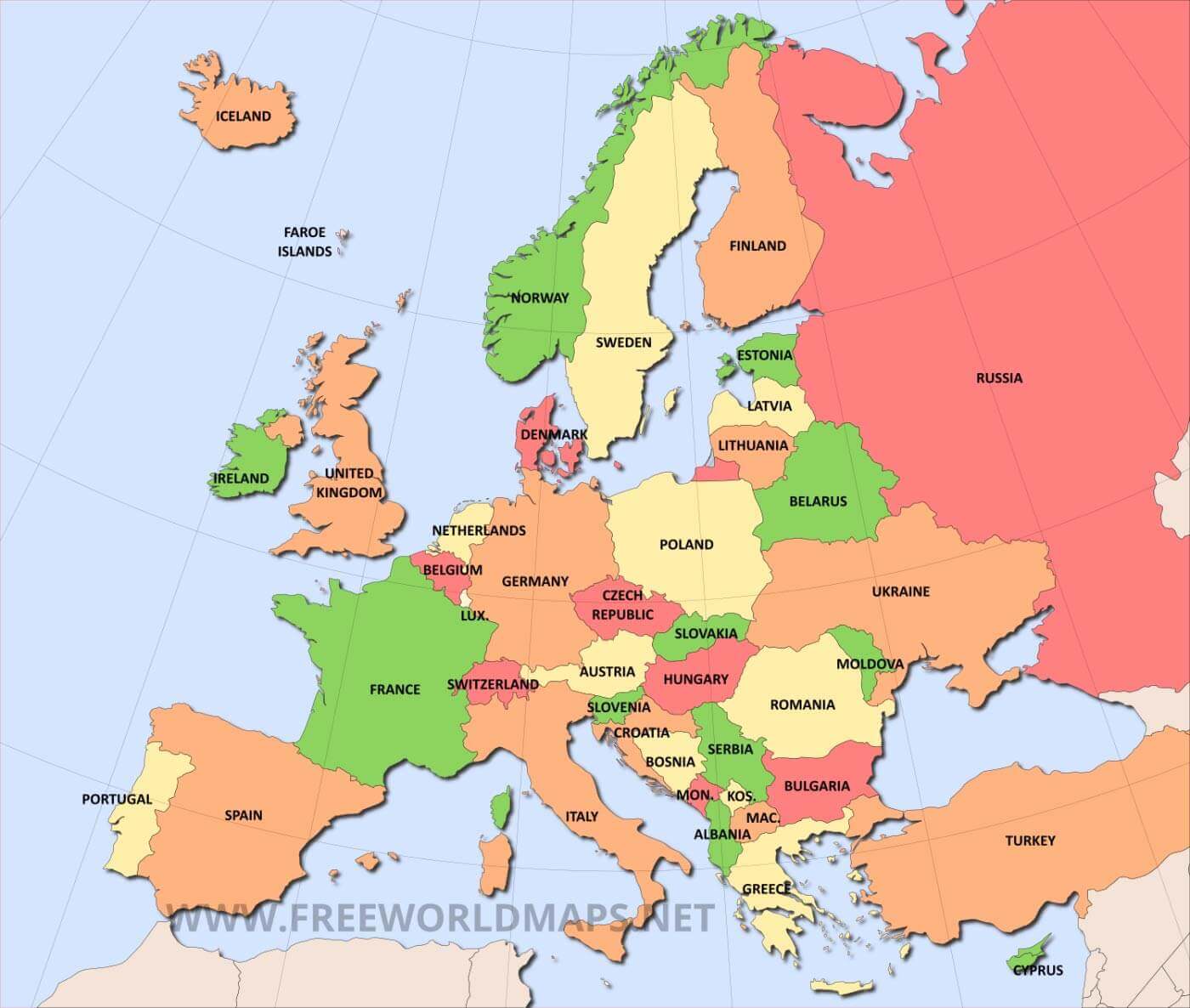
NOTE: The small, isolated territory between Lithuania and Poland is Kaliningrad Oblast, a part of Russia that is separated from the main country by land and is located on the Baltic Sea coast. This exclave was formerly Königsberg, a German territory, and was ceded to the Soviet Union after World War II, becoming part of Russia in 1946.
The Kremlin said on Friday that European concerns about the exercises were an emotional response based on hostility towards Russia. It has declined to comment on this week’s drone incident, which was seen in the West as a wake-up call for NATO and a test of its responses.
Western countries called the drone episode a deliberate provocation by Russia, which Moscow denied. Russia’s Defense Ministry said its drones had carried out an attack in western Ukraine at the time, but it had not planned to hit any targets in Poland. …
POLAND ON HIGH ALERT
Even before the incident, Polish Prime Minister Donald Tusk had described the upcoming “Zapad” maneuvers as “very aggressive” and announced that Poland would close its border with Belarus at midnight on Thursday.
Deputy Polish Defense Minister Cezary Tomczyk said Poland had been preparing for many months and was holding its own exercises, codenamed “Iron Defender.”
“There are about 30,000 soldiers in the Iron Defender exercise and about 5,000 on the border” with Belarus, Tomczyk said in response to Reuters’ questions.
Lithuania has also said it is protecting its border because of the military exercise.
Major General Pavel Muraveiko, chief of the Belarusian General Staff, said all the drills would be held at a “significant distance” from the borders with NATO members and Ukraine.
He said they would include drones, electronic warfare and the use of artificial intelligence to support decision-making.
The last Zapad exercises took place in September 2021, five months before Russia’s full-scale invasion of Ukraine, which it launched in part from Belarusian territory.
Belarusian leader Alexander Lukashenko is a close ally of Russian President Vladimir Putin and has backed him throughout the war, although without committing his own troops to the fighting. Since it began, Belarus has allowed Russia to station tactical nuclear missiles on its soil and is preparing to host Moscow’s new Oreshnik hypersonic missile.
Lukashenko is simultaneously trying to repair relations with the United States after years of U.S. and EU sanctions. On Thursday he freed 52 prisoners at the request of U.S. President Donald Trump and said he stood alongside Trump in the latter’s efforts to resolve a series of international conflicts.
Published at Reuters on Sept. 12. Reprinted here for educational purposes only. May not be reproduced without permission. Reporting by Mark Trevelyan in London and Moscow bureau; additional reporting by Pawel Florkiewicz Editing by Gareth Jones.
From a Sept 12 France24 news analysis:
The last time the two countries held joint drills in February 2022, Russian President Vladimir Putin sent tanks rolling into Ukraine just days later, many of them crossing from Belarus. The ominous precedent will be high on the minds of NATO members – chief among them Poland and Lithuania, which border Belarus – as they monitor the so-called “Zapad” drills.
The 2022 drills allowed Russia to deploy troops to Belarus that were later used to invade Ukraine from the north. They came on the heels of much larger military exercises held months earlier, dubbed “Zapad 2021,” that prompted US and British intelligence agencies to warn of a looming Russian invasion of Ukraine.
After three-and-a-half years of war in Ukraine, NATO members will be watching the latest Zapad drills closely for possible clues about Putin’s next moves, amid growing fears in Europe that Moscow may seek to escalate the war in Ukraine by targeting a member of NATO, the US-led alliance. [Possibly Poland or Lithuania].
Analysts have cautioned against comparing Zapad 2025 with the much larger drills that took place in 2021, stressing that Russia cannot afford to divert substantial resources away from its ongoing war of attrition in Ukraine.
“Right now, Moscow cannot send the tens of thousands of troops to Belarus that would be needed to pose a credible threat to countries on NATO’s eastern flank,” said Ryhor Nizhnikau, a senior research fellow and Russia expert at the Finnish Institute of International Affairs.
“The idea that Russia may one day use Zapad drills to strike at countries on NATO’s eastern flank is indeed credible – particularly if it attains its goals in Ukraine and frees up military resources,” he added. “But not this time.”
Background
NATO:
- The North Atlantic Treaty Organization (NATO) is an alliance of 32 countries from North America and Europe committed to fulfilling the goals of the North Atlantic Treaty signed on April 4, 1949.
- NATO was established to counter the risk that the Soviet Union would seek to extend its then-control of Eastern Europe to other parts of the continent.
- Twelve countries were part of the founding of NATO: Belgium, Canada, Denmark, France, Iceland, Italy, Luxembourg, the Netherlands, Norway, Portugal, the United Kingdom, and the United States. NATO grew by including Greece and Turkey in 1952 and West Germany in 1955, and then later Spain in 1982.
- In accordance with the Treaty, the fundamental role of NATO is to safeguard the freedom and security of its member countries by political and military means. (from nato.int)
- NATO’s role as a political and military alliance was to provide for collective defense against any form of aggression and to maintain a secure environment for the development of democracy and economic growth.
- NATO is committed to the peaceful resolution of disputes. If diplomatic efforts fail, it has the military capacity needed to undertake crisis-management operations. These are carried out under Article 5 of the Washington Treaty – NATO’s founding treaty – or under a UN mandate, alone or in cooperation with other countries and international organizations. (from nato.int)
The member states of NATO in the order of joining:
- 1949 – Belgium, Canada, Denmark, France, Iceland, Italy, Luxembourg, Netherlands, Norway, Portugal, United Kingdom, United States.
- 1952 – Greece, Turkey
- 1955 – Germany
- 1982 – Spain
- 1999 – Czech Republic, Hungary, Poland
- 2004 – Bulgaria, Estonia, Latvia, Lithuania, Romania, Slovakia, Slovenia
- 2009 – Albania, Croatia
- 2017 – Montenegro
- 2020 – North Macedonia
- 2023 – Finland (its membership was prompted by Russia's invasion of Ukraine)
- 2024 – Sweden (its membership was prompted by Russia's invasion of Ukraine)
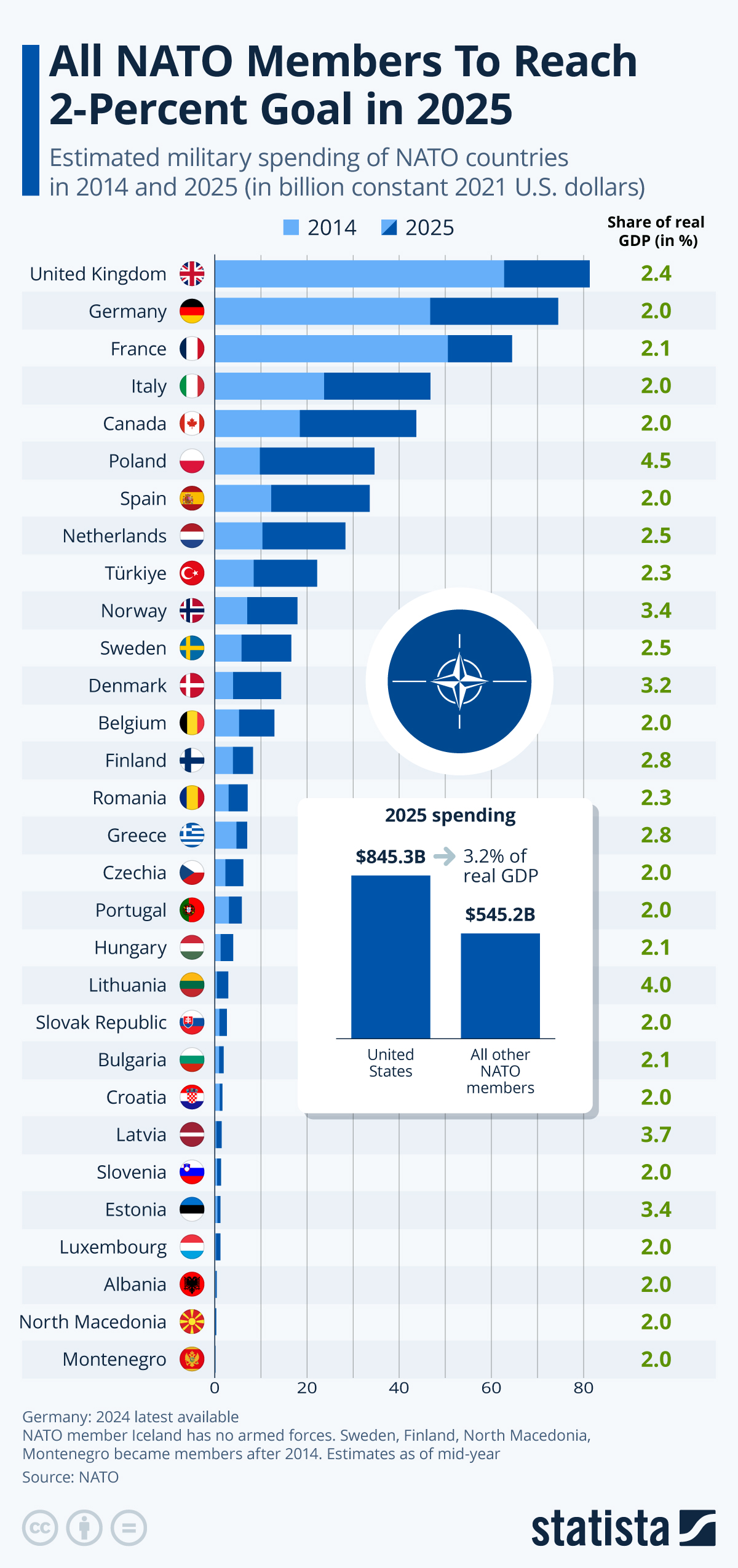
The U.S. has consistently been one of the highest-spending NATO members as a percentage of GDP, a figure that includes all its military expenses. In 2024, this was estimated at 3.4% of its GDP.
During his first term, President Trump in 2018 brought the issue to the forefront as he criticized a number of NATO member states, especially Germany, for not making enough of an effort to meet the 2-percent-of-GDP spending threshold.
Now in his second term in office, Trump is again pushing NATO countries to honor their spending obligations. While 2025 figures for Germany still lack in NATO's reporting, the country is majorly overhauling its military spending and reached the 2-percent goal in 2024.
Following a meeting with President Trump in June 2025, NATO members agreed to his new, higher defense spending goal to ensure all members are contributing their fair share. NATO members have now committed to investing 5% of their GDP annually by 2035.
The new 5% target is split into two areas:
3.5% for core defense requirements, including military equipment and personnel.
1.5% for related security spending, such as cybersecurity and critical infrastructure.