
More young Americans choosing skilled trades over college
Daily News Article — Posted on October 3, 2025
(by Megan Cerullo, CBS News) – At just 23, Jacob Palmer is already running his own electrical company. He launched the business in 2024 after starting in the field as an apprentice electrician, a career path he embarked on when college turned out not to be for him.
Palmer has no regrets about his decision to forego college and instead establish himself as a tradesman. “I am very happy doing what I am doing now because it has given me the opportunity to work for myself and be independent,” he told CBS News.
Experts say the skilled trades — jobs like electricians, plumbers, welders, masons, HVAC technicians and other occupations requiring extensive training and often licensing — are attracting a growing number of young people put off by high tuition costs.
More than 57% of Gen Zers surveyed by Jobber, a software tool for service businesses, cite student loan debt as a concern about going to college, according to the company’s annual report on attitudes toward blue-collar jobs.
More recently, signs that artificial intelligence is starting to gobble up the kind of entry-level jobs that once went to young college graduates are also leading young workers to consider the trades. Some 77% of Gen Zers say it’s important that their future job is hard to automate, with many pointing to professions like carpenter, plumber, and electrician as occupations they believe are safe from automation. By contrast, they see less security in fields like software development, data analytics, and accounting, according to the survey.
“That route is losing some of the stigma,” said David Asay, president of Advantage Reline, a trenchless pipe rehabilitation company in Mesa, Arizona. “The perception among that younger group is no longer, ‘Oh, you’re working construction, you didn’t go to school?’ It’s, ‘What a cool skillset. You’re making a good career path.'”
For decades, many young people shunned the trades, with everyone from economists and career experts to politicians and parents emphasizing the importance of obtaining a college diploma. That conventional wisdom isn’t entirely wrong — it’s just behind the times.
“The attitude was that jobs in the trades were less than desirable,” said Angie Hicks, co-founder of Angi, an online home improvement services guide told CBS News.
But several factors are contributing to a shift in how people are thinking about such occupations. For one, going to college for many Americans often requires going into debt. The average cost of college, including tuition and room and board, now tops $38,000 a year and is approaching $60,000 for private institutions, according to the Education Data Initiative.
Factoring in the added [cost] of interest [paying off] student loans and potential income one foregoes while in school, the total cost of earning a bachelor’s degree can exceed $500,000, the research firm has found.
More recently, economists also point to a jump in unemployment for recent college grads, which some experts say is an early warning sign that AI is taking jobs away from less experienced workers. The jobless rate for 23-to-27-year-old college grads this year now hovers around 4.6%, up from 3.2% for the same demographic in 2019.
Strikingly, non-college-educated workers in the same age range have experienced a much smaller uptick in unemployment, at roughly 0.5%, over the same period, according to an analysis from the Federal Reserve Bank of St. Louis. …
Some school districts also report seeing growing student interest in blue-collar careers. Marlo Loria, director of career and technical education and innovative partnerships at Mesa Public Schools in Mesa, Arizona, said more of her students are enrolling in schools’ welding, construction and auto shop programs than there is space for.
Asay, of Advantage Reline, added that students with an entrepreneurial bent can also be well-suited for the skilled trades.
“They can take their skills and create their own business, or become a bigger part of our business, outside of being someone with a shovel in a trench,” he said.
Palmer said his business generated $90,000 in revenue in its first year and is on track to top $150,000 in 2025, a more than 30% increase — no college degree needed. The other upside to life as an electrician, as he sees it, is the job security.
“I don’t feel overly threatened by the growth of AI in my industry. That will be a pretty impressive robot that can do my job one day, if it ever happens,” Palmer said.
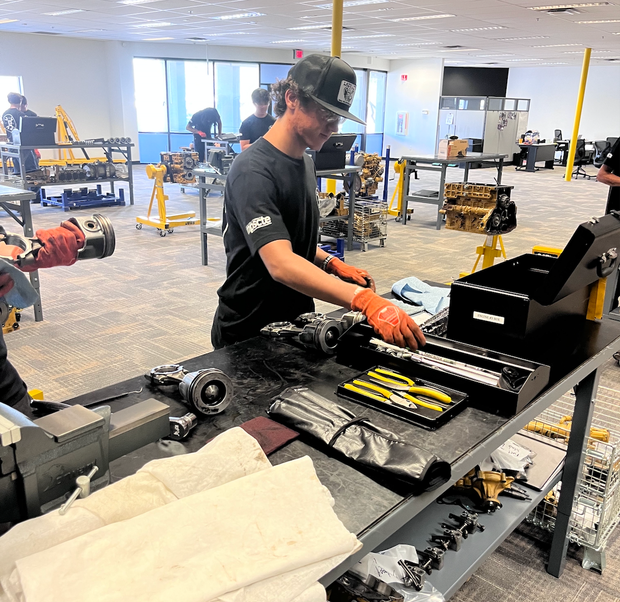
High school senior Kayden Evans is confident that he’ll be shielded from AI if he pursues a carer in the trades.
Courtesy of Kayden Evans
Kayden Evans, an 18-year-old senior at Mountain View High School in Mesa, Arizona, has his eyes set on a career working with his hands, and to eventually start his own business. Currently an intern at Empire Cat, a company that sells, rents and services heavy equipment and tractors, he plans on going straight from high school into an apprenticeship with the company.
“I wouldn’t say I am worried about AI because where I want to grow is as a field technician, and even though it helps, I don’t think AI can take that over,” he said. “AI can’t go out in the field and take apart an engine.”
Questions
1. Who is Jacob Palmer? What does he do?
2. a) What are skilled trades?
b) List jobs included in the skilled trades.
3. For many years, young people have been told "Go to college." For what reasons are high school students today considering trade schools over college?
4. What job fields are considered safe? Which have been seen recently as having less security?
5. What is the average tuition per year for college?
5. a) How has the unemployment rate changed for college graduates from 2019 to today?
b) How do unemployment rates differ between college grads and non college-educated workers in the same age range?
6. How much revenue has Jacob Palmer's business made?
7. What does 18-year-old Arizona high school senior Kayden Evans plan on doing after college?
8. Read the additional examples of high school students choosing trade schools (or vocational tech in high school) under "Background" below. Do these stories inspire/encourage you? Explain your answer.
NOTE: Many white collar jobs (not just doctor, lawyer, teacher, etc.) require a college diploma. Employees generally need a college degree to advance from an entry level position to a higher paying job with more responsibilities in large companies/corporations. But the cost for a 4 year college is exorbitant. So you should have a career plan. Don't just go to college without knowing what you want to do.
Know what your goal is and work toward it. Research salaries and job opportunities in your chosen field for when you graduate.
Or if you are interested, consider a skilled trade, and the type of training you need. Talk to a parent about the advantages and disadvantages including salaries and job opportunities for certain skilled trades, as well as for careers where a college degree is necessary.
Proverbs 3:5-6
Background
Excerpted from a May 7, 2025 Wall Street Journal article:
PHILADELPHIA—Elijah Rios won’t graduate from high school until next year, but he already has a job offer—one that pays $68,000 a year.
Rios, 17 years old, is a junior taking welding classes at Father Judge, a Catholic high school in Philadelphia that works closely with companies looking for workers in the skilled trades. Employers are dealing with a shortage of such workers as baby boomers retire. They have increasingly begun courting high-school students like Rios—a hiring strategy they say is likely to become even more crucial in the coming years.
Employers ranging from the local transit system to submarine manufacturers make regular visits to Father Judge’s welding classrooms every year, bringing branded swag and pitching students on their workplaces. When Rios graduates next year, he plans to work as a fabricator at a local equipment maker for nuclear, recycling and other sectors, a job that pays $24 an hour, plus regular overtime and paid vacations.
“Sometimes it’s a little overwhelming—like, this company wants you, that company wants you,” says Rios, who grew up in the Philadelphia neighborhood of Kensington around drug addicts and homelessness, and says he was determined to build a better life for himself. “It honestly feels like I’m an athlete getting all this attention from all these pro teams.”
Increased efforts to recruit high-schoolers into professions such as plumbing, electrical work and welding have helped spur a revitalization of shop classes in many districts. More businesses are teaming up with high schools to enable students to work part-time, earning money as well as academic credit. More employers are showing up at high school career days and turning to creative recruiting strategies, as well.
Employers say that as the skilled trades become more tech-infused, they anticipate doing even more recruitment at an early age, because they need workers who are comfortable programming and running computer diagnostics. “I’m not looking to hire the guy I used to have 20 years ago,” says Bob Walker, founder of Global Affinity, the Bristol, Pa.-based manufacturer who offered Rios a job. The equipment he uses is highly advanced, including a $1.7 million steel laser cutter, and he says he needs tech-savvy workers to operate it. ...
A decade ago, administrators often snubbed employers in the skilled trades who tried to get a table at a high school career fair, says Aaron Hilger, CEO of the Sheet Metal and Air Conditioning Contractors’ National Association. But with more high schools trying to give students alternatives to college, he says, that attitude has changed.
Constellation Energy, an operator of U.S. nuclear power plants based in Baltimore, offers maintenance technician and equipment-operator roles that are open to high-school graduates without four-year college degrees, and pay as much as six figures. “These are family-sustaining careers,” says Ray Stringer, a vice president overseeing workforce development at the company. Last year, Constellation launched a work-based learning program outside Chicago that invites high-school students to shadow workers at the company’s nuclear facilities while also earning community-college credit. ...
Dan Schnaufer, service and body shop director at the nearby D’Addario Automotive Group, brings on several high-school students every year to work part-time in his shop, including from Bullard-Havens. They receive academic credit for their work, and he has the benefit of seeing their skills and temperament in action and being first in line to hire them once they graduate.
“The idea of growing your own talent has gotten more critical in recent years, when you have fewer and fewer people going into this industry,” he says. At his shop, fresh high-school graduates can make around $50,000 a year, he says, and six figures within five years, without college debt.
... At Philadelphia’s Father Judge, all 24 graduating seniors in the welding program have job offers, each paying $50,000 and above, says welding instructor Joe Williams. More employers, he says, reach out to him every semester.
Aiden Holland, a senior at the high school, was recruited earlier this spring to become a nuclear submarine welder at a defense contractor in New Jersey, a position paying $75,000 a year. The 18-year-old says he’s grateful to have landed a job like that, with no college debt, and that his college-bound peers are often astonished to learn how much he can make with no degree.
“It feels good knowing we’re very, very much in demand,” he says.