
Health officials announce potential link between acetaminophen use during pregnancy and Autism
Daily News Article — Posted on September 23, 2025
(by Brooke Mallory, OAN) – President Donald Trump and Health and Human Services (HHS) Secretary Robert F. Kennedy Jr. have announced that use of Tylenol, or acetaminophen, during pregnancy is linked to a higher risk of autism in children. The administration referenced a study conducted by Harvard and Mount Sinai.
However, pregnant women who report having an “extremely high fever” are still cautioned to take Tylenol…President Trump [who spoke at length] added, before stepping aside to let Kennedy speak.
Autism, more formally called Autism Spectrum Disorder (ASD), is a neurodevelopmental condition that affects how a person perceives the world, communicates, and interacts with others. The word “spectrum” is crucial — as autism can manifest in many different ways, ranging from mild to more pronounced differences in social, cognitive, and behavioral functioning. …
On Monday, President Trump and Kennedy, joined by Dr. Mehmet Oz, the administrator of the Centers for Medicare & Medicaid Services, NIH Director Dr. Jay Bhattacharya, and FDA Commissioner Dr. Marty Makary, arrived at the Roosevelt Room of the White House for the anticipated announcement regarding autism and Tylenol (acetaminophen) use during pregnancy.

(left to right:) NIH Director Dr. Jay Bhattacharya, FDA Commissioner Dr. Marty Makary, Secretary of Health and Human Services Robert F. Kennedy, Jr., President Trump and Administrator of the Centers for Medicare & Medicaid Services Dr. Mehmet Oz, the Roosevelt Room of the White House, September 22, 2025.
The White House announcement had been [supported] by Kennedy in recent months, and President Trump suggested prior [to Monday’s press conference] that this revelation could be one of the most important medical developments in U.S. history. …
As Kennedy stepped up to the podium on Monday, pausing briefly as cameras captured the moment, he…address[ed] the widely debated topic.
“To meet the president’s challenge, I’ve ordered [the] HHS to launch an unprecedented all agency effort to identify all causes of autism, including toxic and pharmaceutical exposures … Historically, [the] NIH has focused almost solely on politically safe and entirely fruitless research about the genetic drivers of autism. That would be like studying the genetic drivers of lung cancer — without looking at cigarettes … As a result, we don’t have an answer to this critical question, despite the cataclysmic impact of the epidemic on our nation’s children. We are now replacing the institutional culture of politicized science and corruption with evidence-based medicine. NIH research teams are currently testing multiple hypotheses with no area off limits.
“We promise transparency. Every protocol will be published, every dataset will be available for independent review, and every finding will be shared with the American people promptly. Trust in science can only be restored through absolute openness,” Kennedy stated.
The HHS Secretary also disclosed that the agency has found evidence suggesting that Tylenol use may be associated not only with autism but with ADHD and liver toxicity in children as well.
He continued to emphasize the GOP administration’s commitment to [support research into] the nation’s autism epidemic [to discover] causes and potential treatments for autism, which has seen an almost 400% increase since 2000. It now affects 1-in-31 American children, Kennedy noted.
What Happens Next
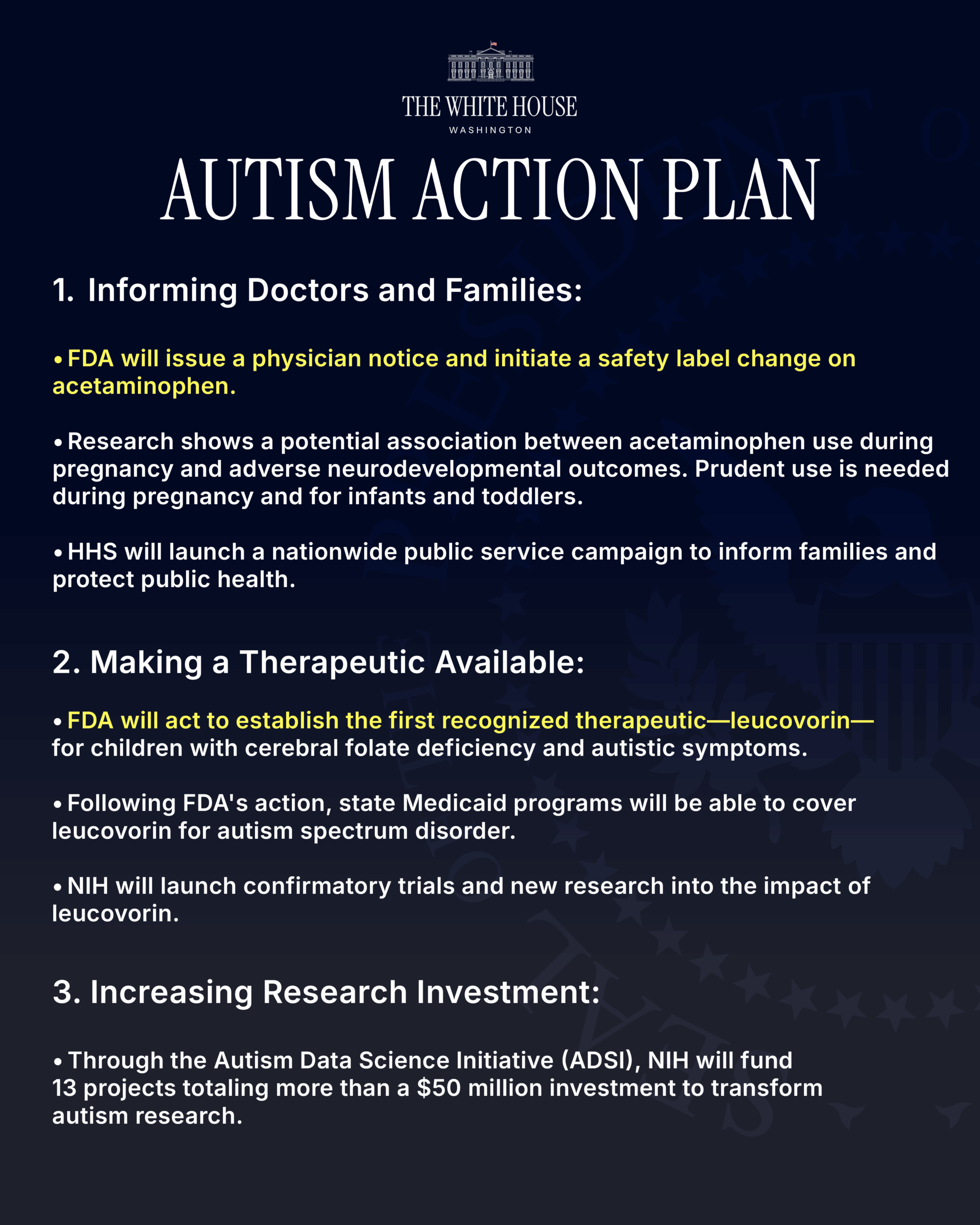
- The FDA will be updating the label for leucovorin (folinic acid) to include treatment for children with cerebral folate deficiency and autism-like symptoms. This is the first FDA-recognized therapeutic for children with ASD. Although leucovorin is not a cure for autism, it may improve speech-related deficits in a subset of children.
- The FDA is initiating a safety label change for acetaminophen (Tylenol) to inform healthcare providers and the public about potential risks associated with its use during pregnancy, backed by clinical and laboratory studies suggesting a possible association between prenatal acetaminophen use and adverse neurodevelopmental outcomes.
The Trump administration will also be advising clinicians to prescribe the lowest effective dose for the shortest duration if treatment is required.
[In addition, the NIH today is announcing the recipients of the Autism Data Science Initiative (ADSI), funding 13 projects totaling more than $50 million to transform autism research. ADSI integrates large-scale biological, clinical, and behavioral data with an exposomics approach that examines environmental, nutritional, medical, and social factors alongside genetics].Meanwhile, the scientific community is divided on the matter. Some studies have suggested a strong association between prenatal [during pregnancy] acetaminophen exposure and neurodevelopmental disorders like ASD and ADHD, according to Mount Sinai Health System. However, other studies, including a previous analysis of over 2 million children in Sweden, found no causal link between acetaminophen use during pregnancy and the risk of developing autism, ADHD, or intellectual disabilities, according to the National Institutes of Health (NIH).
Kenvue, the maker of Tylenol, issued the following statement pushing back on the Trump administration: “We believe independent, sound science clearly shows that taking acetaminophen does not cause autism. We strongly disagree with any suggestion otherwise and are deeply concerned with the health risk this poses for expecting mothers.”
Published at OAN on Sept. 22. Reprinted here for educational purposes only. May not be reproduced on other websites without permission.
Questions
1. What did President Trump and HHS Secretary Kennedy announce about the use of acetaminophen/Tylenol from the White House on Monday?
2. President Trump stated that pregnant women should not take Tylenol for a low grade fever or pain, but noted they should take it when?
3. How does autism affect those who have it?
4. a) What did HHS Secretary Kennedy announce he has ordered his department to do regarding autism?
b) What did he promise the American people he will do?
5. What other conditions did Secretary Kennedy say they had found evidence suggesting a link to the use of Tylenol during pregnancy?
6. What three specific actions will the FDA and NIH take in addressing autism?
7. In a USA Today article, the reporter wrote:
"Trump suggested without evidence that people be vaccinated against measles, mumps and rubella separately, and that they space out vaccines over longer periods of time."
Instead of dismissing concerns of many parents, the president has his administration working to find causes and/or treatments for autism. He does not say to not get your children vaccinated, but suggests spreading out the vaccines over a longer period of time. He also noted that he is not a doctor, and it is only his opinion.
Children receive approximately 60 vaccines today compared to about 11 thirty years ago (do a search for exact numbers - young people previously did not receive yearly flu shots, and new vaccines include for Chickenpox, HPV, Hepatitis A and several more).
Is he making a reasonable suggestion to say they should be more spread out? - ask a parent.
CHALLENGE. Read the info under "Background" below the questions.
Secretary Kennedy said during the announcement on Monday: “For too long, families have been left without answers or options as autism rates have soared. Today, are taking bold action — opening the door to the first FDA-recognized treatment pathway, informing doctors and families about potential risks, and investing in groundbreaking research. We will follow the science, restore trust, and deliver hope to millions of American families.”
Many news reports portray Secretary Kennedy as a crackpot for his views on vaccines, etc. But many Americans support his efforts.
- NIH director Dr. Jay Bhattachary was previously a professor at Stanford University.
- FDA commissioner Dr. Marty Makary was previously a professor at Johns Hopkins University.
- Dr. Mehmet Oz, administrator of CMS was previously a professor at Columbia University.
Most people have a family member or friend on the autism spectrum. What do you think? Should the Trump administration's efforts be dismissed as "disproved" "without evidence" "debunked" as many news reports suggest? Explain your answer.
Background
Autism Prevalence in the United States
Key Findings
- 1 in 31 U.S. children (3.2%) born in 2014 are diagnosed with autism spectrum disorder (ASD).
- Sharp increase from 1 in 36 just two years earlier.
- Prevalence nearly 5 times higher than when the CDC began tracking in 2000 (1 in 150).
- Boys disproportionately affected: 1 in 20 (5%).
- California highest prevalence: 1 in 12.5.
- Source: Centers for Disease Control and Prevention (CDC), Morbidity and Mortality Weekly Report (MMWR), Surveillance Summaries, Vol. 74, No. SS-2, April 2025
Read more at the HHS's "Autism Announcement Fact Sheet"
Acetaminophen, commonly sold under the brand name Tylenol and many others, has been considered the safest painkiller for pregnant women to manage fever, headache, and other pain.
But in a study published in August 2025, researchers led by Andrea Baccarelli of Harvard University found that when children are exposed to the drug during pregnancy “they may be more likely to develop neurodevelopmental disorders (NDDs) including autism and ADHD,” a university press release said on Aug. 20.