
America’s oil comeback story
Daily News Article — Posted on November 4, 2025
The Permian Basin is the most active drilling area in the United States (and the world), with hundreds of rigs in operation.
Its dominance is driven by advancements like horizontal drilling and hydraulic fracturing, and unique geological features such as “stacked pay” zones, which allow multiple wells to be drilled from a single location.
The basin is home to a large number of oil and gas companies, with ExxonMobil, Occidental Petroleum, ConocoPhillips, and EOG Resources frequently appearing at the top of rig count and production lists.
Watch Maria Bartiromo’s FoxBusiness report “From near collapse to global dominance — America’s oil comeback story” Part 1 and answers the questions below:
Questions
NOTE: The questions are from the first 5+minutes of the video.
1. Where/what is the Permian Basin?
2. a) How much of the U.S. oil supply does the Permian Basin produce? By how much is it expected to increase?
b) How much of the U.S. natural gas production comes from the Permian Basin?
3. How has America's oil and gas production changed in the last 20 years? (at around 1:00)
4. a) For how long has the Permian Basin been producing oil?
b) How much oil does the Permian Basin produce a day? What is significant about this? (around 1:20)
5. What has led to new business opportunities for America's oil producers, according to FoxBusiness' Maria Bartiromo?
6. What new industry is natural gas needed for in the U.S.?
7. a) How large is the Permian Basin?
b) What do officials believe to be true about the oil and gas supply located in this area? AND Why is this significant? (around 2:20)
8. Chevron's Shale VP Kim McHugh, who is a second generation driller, said she picked her career because she was good at math and science - and it was a challenge with very few women in the field when she began. Why does she call the work they are doing "a noble cause"? (around 2:40)
9. Why does Chevron CEO Mike Wirth say America's energy strength (adequate supply/abundance) is so important?
10. How did the Biden administration stymie the U.S. oil and gas industry for four years? What steps did they take to do so?
11. a) What is hydraulic fracking? (around 4:35)
b) What effect has fracking and horizontal drilling had on total daily oil production at Permian?
12. Re-watch the part of the video illustrating hydraulic fracturing and horizontal drilling. (around 4:40 on the video). And watch the video under "Resources."
What is your reaction to this engineering feat? (inspired, astonished, encouraged, interested, annoyed, disgusted...) Explain your answer.
13. From Donald Trump's 2024 Republican party platform:
"Common Sense tells us clearly that we must unleash American Energy if we want to destroy inflation and rapidly bring down prices, build the Greatest Economy in History, revive our defense industrial base, fuel emerging industries, and establish the United States as the Manufacturing Superpower of the World. We will DRILL, BABY, DRILL and we will become energy independent, and even dominant again. The United States has more liquid gold under our feet than any other Nation, and it’s not even close. The Republican Party will harness that potential to power our future."
One viewer commented on the video:
"Once you get energy prices low, everything else seems to follow. There isn't one thing that a person can name that isn't affected by the price of oil in one way or another. The other big benefit is that we become less dependent on countries that want to hurt us."
Do you agree with Trump - and the reader - that becoming energy independent through oil and gas is good for the country?
Background
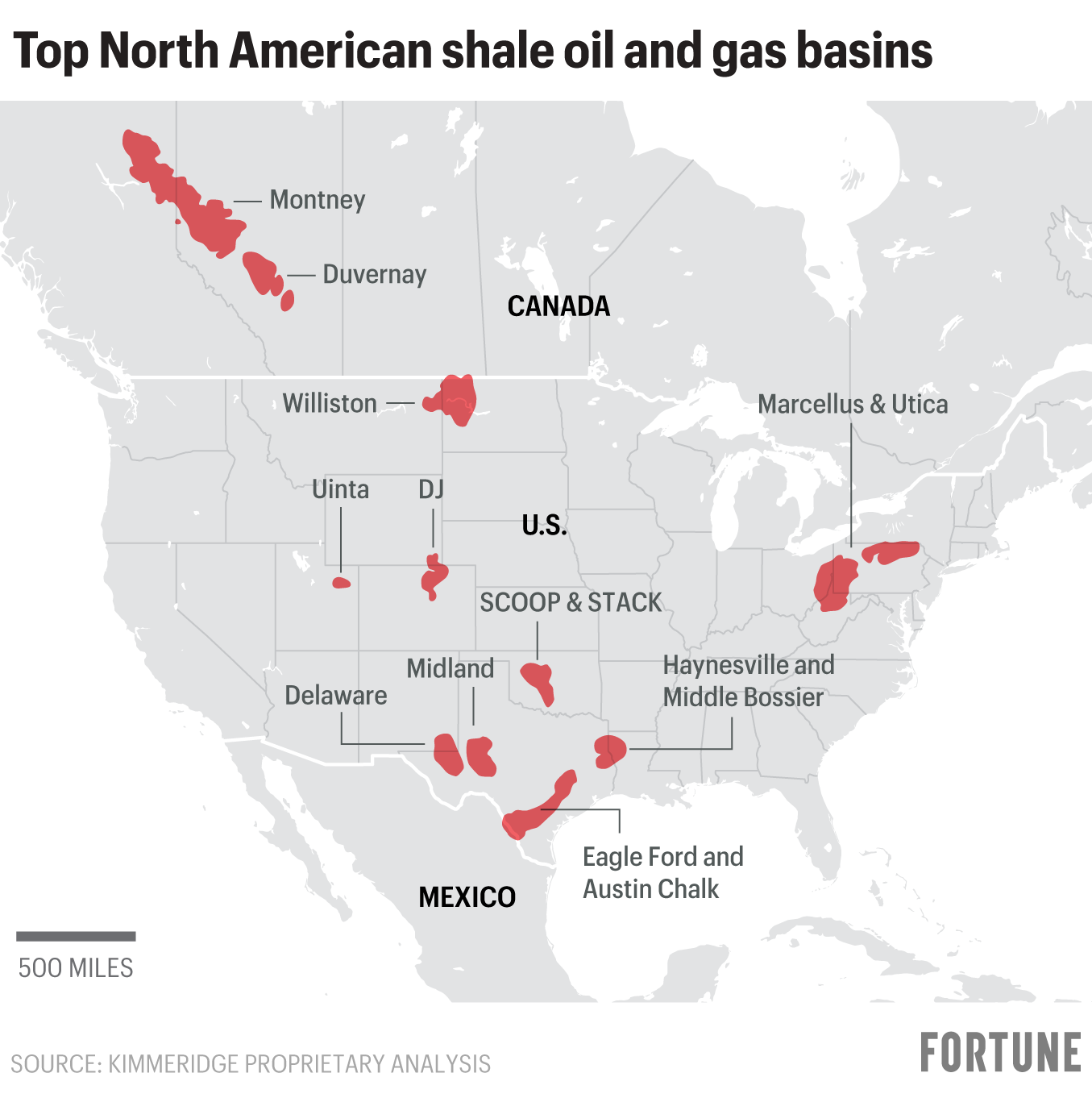
Top North American shale oil and gas basins
What is fracking? (from Grok, Nov. 3, 2025)
Fracking (short for hydraulic fracturing) is a method used to extract oil and natural gas from deep underground rock formations.
How it works:
Drilling: A well is drilled vertically thousands of feet into the earth, then horizontally into shale or other tight rock layers.
Injection: A high-pressure mixture of water, sand, and chemicals (called "fracking fluid") is pumped into the rock.
Fracturing: The pressure creates tiny cracks (fractures) in the rock.
Extraction: Sand holds the cracks open, allowing trapped oil or gas to flow up the well to the surface.
Why it's used:
Unlocks vast reserves of oil and gas trapped in dense rock (like shale) that traditional drilling can't access.
Has significantly increased U.S. energy production since the early 2000s.
- The United States, Canada, China, Argentina account for nearly all commercial shale gas/oil production via fracking.
- The U.S. leads globally, with fracking driving ~70% of natural gas output.
- China launched its first offshore fracking vessel in 2025 to tap deeper reserves.
Fracking began to be used in the Permian Basin in the late 1940s to mid-20th century on the Spraberry trend (Texas oilfield), but it was not until the 2000s that it became widespread and revolutionary when combined with horizontal drilling.
The modern "shale revolution," which involved extensively fracking both natural gas and tight oil, started to gain momentum in the 2010s.
The real game-changer was combining modern hydraulic fracturing with horizontal drilling. This combination, first proven in the Barnett Shale in Texas, was later applied to the Permian Basin to extract tight oil and shale gas, leading to a massive resurgence in production in the 2000s and 2010s. (from Google AI, Nov 3)
The top 10 oil-producing countries are:
- United States
- Saudi Arabia
- Russia
- Canada
- Iraq
- China
- United Arab Emirates
- Brazil
- Kuwait
- Iran
The exact ranking and production numbers can vary slightly depending on the year and source, but these nations consistently appear at the top.