
Amazon employee’s conspiracy theory on outage goes viral
News Stories — Posted on October 23, 2025
(by Stacy Liberatore, UK Daily Mail) -Amazon Web Services (AWS), the cloud computing platform that powers much of the internet, went down for several hours Monday, making [multiple] major websites and apps inoperable.
Amazon employees said they were left in the dark during [the] massive outage, fueling claims the tech giant tested a so-called ‘kill switch.’
One staff member made the claim three hours after Amazon Web Services (AWS) went down, which caused widespread disruptions across social media, gaming, food delivery, streaming and financial platforms.
The employee said in the video posted to TikTok: “They don’t have any information for us…. I believe in the kill switch. They are just trying to test it out, and it works.” …
The “kill switch” the employee mentioned in the video likely refers to a conspiracy theory claiming that AWS has a secret mechanism to intentionally shut down online infrastructure for control or censorship.
However, the company cited an “operational issue” affecting multiple services and said it was “working on multiple parallel paths to accelerate recovery.”
The outage began around 3:11am ET, prompting AWS to investigate higher error rates and slower response times in its US-EAST-1 region, the company’s oldest and largest data hub. All services returned to normal by 6pm.
The Daily Mail has contacted Amazon for comment and has yet to receive a response.
The TikTok video has since gone viral on X, where many users agreed that the tech giant activated a kill switch.
“If they actually have a kill switch and just tested it on their entire workforce, that is genuinely terrifying,” one user posted.
However, another user posted on X: ‘An outage like this is the worst possible scenario for the company.
“The internal systems that provide status updates and VTO were also out. There’s no reason for a company to do this on purpose. Would be lighting a building on fire to see if smoke alarms work.”
Amazon said the outage was related to issues with its domain name system, which converts web addresses into IP addresses – numeric designations that identify locations on the internet.
DownDetector, a website that tracks online outages, said in a Facebook post that it received more than 11 million user reports of issues at more than 2,500 companies.
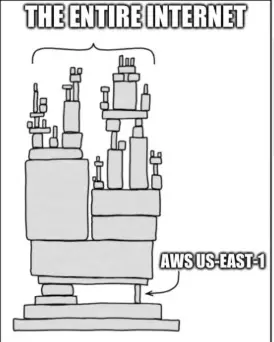
Users reported trouble with the social media app Snapchat, the Roblox and Fortnite video games, the online broker Robinhood and the McDonald’s app, as well as Netflix, Disney+ and many other services.
The cryptocurrency exchange Coinbase and the Signal chat app both said on X that they were experiencing trouble related to the outage.
Amazon’s own services were also affected. Users of the company’s Ring doorbell cameras and Alexa-powered smart speakers reported that they were not working, while others said they were unable to access the Amazon website or download books to their Kindle.
Many college and K-12 students were unable to submit or access their homework or course materials on Monday because the AWS outage knocked out Canvas [and Class Link], widely used educational platforms. …
While the exact number of schools impacted was not immediately known, Canvas said on its website that it is used by 50 percent of college and university students in North America, including all Ivy League schools in the US.
At the University of California, Riverside, students could not submit assignments, take quizzes or access course materials, and online instruction was limited, the institution said.
The Ohio State University informed its 70,000 students at all six campuses by email Monday morning that online course materials might be inaccessible due to the outage and that ‘students should connect with their instructors for any alternative plans’.
Published at UK Daily Mail on Oct 21. Reprinted here for educational purposes only. May not be reproduced on other websites without permission.
Background
From Oct. 22, Google AI Overview: Amazon says the recent outage was caused by a significant Domain Name System (DNS) error that impacted its US-EAST-1 data center, preventing applications from correctly finding the address for the crucial DynamoDB database. This "common tech glitch" prevented many websites and apps, which rely on Amazon's cloud services, from loading. While the initial problem is fixed, a full post-mortem with the exact root cause is expected to be released later, according to CNN.
What a DNS error is and why it's a problem
- DNS explained: The DNS is like the internet's phone book, translating human-readable website names (like amazon.com) into the numerical IP addresses that computers need to locate and connect to services.
- How it caused the outage: A problem with the DNS meant that applications could not get the correct IP address for the DynamoDB database, which stores critical user data for many companies.
- Impact: This prevented apps from accessing their data, even though the data itself was safe and stored on Amazon's servers.
- Widespread effect: Because so many services rely on AWS, a problem in one of its core systems like the DNS had a widespread impact, affecting numerous major platforms.
From Oct. 22 Perplexity AI: The following (and more) were affected by Amazon (AWS) outage Monday:
- Gaming services, notably Roblox, Fortnite, PUBG, and Rainbow Six Siege, were inaccessible for extended periods.
- Messaging and video services like WhatsApp, Signal, Zoom, and Slack
- Email marketing via Mailchimp stopped, impacting campaigns and business communications.
- Amazon Prime Video, Twitch, and Vimeo streaming platforms saw widespread errors.
- Snapchat and Reddit users could not share updates, send messages, or browse feeds.
- Creative platforms like Canva and Duolingo experienced outages, locking out users from design projects or learning.
- Amazon Alexa and Ring smart home systems were rendered inoperable, affecting voice control and home security access.
- Shopify experienced downtime that prevented online sales for many businesses.
- Amazon warehouse and delivery staff were unable to use internal systems or pay apps at work locations.
- Learning tools and platforms such as Google Drive, Canvas, and Goodreads faced failures, restricting document access and assignment submissions.
- OpenAI (ChatGPT), Claude (Anthropic), Box (file sharing), and other cloud service providers had connection problems impacting AI and productivity services.