
Abraham Lincoln – Honest Abe, the Great Emancipator
Daily News Article — Posted on February 11, 2026
NOTE: Presidents’ Day, is a federal holiday held on the third Monday of February. Lincoln’s birthday (Feb. 12) and Washington’s birthday (Feb. 22) used to be celebrated separately before the two were combined into Presidents’ Day.
Today’s post is on Abraham Lincoln. (Monday’s post will be on George Washington.)
HOW MUCH DO YOU KNOW ABOUT OUR 16TH PRESIDENT?
Abraham Lincoln (1809–1865) was the 16th U.S. President, renowned for leading the Union through the Civil War, preserving the nation, and abolishing slavery via the Emancipation Proclamation. He is widely considered one of America’s most influential presidents.
Lincoln was born in a one-room log cabin in Kentucky on February 12, 1809 and was largely self-educated. He worked as a flatboat navigator and a storekeeper before becoming a successful lawyer in Illinois. He served in the Illinois legislature and one term in the U.S. House before becoming the first Republican president.
Lincoln was shot by John Wilkes Booth at Ford’s Theatre in Washington, DC just days after the Confederate surrender, on the evening of April 14, 1865. He died at 7:22 a.m. on April 15, 1865.
Lincoln’s birthday is marked by traditional wreath-laying ceremonies at Abraham Lincoln Birthplace National Historic Site in Hodgenville, Kentucky, and at the Lincoln Memorial in Washington, D.C. The latter has been the site of a ceremony ever since the Memorial was dedicated in 1922. A wreath is laid on behalf of the President of the United States, a custom also carried out at the grave sites of all deceased U.S. presidents on their birthdays. Lincoln’s tomb is in Springfield, Illinois.
- Read about Lincoln’s faith in God and Lincoln’s biblical faith.
- Read Lincoln’s Gettysburg Address at abrahamlincolnonline.org
- Read Lincoln’s Emancipation Proclamation at archives.gov.
- Read Lincoln’s entire 2nd Inauguaral Address at avalon.law.yale.edu.
- While noting some of the biblical references Lincoln made in his Second Inauguaral Address, the Wikipedia post on the address states, “Lincoln’s point seems to be that God’s purposes are not directly knowable to humans, and represents a theme that he had expressed earlier” After Lincoln’s death, his secretaries found among his papers an undated manuscript now generally known as the “Meditations on the Divine Will.” In that manuscript, Lincoln wrote:
- “The will of God prevails—In great contests each party claims to act in accordance with the will of God. Both may be, and one must be wrong. God cannot be for, and against the same thing at the same time. In the present civil war it is quite possible that God’s purpose is somewhat different from the purpose of either party—and yet the human instrumentalities, working just as they do, are of the best adaptation to effect this…”
- Read about Lincoln’s first Thanksgiving Proclamation from 1863 (and the text here).
- Read Lincoln’s 1863 Proclamation for a Day of Fasting, Humiliation and Prayer
- Read President Lincoln’s last public address, given on April 11, 1865, (which followed Confederate Gen. Lee’s surrender to Union Gen. Grant) a few days before he was assassinated on April 15.
- Visit the Library of Congress page on Lincoln at loc.gov
- See Lincoln’s Papers at papersofabrahamlincoln.org.
- For an interesting, well-researched book on Lincoln’s assassin, read:
“Manhunt: The 12-Day Chase for Lincoln’s Killer” by James L. Swanson
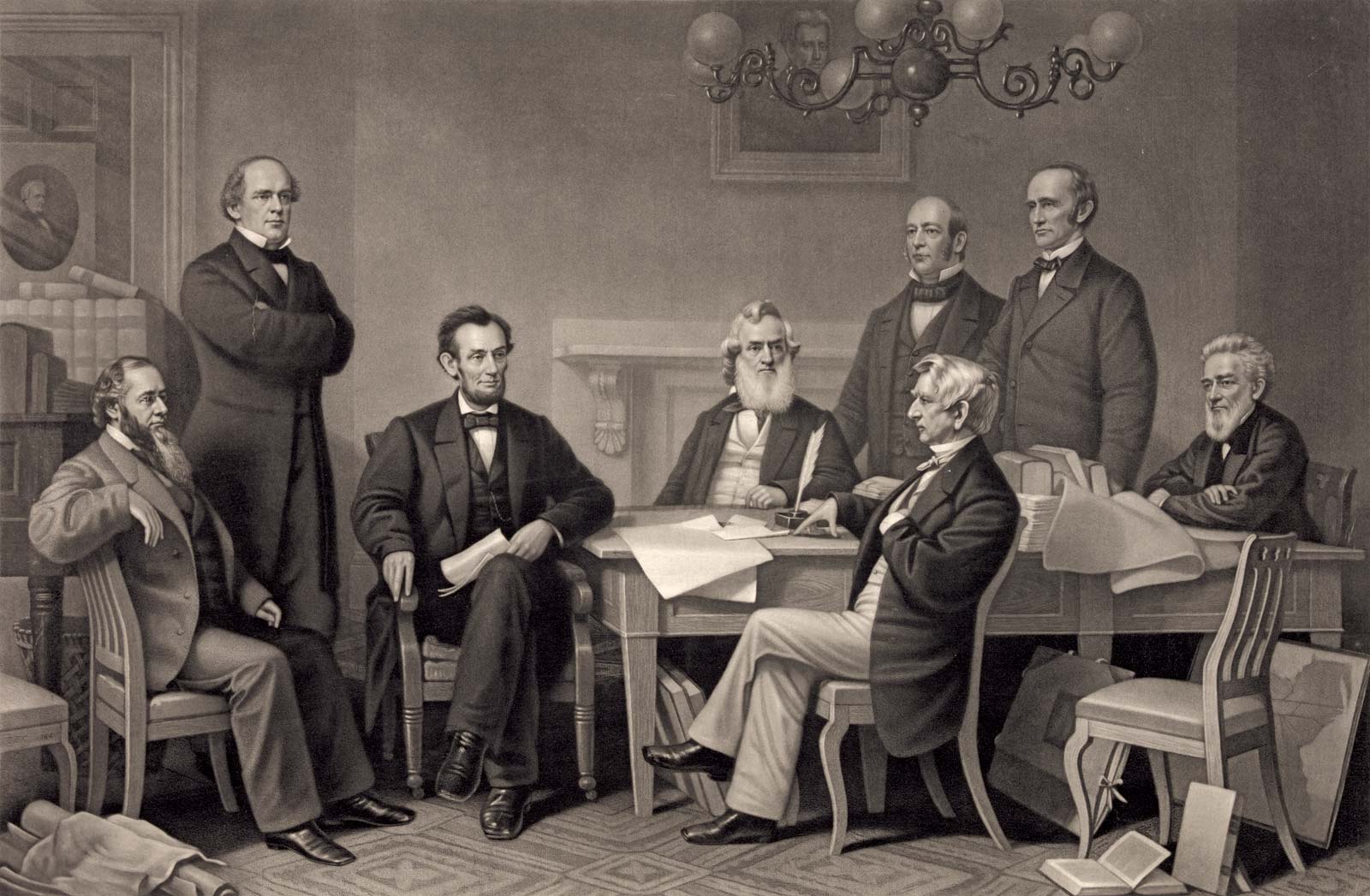
The first reading of the Emancipation Proclamation, engraving by A.H. Ritchie, 1866. Seated from left to right: Secretary of War Edwin M. Stanton, Pres. Abraham Lincoln, Secretary of the Navy Gideon Welles, Secretary of State William H. Seward, and Attorney General Edward Bates. Standing from left to right: Secretary of the Treasury Salmon P. Chase, Secretary of the Interior Caleb B. Smith, and Postmaster General Montgomery Blair.
ABOUT LINCOLN’S GETTYSBURG ADDRESS (NOV. 19, 1863):
- When the armies marched away from Gettysburg they left behind a community in shambles and more than 51,000 killed, wounded, and missing. Wounded and dying were crowded into nearly every building. Most of the dead lay in hasty and inadequate graves; some had not been buried at all.
- This situation so distressed Pennsylvania’s Gov. Andrew Curtin that he commissioned a local attorney, David Wills, to purchase land for a proper burial ground for Union dead. Within four months of the battle, reinterment began on 17 acres that became Gettysburg National Cemetery.
- When the cemetery was dedicated on November 19, 1863, less than half the Union battle dead had been removed from their field graves. The principal speaker was the renowned orator, Edward Everett. As was common for the day, his detailed speech lasted for over two hours.
- Also on the program was a guest who had been invited to present “a few appropriate remarks” only as an afterthought. President Abraham Lincoln’s delivery of these remarks lasted only two minutes that day. The short length was in such contrast to the Everett allocution that the audience, stunned for a moment, barely reacted. Upon returning to his seat Lincoln remarked to a friend: “That speech won’t scour. It is a flat failure.” To the contrary, the Gettysburg Address has become known as one of the supreme masterpieces of eloquence in the English language. On November 20, Everett wrote Lincoln “I should be glad if I could flatter myself that I came as near to the central idea of the occasion in two hours as you did in two minutes.”
- The 272 words of the Gettysburg Address were formulated with great thought by Lincoln. He wrote the first draft in Washington shortly before November 18 and revised it at the home of David Wills in Gettysburg the night before the dedication.
- The speech transformed Gettysburg from a scene of carnage into a symbol, giving meaning to the sacrifice of the dead and inspiration to the living.
- Within a few years, however, the bodies of more than 3,500 Union soldiers killed in the battle had been reinterred in the cemetery. Following the war, the remains of 3,320 Confederate soldiers were removed from the battlefield to cemeteries in the South.
- Today the cemetery is the final resting place for over 6,000 honorably discharged servicemen and their dependents from the Civil War, Spanish-American War, World War I, World War II and the Vietnam War.
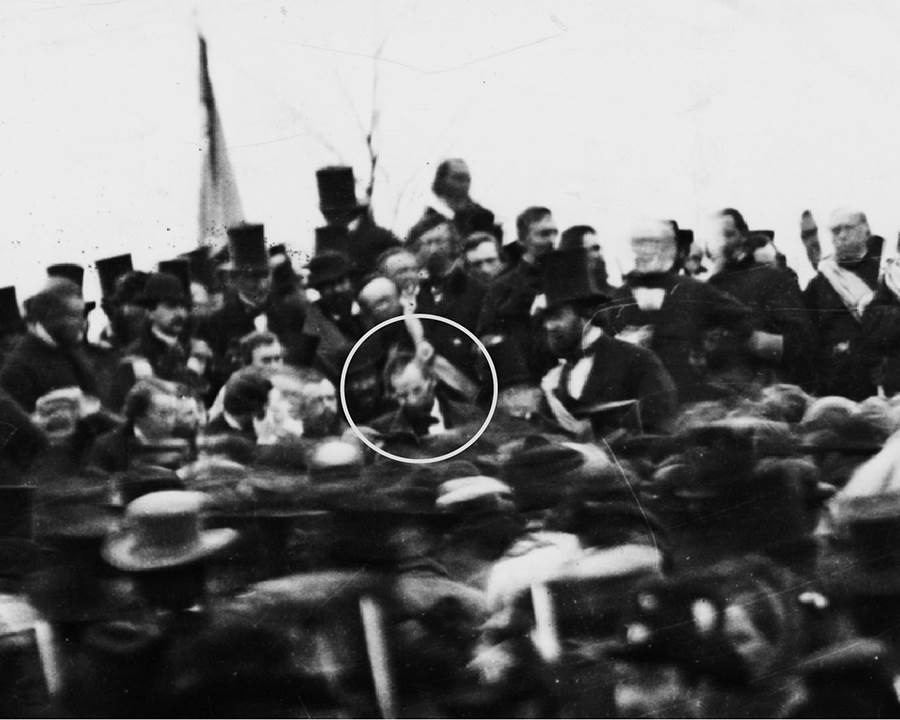
A Matthew Brady photo of the crowd at Gettysburg caught a blurry image of Abraham Lincoln before he delivered his famous address.
Questions
1. What 2-3 adjectives come to mind when you think of President Abraham Lincoln? Explain your answer.
2. Abraham Lincoln was known as "Honest Abe" and "The Great Emancipator." Why was he given each of these nicknames?
3. Take some time to check out the links on Abraham Lincoln in today's post. Has your answer to question #1 changed? Explain your answer.
4. Read some of President Lincoln's speeches, including:
- Gettysburg Address at Library of Congress loc.gov.
- Emancipation Proclamation at archives.gov.
- 2nd Inauguaral Address at avalon.law.yale.edu.
- Read about Lincoln's first Thanksgiving Proclamation from 1863 (and the text here).
- Lincoln's last public address, given on April 11, 1865, following Gen. Lee's surrender to Gen. Grant
Tone is the attitude a writer takes towards his subject. For each speech, what is the general tone?
CHALLENGE: Abraham Lincoln remained steadfast in his embrace of the Declaration of Independence throughout his presidency. As he had urged in a speech in 1858:
"Return to the foundation whose waters spring close by the blood of the Revolution. Think nothing of me; take no thought for the political fate of any man whomsoever, but come back to the truths that are in the Declaration of Independence."
How many times have you read through the Declaration of Independence? Read through the Declaration of Independence a few times. Why do you think these truths were so important to Lincoln? For the full text, go to the U.S. Archives: archives.gov