redo Jump to...
print Print...
Directions
-Read the excerpt below (from K. Daniel Glover's May 21st post at AIM.org).
-Read "Types of Media Bias" in the right column. Then answer the questions.
…[On May 19th, California] voters rejected five ballot propositions aimed at addressing the state’s fiscal crisis by [increasing taxes]. …Most California media outlets, on the other hand, supported the propositions. …
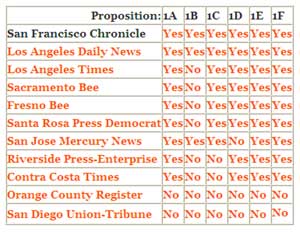
The chart below [adapted from the San Fransisco Chronicle and posted at Reason.com] shows the editorial endorsements of the top 11 California general-interest daily newspapers:
… Journalists both in California and beyond have reacted to Tuesday’s vote in one of two ways:
1. Chastising voters for taking a stand against more taxes and spending…
2. Or writing sob stories designed to make voters feel guilty about demanding responsible budgeting from their governments. (Expect more like these in the weeks ahead.)
The most egregious display of post-election journalistic arrogance occurred on the Web site of the Sacramento Bee. T[he day after the vote], the newspaper’s editorial board published an attack on voters for daring to exercise their democratic rights at the ballot. Here’s a sample [from the Sacramento Bee’s editorial]:
Good morning, California voters. Do you feel better, now that you’ve gotten that out of your system?
You wanted to show the state’s politicians just how mad you are at them. And you did. Boy, did you ever. …
[Y]ou’re sick and tired of all this political mumbo-jumbo. So you showed those politicians who’s in charge. You. You’re now officially in charge of a state that will be something like $25 billion in the hole for the fiscal year beginning July 1.
So, now that you’ve put those irksome politicians in their place, maybe it’s time to think about this: Since you’re in charge, exactly what do you intend to do about that pesky $25 billion hole in the budget?
[After many reader complaints] The Bee eventually yanked the editorial offline and republished the piece that appeared in the print edition, which put the blame where it belongs — on the governor and state Legislature. A note at the bottom said the first version was “posted in error” and was just “a draft prepared for internal discussion.”
Fine. Those kinds of errors do happen. But it was a most revealing error.
It offered a glimpse into a mindset that is evident in newsrooms across America — that government can solve everything and that “the people” are stupid sheep who need to be led. …
These days, the “press” that our forefathers so wisely and prominently saw fit in the Constitution to protect from the government has decided that its role is to defend the government from the unruly, clueless mobs who give them power. …
Today’s journalists have far more in common with the people they cover … than with their news audiences. They spend more time hobnobbing with bigwigs on the party circuit … than trying to understand why taxes and spending have become such a burden on so many people. … [The news media] clearly don’t share the perspective of the average taxpayer. But worse, they aren’t even curious enough to explore it honestly and fairly. …
(Read the original post at AIM.org.)
To accurately identify different types of bias, you should be aware of the issues of the day, and the liberal and conservative perspectives on each issue.
Types of Media Bias:Questions
After reading Mr. Glover’s post on the media vs. the taxpayer, do you agree with his assertion that “[The news media] clearly don’t share the perspective of the average taxpayer. But worse, they aren’t even curious enough to explore it honestly and fairly”? Explain your answer.